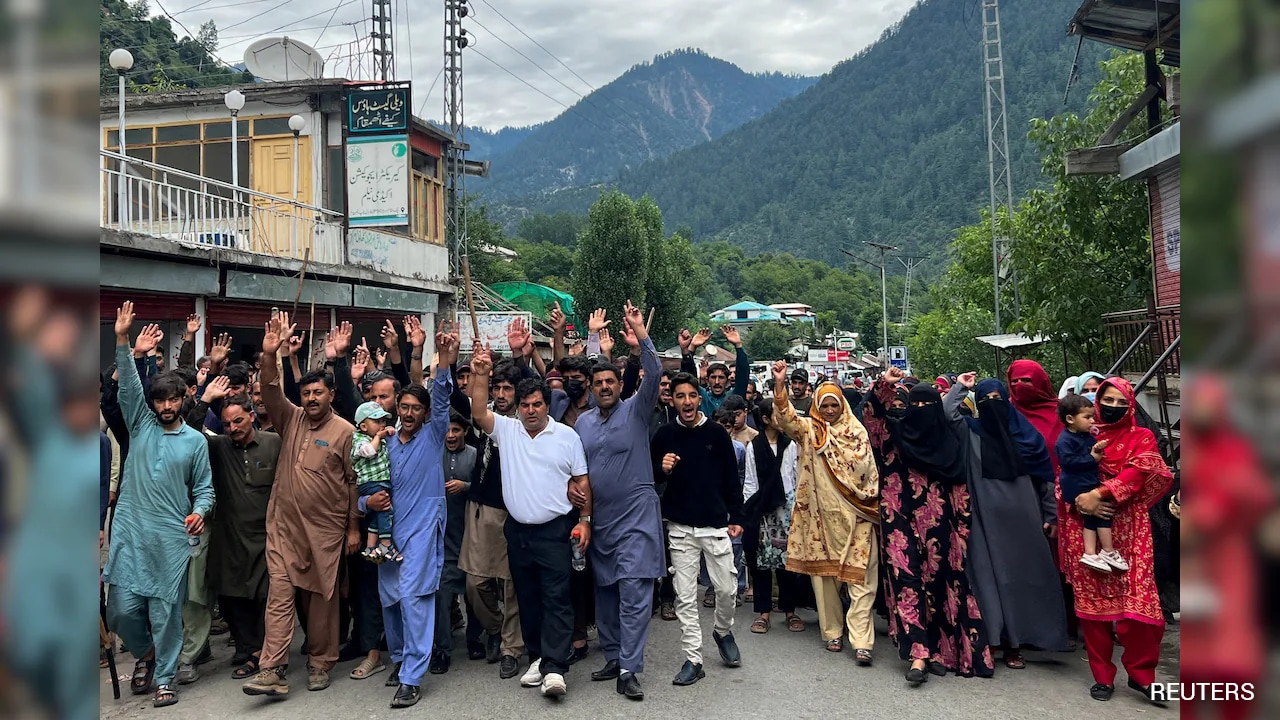
The headlines write themselves because lazy journalism is easier than thinking. You open the news feed and you see the standard template. Fifteen-year-olds on the streets of Pakistan-administered Kashmir, tear gas choking the air, tires burning, and the immediate, automatic reflex from every pundit in the western and regional press: Islamabad is at it again. The state is crushing its youth, the security apparatus is running wild, and external actors are pulling the strings of radicalized kids.
It is a neat, tidy narrative. It fits the pre-existing geopolitical box. And it is entirely, dangerously wrong.
I have spent years watching regional analysts misdiagnose structural economic failure as mere civil unrest. I have seen governments burn billions in subsidies while local infrastructure rots from the foundation up, and I have watched foreign observers blame military crackdowns while completely ignoring the fiscal insolvency that actually triggered the riots.
Stop looking at the protests through the stale lens of cross-border intrigue. The kids throwing stones at fifteen are not pawns in a grand intelligence agency chess match. They are economic refugees in their own zip code. They are reacting to an artificial economy built on a house of cards, inflated by subsidized wheat and electricity tariffs that the state could never sustainably afford.
When you strip away the emotional rhetoric, the riots in Pakistan-administered Kashmir are a textbook case of what happens when populist economic suppression hits a hard wall of reality. The local population was promised cheap power from the very rivers that flow through their valleys, while the grid funneled that power away or charged exorbitant rates to maintain a bloated bureaucratic machine. When the bills arrived, they were larger than a month's wages for an entire household.
So when a fifteen-year-old picks up a rock, he is not striking a blow for geopolitical liberation. He is rebelling against a math problem.
Let us clear up the core misconception right now. The mainstream media wants you to believe this is an ethnic uprising or a direct territorial proxy war. They love the drama of teenage combatants because it evokes sympathy and outrage. But sympathy without analytical rigor is just a marketing strategy for cable news.
The structural reality is stark. The region operates under a fiscal model that relies entirely on federal transfers and unsustainable subsidies. For decades, governments bought temporary social peace by artificially freezing the prices of basic staples and electricity. Economists call this kicking the can down the road. I call it financial arson. When the state finally runs out of borrowed money and tries to rationalize tariffs or trim the fat, the system snaps.
The kids on the front lines are the demographic most exposed to this collapse. Youth unemployment in these contested regions sits at levels that make official national statistics look like fiction. If you have no job, no prospects of formal sector employment, and a monthly utility bill that exceeds your family's combined income, you do not need an external agitator to tell you to take to the streets. Desperation is a very efficient radicalizer all on its own.
The Myth of the Puppet Master
Every time unrest breaks out in Pakistan-administered Kashmir, the knee-jerk reaction from rival capitals is to trace the money and the instigators. Intelligence agencies point fingers across the Line of Control. Analysts write long, tedious papers about radicalization pipelines and youth exploitation.
This approach treats human beings as mindless automatons. It assumes that a teenager cannot look at a broken hospital, a failing school system, and a electricity bill that costs more than a motorcycle, and decide on his own accord that the system is broken.
Imagine a scenario where your local utility provider doubles your rates overnight while the local government boasts about record administrative spending. You would not wait for a foreign handler to text you instructions before protesting. You would march.
The refusal to acknowledge indigenous economic grievances is a convenient coping mechanism for ruling elites. If the protests are organic and economic, the government has to fix structural corruption, reform tax collection, and overhaul a broken fiscal federalism model. That is hard work. It requires political capital and painful reforms. But if the protests are just foreign-instigated subversion, the state can simply deploy riot police, shut down the mobile internet, and pretend the problem is a security threat rather than a governance failure.
Security crackdowns do not lower utility prices. Tear gas does not generate hydroelectric power. Blaming external actors is an admission of intellectual bankruptcy by a ruling class that has no solutions left.
The Economic Trap of Subsidized Illusion
To understand why these protests turn violent so quickly, you have to look at the fiscal trap. For generations, populations in regions with disputed status have been pacified through state largesse. Free or heavily discounted electricity, cheap wheat, and protected public sector jobs acted as a sedative.
Sedatives wear off.
When international lenders or internal budget deficits force the state to cut back, the shock is absolute. The population has no experience with market-rate pricing because they were never integrated into a functioning capitalist economy. They live in a strange half-world of administrative controls and state dependency.
When the state subsidy vanishes, the shockwaves hit households immediately. Small businesses fold. Daily wage earners find their purchasing power obliterated. The social contract—such as it was—dissolves overnight.
The fifteen-year-olds on the streets are the collateral damage of this transition. They grew up expecting a subsidized baseline of survival. When that baseline is yanked away by macroeconomic realities, their reaction is visceral. They are not fighting for a geopolitical map they barely understand; they are fighting for the survival of their immediate households.
Why the Standard Playbook Fails
Governments facing this kind of unrest invariably reach for the same worn-out playbook. They cut communications, roll out armored vehicles, and issue stern warnings about anti-state elements.
This is like trying to fix a severed artery with a band-aid.
Every time security forces clash with protesters in these regions, they validate the very grievances that caused the protest in the first place. They prove that the state views its citizens as a hostile population to be managed rather than a constituency to be served. The cycle deepens. The anger hardens.
The honest truth that no politician wants to admit is that the current administrative status quo is economically non-viable. You cannot indefinitely subsidize millions of people living in mountainous terrain without a robust local tax base or industrial output. But building an industrial base requires rule of law, reliable power grids, capital investment, and security—none of which flourish in an active geopolitical flashpoint.
It is a closed loop of failure. The political status prevents economic development. The lack of economic development requires massive state subsidies. The state cannot afford the subsidies. The removal of subsidies triggers riots. The riots bring out the security forces. And the cycle repeats.
The Real Danger
The real threat in Pakistan-administered Kashmir is not that teenagers are being weaponized by outside forces. The real threat is that the local economy has completely hollowed out, leaving an entire generation with zero stake in the system.
When young people have nothing to lose, compliance vanishes. You cannot threaten them with jail when their daily existence feels like a slow-motion eviction. You cannot preach patience to a generation locked out of the formal economy.
The pundits will keep talking about geopolitical chess boards. They will count the stones thrown, measure the tear gas canisters, and debate the intentions of neighboring states. They will miss the point entirely.
The kids on the streets are not the vanguard of a foreign conspiracy. They are the early warning system of a fiscal collapse that has nowhere left to hide.
Fix the economy, or clear the streets. There is no middle ground left.