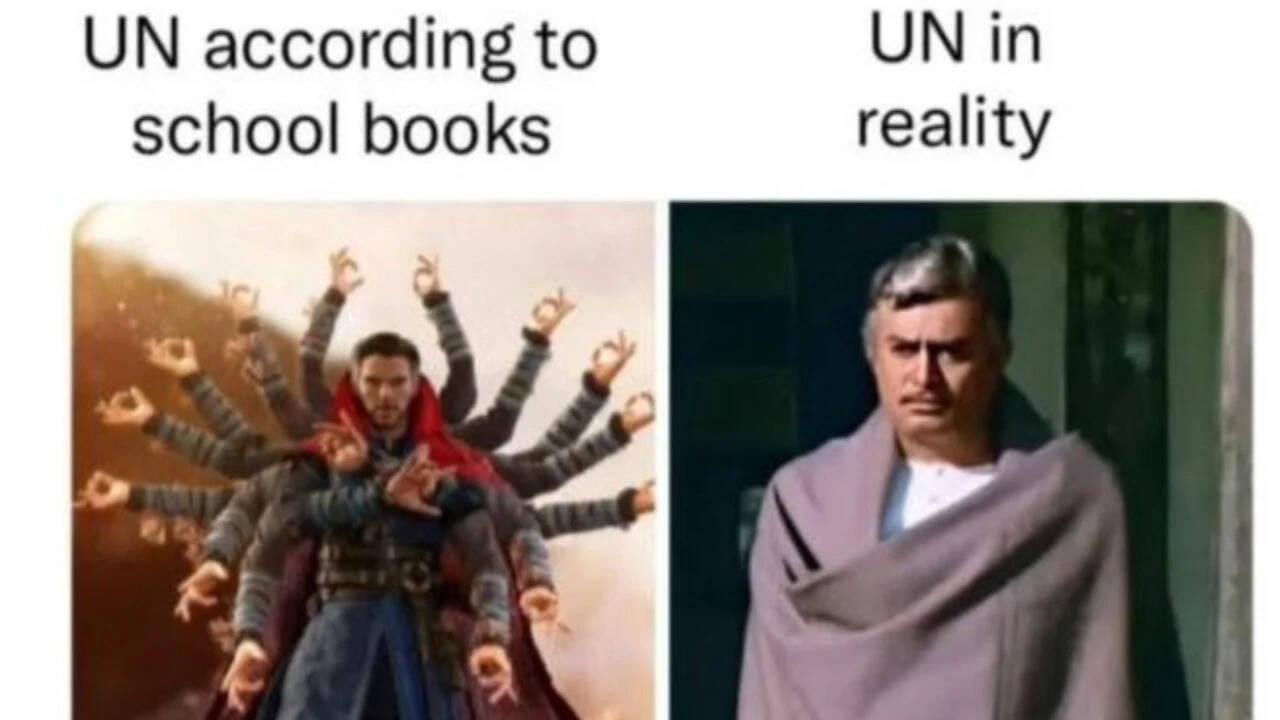
Every time Tehran drops a meme mocking international bodies or a disgruntled diplomat scoffs at a stalled Security Council resolution, the commentariat treats us to the exact same exhausted ritual. They hyperventilate about institutional paralysis, declare the post-war global order dead for the four-thousandth time, and wring their hands over the UN's inability to stop bloodletting from the Middle East to Eastern Europe.
It is a deeply comforting narrative. It allows everyone to point a collective finger at a glass tower in Manhattan and pretend that a bureaucratic secretariat holds some magic wand of sovereign coercion that it is simply too cowardly to wave. For a more detailed analysis into similar topics, we recommend: this related article.
The lazy consensus says the United Nations is broken because it cannot enforce peace.
That premise is entirely backwards. The United Nations is not failing because it is weak. It is functioning precisely as it was engineered to function: as an expensive, high-altitude talking shop designed to keep nuclear-armed superpowers from accidentally vaporizing each other, while preserving absolute state sovereignty above all else. For further information on this issue, comprehensive analysis is available at The Washington Post.
When you treat a fire extinguisher like a rocket engine and then complain that it cannot reach Mars, the engineering error is yours, not the machine's.
The Sovereign Vetocracy Trap
Let us dispense with the fairy tale that the UN was ever intended to act as a global government. Look at the architecture. The entire system rests on Article 2, Paragraph 7 of the Charter, which explicitly protects domestic jurisdiction. More importantly, it enshrines the veto power of the five permanent Security Council members.
That veto is not a design flaw. It is the price of admission.
In 1945, the architects of this system faced a binary choice: build an international organization that could override great powers by force, or build one that the great powers would actually join and stay inside. They chose the latter. They understood a brutal historical truth: the moment you build a body with the independent authority to override Washington, Beijing, Moscow, Paris, or London, those capitals walk out the door. And the moment they walk out, you are left with the League of Nations version two. A ghost ship.
So when critics shriek that the Security Council is paralyzed by vetoes, they are complaining that the steering wheel is connected to the tires. If you remove the veto to make the system "effective," the system ceases to exist overnight because the major powers will withdraw their funding, their recognition, and their military backing.
Tehran knows this. Washington knows this. Moscow knows this. The only people who seem perpetually shocked by this dynamic are the op-ed columnists who treat international relations like a moral philosophy seminar.
The Real Power Sinks Beyond the Glass Tower
Focusing your anger on General Assembly resolutions or Security Council gridlock is a brilliant way to miss where actual geopolitical leverage is deployed. Global outcomes are not shaped by diplomats arguing over comma placements in non-binding declarations. They are shaped by logistics, supply chains, currency dominance, and back-channel intelligence sharing.
When sanctions bite, they do not bite because the UN General Assembly voted 140 to 12 to express deep concern. They bite because the Clearing House Interbank Payments System controls international transactions, and American secondary sanctions can lock any bank on the planet out of the dollar ecosystem.
When a regional war flares, it is rarely settled by blue helmets deployed via UN mandate. It is settled when the combatants and their patrons hit a point of structural exhaustion, or when a bilateral backchannel brokered by a third-party intelligence service forces a ceasefire.
Blaming the UN for failing to solve conflicts it was never structurally capable of resolving lets the actual belligerents off the hook. It provides a convenient theater where regional actors can score cheap rhetorical points—memeing about international impotence—while waging aggressive proxy wars beneath the threshold of superpower direct confrontation.
The Danger of Institutional Fetishism
There is a severe cost to this continuous cycle of institutional hand-wringing. By treating the UN as the primary metric of global order, we misallocate diplomatic capital.
When crises erupt, we waste critical weeks trying to squeeze consensus out of a body that requires unanimous agreement among geopolitical rivals. We draft resolutions destined to be vetoed, hold emergency sessions that produce nothing more than soundbites, and confuse diplomatic motion with political action.
Imagine a corporation where the board of directors consists of bitter corporate raiders actively trying to bankrupt one another, operating under bylaws that grant every single one of them an absolute veto over any strategic move. Nobody would look at that board and declare it "dysfunctional" when it failed to launch a new product line. You would recognize that the board is a hostage negotiation disguised as governance.
That is the United Nations. It is a permanent diplomatic hostage exchange. It prevents total communication collapse, manages millions of refugees through specialized agencies like the UNHCR and WFP, and provides a neutral venue where enemies can pass notes in the hallway when shooting each other becomes too expensive.
That is not a failure. That is a low-friction containment valve.
Stop Asking the Wrong Questions
The next time a state actor releases a viral video mocking international organizations, or another pundit writes a breathless obituary for multilateralism, ask yourself what outcome they are actually selling. Usually, they are selling either naive utopianism—the belief that we can magically legislate global harmony if we just write harsher resolutions—or cynical deflection, using institutional impotence as cover for aggressive local ambitions.
The global order is anarchic. It always has been, and no amount of diplomatic wishful thinking will turn sovereign states into compliant municipal districts.
The UN is a mirror, not a hammer. It reflects the divisions, malice, and irreconcilable interests of the nations that inhabit it. If you do not like what you see in the mirror, breaking the glass will not change your face.


