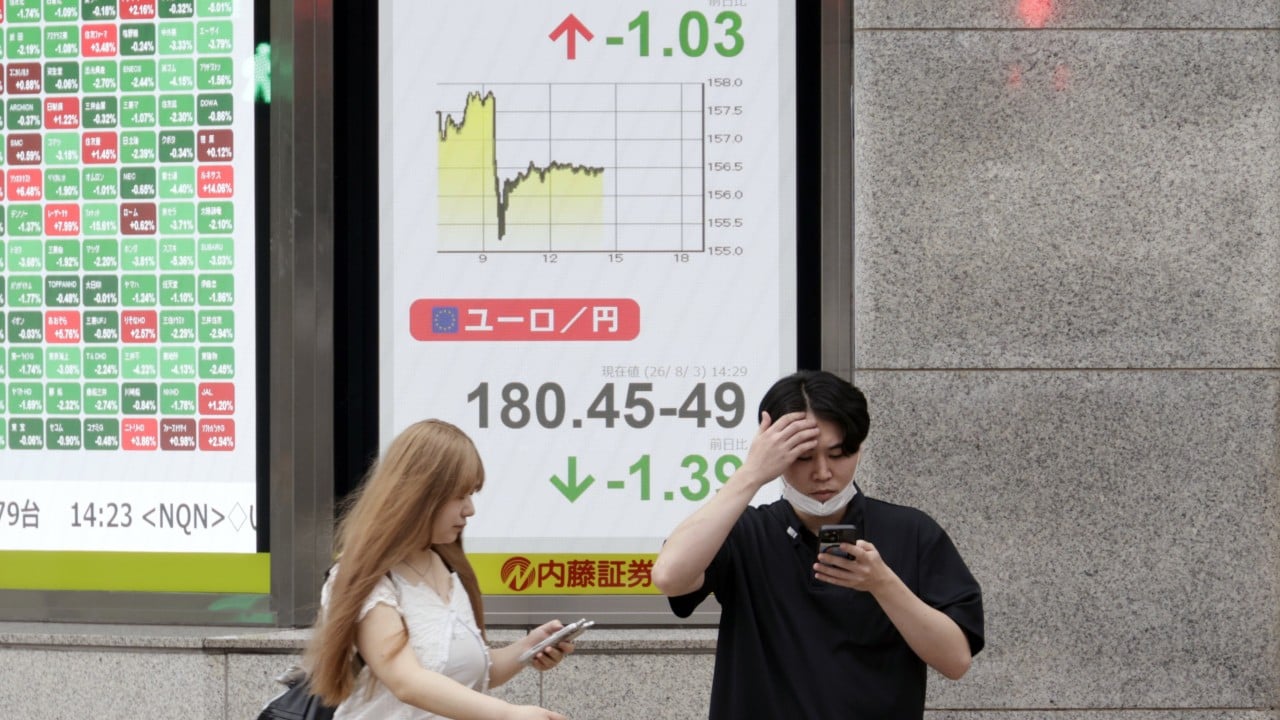
Every Wall Street strategist with a Bloomberg terminal and a quota to fill has latched onto a convenient scapegoat for the current tech rally. They point to Tokyo, whisper about the carry trade, and claim that a collapsing yen is inflating silicon valuations.
It is a neat, tidy narrative. It is also entirely backwards.
I have spent two decades watching markets invent excuses to justify their own disbelief. When asset prices defy gravity, commentators panic and hunt for an external crutch to explain why the math does not fit their outdated textbooks. Blaming currency depreciation for the artificial intelligence capital expenditure supercycle misses the structural reality of modern corporate finance. The yen is not driving the valuation of compute. Compute is defining the future of global balance sheets, and currency fluctuations are merely the noise around a massive economic signal.
Let us dismantle the consensus.
The Carry Trade Straw Man
The core argument of the currency panic goes like this: cheap yen borrowed from Japanese banks flooded global markets, finding its way into American mega-cap equities, artificially bidding up server farms and chip designers.
This theory collapses under basic scrutiny.
First, institutional capital allocation does not operate on retail forex mechanics. The funding cost of the yen matters for short-term speculative positioning, but it does not dictate why Microsoft, Alphabet, Meta, and Amazon are burning tens of billions of dollars every single quarter on accelerated infrastructure. These firms are not buying H100 and B200 accelerators with margin accounts funded by Tokyo overnight rates. They are funding these builds out of hyper-profitable core cash flows, massive corporate bond issuance, and retained earnings.
When a company generates hundreds of millions in daily free cash flow, currency carry mechanics are a rounding error. Attributing a multi-trillion-dollar valuation shift in the productivity layer of the global economy to a fluctuating exchange rate in Japan is economic illiteracy masquerading as sophistication.
Follow the Real Liquidity
If you want to understand where the momentum originates, stop looking at foreign exchange desks and look at enterprise balance sheets.
We are living through a capital expenditure arms race unlike anything since the buildout of the transcontinental railroads or the fiber-optic cable glut of the late nineties. The difference? Those past expansions were fueled entirely by speculative debt and venture capital vapor. Today's infrastructure boom is anchored by balance sheets holding hundreds of billions in pristine cash.
When Jensen Huang ships systems that cost the price of commercial real estate to customers who can write the check without calling their banks, currency volatility in East Asia is irrelevant. The market is not bubbling because yen are cheap. The market is pricing in a structural shift in labor efficiency and marginal cost reduction.
Of course, there is a bubble. Bubbles are the natural operating system of technological revolutions. The railroad boom ended in bankruptcies, but the railroads still transformed commerce. The dot-com crash wiped out pets.com, but it laid the foundation for modern e-commerce. Calling the current cycle a bubble driven by a weak currency completely misdiagnoses the pathology. The bubble is not that companies are spending too much; it is that they have no choice but to spend too much if they want to survive the next decade.
The Mechanics of Silicon Scarcity
Let us define what is actually happening in the semiconductor supply chain, stripped of financial media sensationalism.
Silicon manufacturing is the most concentrated, capital-intensive industrial process in human history. Taiwan Semiconductor Manufacturing Company holds a near-monopoly on high-performance node production not because of macro currency shifts, but because of decades of compounding engineering execution, extreme capital expenditure, and institutional knowledge that cannot be replicated by throwing subsidies at greenfield foundries in Ohio or Germany.
When hyperscalers demand more compute, the bottleneck is physical lithography, advanced packaging, and power availability. A weaker yen might marginally alter the cost structure of Japanese material suppliers, but it does not manufacture extreme ultraviolet lithography machines. It does not solve the electrical grid deficits facing every major data center hub from Northern Virginia to Dublin.
Financial analysts love macroeconomic narratives because they require zero technical literacy. It is much easier to look at a chart of the USD/JPY pair than it is to understand the thermal design power limits of liquid-cooled server racks or the software moats being built around proprietary model fine-tuning.
What the Contrarians Get Wrong About the Risk
Admitting that the currency argument is wrong does not mean pretending everything is healthy. There is a very real danger in the current market structure, but it has nothing to do with Tokyo.
The risk is amortization mismatch.
Companies are buying expensive hardware with short useful economic lives. GPUs and specialized neural accelerators face obsolescence cycles that are brutally fast compared to traditional enterprise IT assets like mainframe computers or commercial real estate. If the revenue models built on top of these models fail to convert enterprise efficiency into tangible margin expansion within the next twenty-four to thirty-six months, these capital investments will become massive corporate anchors.
I have seen companies blow millions on custom infrastructure builds because of executive FOMO, only to watch the underlying workload get optimized away by a software update a year later. That is the real hazard. Not a central bank policy meeting in Japan.
The Uncomfortable Reality of the Next Decade
We are witnessing the violent consolidation of economic power into the hands of firms that control compute and data.
To navigate this market, you have to abandon the comforting fiction that macroeconomic indicators explain microeconomic tech dominance. Currency fluctuations are symptoms, not causes. If the yen strengthens tomorrow, the capital expenditure budgets of the tech giants will not shrink by a single dollar.
Stop listening to strategists who confuse foreign exchange noise with technological transformation. Look at the power plants, look at the supply chains, and look at the software adoption curves. Everything else is just commentary.
Sell your yen theories. Buy a calculator.