The air inside Penn Station always smells of a volatile mix of stale pretzels, diesel fumes, and pure, unfiltered anxiety. But on a playoff Sunday in Midtown Manhattan, that anxiety sharpens into something electric. You feel it in your teeth before you even step off the escalator.
Thousands of people are funnily channeled through concrete corridors, a sea of blue and white jerseys moving like a human tide toward the escalator banks. They are screaming. They are chanting names of men who skate at terrifying speeds on sheets of frozen water.
Then, you hit the glass doors.
Usually, the transition from the subterranean chaos of the subway to the concrete rotunda of Madison Square Garden is a familiar dance. You flash a barcode on your phone, slide through a metal detector, and suddenly you are under the ceiling that looks like a giant, futuristic bicycle wheel. Not today. Today, the perimeter has moved outward, bleeding onto the cracked asphalt of Eighth Avenue.
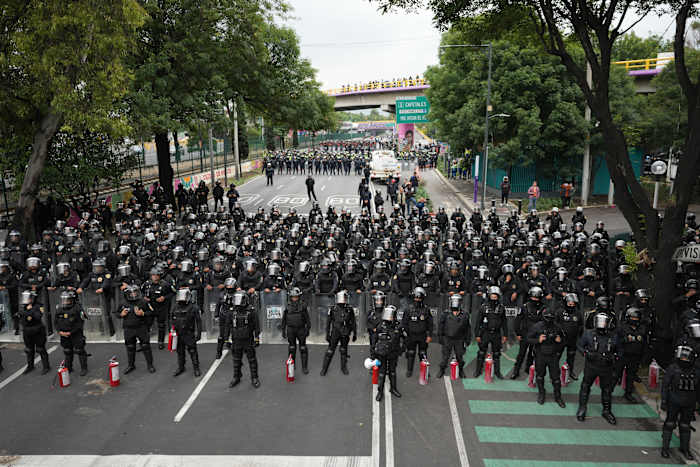
There are barricades. Heavy, interlocking steel teeth cutting off the sidewalk. There are men and women in dark jackets with earpieces, their eyes scanning the crowd not with the casual indifference of a ticket-taker, but with the cold, hyper-focused precision of a secret service detail.
The Garden has gone on lockdown. Again.
To understand why a basketball or hockey game requires the tactical preparation of a geopolitical summit, you have to look past the box scores. Game 4 isn’t just a date on a sports calendar. It is a powder keg. When the New York Knicks or the Rangers deep-dive into the postseason, Madison Square Garden ceases to be just an arena. It becomes the emotional epicenter of a city that does not know how to do anything quietly.
Consider a hypothetical fan named Marcus. Marcus saved for three months to buy a single ticket in the 200 section for Game 4. He expects the noise. He expects the $18 beers. What he does not expect is the realization that his evening is being choreographed by a massive, largely invisible security apparatus designed to prevent the modern world’s worst nightmares from stepping onto the hardwood.
Marcus waits. The line crawls. A man three people ahead of him grumbles about having to take off his watch.
"It’s for the game, pal," the guard says. His voice is flat. Unyielding. He doesn't look up as he ushers the man through.
This is the friction of modern fandom. We want the euphoria of thirty thousand strangers screaming in unison, but that very unison requires a sterile, heavily policed border to protect it. The stricter security measures rolling out for Game 4 aren't just a reaction to a specific threat; they are the manifestation of an ongoing mathematical equation where the variables are human emotion, high stakes, and the absolute intolerance for error.
The Garden itself is a logistical paradox. It sits directly on top of the busiest transportation hub in North America. While Jalen Brunson is driving the lane or Igor Shesterkin is tracking a puck through a screen, hundreds of thousands of commuters are moving directly beneath their feet. It is a layered cake of vulnerability.
Because of this unique geography, security here cannot be reactive. It has to be a physical presence that alters the behavior of the crowd before they even catch a glimpse of the arena lights. The expansion of the security perimeter for high-stakes playoff games serves a psychological purpose as much as a tactical one. It slows down the velocity of the crowd. It breaks the mass of humanity into manageable, scannable streams.
But the real problem lies elsewhere, far from the metal detectors and the bomb-sniffing K-9 units patrolling the loading docks.
The real tension is found in the clash between New York's raw, unvarnished passion and the corporate, sanitized reality of modern sports entertainment. Fans want the Garden to be a bear pit. They want it hostile, loud, and unpredictable. Yet, the people holding the clipboards and monitoring the closed-circuit television cameras in the bowels of the building require absolute predictability.
Every gate is monitored. Every bag is measured down to the millimeter. If your purse is too large, it doesn't matter if it holds life-saving medication or just a handful of lip balm; it is turned away. The rules are binary. There is no nuance when forty million dollars of broadcast equipment and the safety of international celebrities are on the line.
Marcus finally clears the check. He walks through the tunnel, the concrete giving way to that sudden, breathtaking bowl of light and color. The players are warming up. The bass from the speakers rattles the fillings in his jaw. For a second, the frustration of the street evaporates. The friction of the last forty-five minutes feels like a small tax to pay for admission to the cathedral.
Look closely at the courtside seats, though. Even there, the invisible wall remains. The suits sitting inches from the hardwood are surrounded by a human shield of security personnel whose entire job is to ensure that the boundary between the performers and the paying public remains completely inviolable. In the old days, a fan could lean over the railing and offer a piece of their mind to a coach. Today, that action will get you tackled, detained, and banned for life before the next commercial break concludes.
We have traded a certain kind of innocent intimacy for an absolute guarantee of survival.
The lights go down. The crowd roars, a collective, deafening boom that shakes the rafters where the championship banners hang. In that moment, the thousands of security guards, the police officers stationed on every corner of Seventh Avenue, and the federal agents monitoring the radio frequencies become completely invisible to the naked eye. They become the background noise of the city, working tirelessly to ensure that the only drama New York has to witness tonight happens entirely within the boundaries of the white lines.
Out on the concourse, a guard stands near a fire exit, his back to the court. He can't see the game. He can only hear the crowd's roar, reacting to a play he will have to watch on highlights when his shift ends at 2:00 AM. He adjusts his belt, his eyes tracking a teenager walking a little too quickly toward the restroom.
The city outside continues to churn, oblivious to the fragile ecosystem holding it all together inside the world's most famous arena.