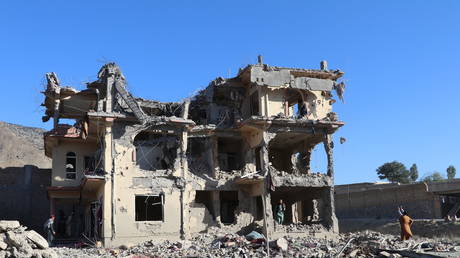
The border does not run along a map. It runs through the lungs.
When the wind shifts off the Hindu Kush, it brings the smell of dust, dry pine, and old iron. For the families living in the shadow of the Durand Line, that scent has a name: anticipation. They know the sound before the glass rattles. It is a low, heavy thrum that starts in the dirt beneath their feet long before the gray shapes slice across the high, indifferent sky.
Airstrikes do not arrive as arguments. They arrive as punctuation marks at the end of sentences no one in the valley was allowed to finish.
To understand what happened when Pakistani warplanes crossed into the Khost and Paktika provinces of eastern Afghanistan, you have to strip away the terminology of geopolitical briefs. You have to stop reading about "intelligence-based operations," "militant infrastructure," and "cross-border kinetic action." Those are the words used by men sitting three thousand miles away in air-conditioned rooms, staring at high-resolution monitors where human lives are reduced to thermal pixels.
On the ground, the reality is far more fragile.
Imagine a mud-brick compound in Bermal district. Inside, a grandfather named Gul Rahman sits on a woven charpoy, working a string of amber prayer beads through fingers calloused by forty years of tending rocky soil. His grandson, twelve-year-old Tariq, is chasing a stray goat around the courtyard. The walls are thick enough to keep out the winter chill, but they are paper against the concussive force of a five-hundred-pound bomb.
When the strike hit three kilometers away, the tea in Gul’s clay cup didn't spill; it vibrated, sending tiny concentric ripples across the dark surface.
"They say they are hitting ghosts," Gul muttered later, his voice barely louder than the dry grass scraping against the stone wall. "But the dust settles on our wheat."
The tensions between Islamabad and Kabul did not begin with the return of the Taliban administration to power in 2021, but they certainly sharpened. For years, Islamabad pointed a finger across the jagged peaks, accusing Kabul of providing sanctuary to the Tehrik-i-Taliban Pakistan, or TTP, the domestic militant group that has waged a relentless insurgency against the Pakistani state. Kabul, for its part, denies the presence of foreign fighters, insisting that Pakistan's security failures are homegrown, rooted in decades of domestic political fracture and economic collapse.
Between these two stubborn narratives lie miles of porous, unlit borderland. It is a terrain that has defied empires from the British to the Soviets, a landscape of smugglers, nomads, and families whose tribal loyalties stretch across the boundary lines drawn by foreign diplomats in the nineteenth century.
When Islamabad ordered the airstrikes following a series of devastating suicide bombings inside Pakistan—including a horrific assault on a security post in North Waziristan—it was acting on a calculus of deterrence. From the perspective of the military brass in Rawalpindi, sovereignty ceases to be a shield when it is used as a springboard for attacks against your own soldiers. The logic is brutal, simple, and ancient: if the neighbor will not clear the wasps from his roof, you must smoke out the nest yourself.
Yet, sovereignty is not a theoretical abstraction for the people who wake up beneath it.
When the bombs fall, they do not sort the guilty from the innocent with algorithmic precision. The local authorities in eastern Afghanistan reported that the strikes killed mostly women and children—eight civilians in one hamlet, six in another. Whether the target was indeed a hideout of the Hafiz Gul Bahadur group or the TTP matters very little to a mother pulling her daughter’s sandals from the rubble of a collapsed kitchen.
This is the invisible cost of modern counter-terrorism. It is an arithmetic of collateral damage where every statistic has a face, a mother, and a grievance.
History teaches us a harsh lesson about the law of unintended consequences. Every time a border is violated from the air, the psychological distance between the state and the civilian population grows wider. In the valleys of Paktika, the anger is not necessarily ideological; it is visceral. A young man who loses his sister to a bomb dropped by a neighbor does not become a diplomat upon burying her. He becomes a recruit. He becomes part of the very cycle of violence the strike was designed to extinguish.
We have seen this script before. We watched it unfold across the Federally Administered Tribal Areas of Pakistan for two decades, where drone strikes eliminated high-value targets while simultaneously seeding generational resentment. We are simply watching the theater shift location now that the geopolitical chess pieces have been rearranged.
Consider the bind of the ordinary Afghan villager. They survived the Soviet invasion, the civil war, the American intervention, and the chaotic withdrawal. They asked for none of this. They simply want to grow their stunted crops of wheat and corn, trade livestock at the local bazaar, and sleep through the night without wondering if the roar overhead belongs to a commercial airliner or a harbinger of death.
When international law is invoked in these moments, it feels almost mocking. What does territorial integrity mean to a man whose roof has just caved in? What is the value of a diplomatic démarche when the smoke is still rising from the orchard?
The truth is that both governments are trapped in a corner of their own making. Pakistan is bleeding from the inside, grappling with an economic crisis and a resurgent domestic insurgency that feels existential. The military leadership feels it has exhausted its patience with a Kabul administration that appears either unwilling or unable to curb transnational militancy. Meanwhile, the Afghan leadership, desperate for international recognition and economic survival, views any violation of its airspace as an intolerable humiliation that demands rhetorical defiance, even if it lacks the conventional air defense systems to stop it.
And so the dance continues. Statements are issued. Condemnations are registered. Ambassadors are summoned and dismissed with cold tea and stern warnings. The diplomatic cables hum with indignation, while out on the frontier, the wind clears away the dust of the latest explosion, leaving behind a silence that is heavier than any noise.
It is a silence pregnant with the next generation of conflict.
As night falls over the Durand Line, the stars emerge with the terrible, crystal-clear brightness unique to high altitudes. Down in the valley, the lanterns flicker in the mud-brick homes. Gul Rahman sits with his grandson, teaching him how to read the ancient script in the fading light. They do not talk about geopolitics. They do not mention the generals in Islamabad or the ministers in Kabul.
They only listen to the wind, wondering which way it will blow tomorrow, and what it will carry across the mountains when it returns.


