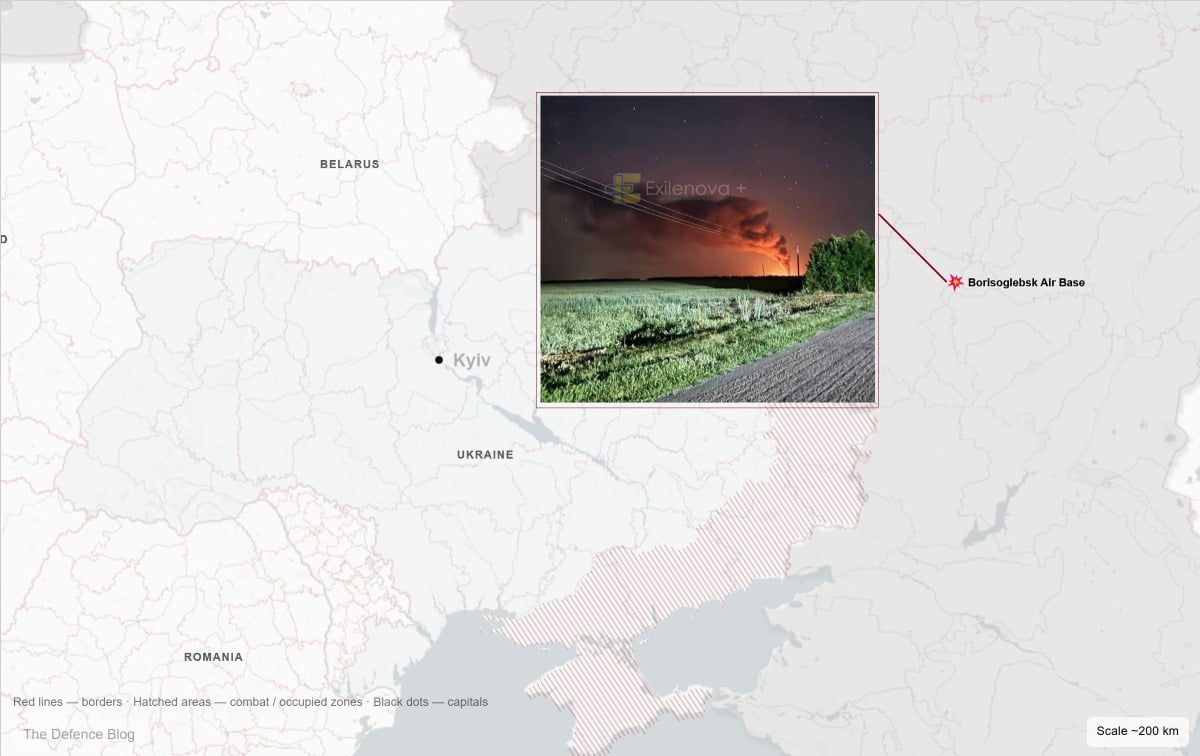
Ukraine just struck another major blow inside Russian territory. Overnight on July 8, 2026, a swarm of long-range drones targeted the Borisoglebsk military airfield in Russia's Voronezh region, sparking a massive fire that lit up the night sky. While Russian state media stays quiet, satellite data and eyewitness footage tell a completely different story.
This isn't just another random border strike. If you think this is just about damaging a few runways, you're missing the bigger picture. The attack on Borisoglebsk hits Russia right where it hurts, targeting both its immediate frontline operations and its long-term military pilot pipeline.
The Dual Role of Borisoglebsk Airfield
Borisoglebsk isn't just an ordinary staging ground. It serves two vital functions for the Russian Aerospace Forces, making it a high-value target for Ukrainian planners.
First, it hosts active combat aircraft. The base frequently sees Su-34 fighter-bombers, Su-35S air superiority fighters, and Su-30SM multirole jets. These are the exact planes responsible for launching guided glide bombs at Ukrainian cities and frontline positions. Lately, the base functioned as a temporary refueling and rearming point, allowing jets to quickly cycle through combat sorties.
Second, it houses the 783rd Aviation Training Center. This facility trains the Assault and Bomber Aviation Faculty under the Krasnodar Higher Military Aviation School. It relies heavily on Yak-130 advanced jet trainers. These trainers prepare rookie pilots before they transition into heavy combat jets. By hitting this base, Ukraine disrupts the flow of newly minted pilots heading to the front lines.
What Actually Burned In The Strike
Eyewitness videos shared by the OSINT community Exilenova+ and the Russian independent outlet Astra show substantial columns of smoke rising from the base. NASA's FIRMS satellite fire-monitoring system quickly picked up thermal anomalies at the airfield, confirming a serious blaze.
The fires hit specific infrastructure. Satellite indicators show the flames concentrated around the airfield's fuel storage tanks and aircraft parking spaces. Destroying fuel infrastructure forces Russia to reroute logistics, slowing down the operational tempo of their jets.
This isn't the first time Ukraine went after Borisoglebsk. A similar strike in July 2025 damaged storage facilities housing universal gliding and correction modules. Those are the kits used to turn dumb bombs into guided glide bombs. Ukraine is clearly executing a systematic strategy to chip away at Russia's aerial capabilities.
Part of a Much Larger Nighttime Operation
The strike on Borisoglebsk didn't happen in a vacuum. It was part of a massive coordinated drone operation across Russian territory. The Russian Defense Ministry claimed its air defenses shot down over 400 drones overnight, showing the sheer scale of the assault.
Other critical targets took heavy damage during the same wave. The Saratov oil refinery, a key facility operated by Rosneft that supplies fuel directly to Russian occupation forces, caught fire after multiple drone impacts. Further east, drones struck the industrial zone of Nizhnekamsk in Tatarstan, hitting the massive TAIF-NK oil refining complex. Even Russian military logistics on water took a hit, with Ukrainian Unmanned Systems Forces striking multiple shadow fleet tankers in the Taganrog Bay and the Sea of Azov.
The Real Impact on the Frontline
Russia can replace concrete and asphalt quickly. Replacing specialized fuel infrastructure, trained ground crews, and pilot training pipelines is a much harder task.
Every time an airfield like Borisoglebsk gets hit, Russia has to pull its air defense systems away from the front lines to protect its domestic bases. This creates gaps in their defensive lines elsewhere. It also forces Russian jets to operate from airbases located much further away from Ukraine, increasing flight times, burning more fuel, and reducing the number of daily sorties they can pull off.
Expect Ukraine to keep hammering these strategic nodes. Forcing Russia onto the defensive inside its own borders remains the fastest way to neutralize its advantage in the skies.