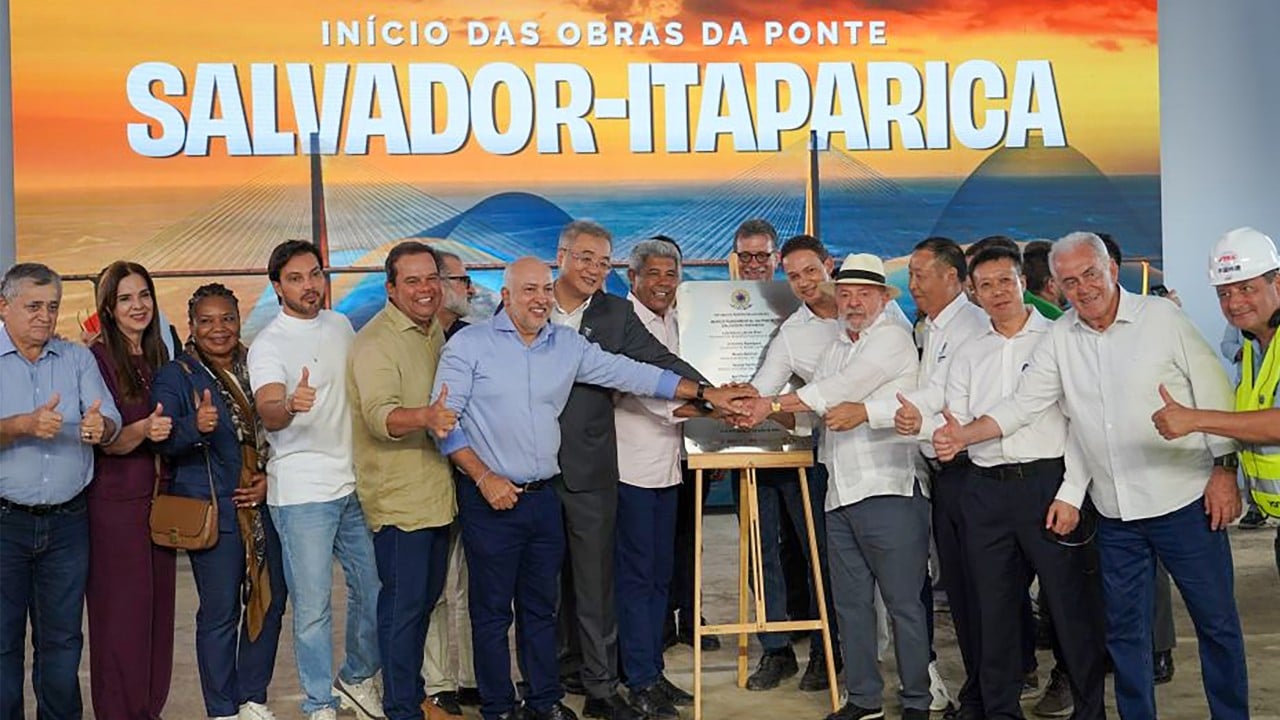
Mega-infrastructure projects in South America rarely move smoothly from boardroom dreams to physical reality. Bureaucracy, financing hurdles, and brutal environmental conditions kill most grand visions before a single shovel hits the dirt. Yet, the Salvador-Itaparica bridge project in Bahia, Brazil, is breaking that mold. Handed to a Chinese consortium featuring major state-owned engineering giants, this project is shaping up to be Latin America's longest sea-crossing cable-stayed bridge.
If you look past the standard political ribbon-cutting hype, the real story involves heavy maritime engineering, massive capital deployment, and a fundamental shift in regional connectivity. Learn more on a connected issue: this related article.
The Engineering Reality Behind the Bay of All Saints
Building over water changes every rule of construction. The bridge stretches across 12.4 kilometers of the Bay of All Saints, linking Salvador directly to Itaparica Island. That distance alone makes it an engineering marvel for the region, but the specific maritime demands are what test the builders.
To pull this off, the consortium relies on specialized heavy marine assets. For instance, massive infrastructure deployment requires immense dynamic-positioning pile-driving vessels, such as the specialized equipment brought in by the China Railway Construction Corporation to handle deep seabed foundations. More journalism by The Guardian delves into similar views on the subject.
Contractors face tough conditions:
- Deep oceanic trenches requiring ultra-stable deep-water piling.
- High vertical clearances reaching up to 82 meters in specific navigation spans to let massive container ships pass safely underneath.
- Corrosion-resistant structural designs built to survive aggressive tropical saltwater environments for decades.
Why This Connection Actually Matters
For decades, getting from Salvador to the southern coast of Bahia meant driving a massive loop around the bay or relying on slow ferry lines that bottleneck during holidays and weekends. Traffic delays routinely waste hours for travelers and commercial cargo alike.
The new transit link cuts travel times by roughly two hours. That sounds like a simple tourist convenience, but it is fundamentally an economic corridor. Itaparica Island and the southern Bahian coastline hold immense tourism and agricultural potential that remained constrained by poor logistical access. By integrating the transport network through a 35-year public-private partnership model, regional authorities expect real estate, logistics, and local commerce to scale rapidly.
The Financial Mechanics and International Partnerships
Mega-projects costing upwards of USD 2.2 billion don't happen through local municipal budgets alone. The financing relies on a complex public-private partnership structure blending state resources from Bahia with heavyweight Chinese international contractors, including China Communications Construction Company (CCCC) and the China Railway 20th Bureau Group Corp (CR20G).
Skeptics often point out the long-term debt and concession risks tied to foreign-backed infrastructure across the Global South. A 35-year concession means the operating consortium collects tolls and manages maintenance over a generation. Independent project management consultancies, such as engineering firms like SYSTRA, are tasked with auditing the detailed designs and supervising execution to ensure structural integrity and compliance with Brazilian safety laws.
Sourcing raw materials locally while importing specialized heavy machinery creates a hybrid supply chain. It is a model defining modern transnational engineering: local political backing combined with foreign industrial muscle.
The physical towers rising over the Bay of All Saints prove that international joint ventures can push past regional funding gaps. Whether this concrete-and-steel reality lives up to its economic promises depends entirely on how well maintenance holds up over those decades of heavy traffic. Watch how cargo movement shifts across Bahia once the asphalt finally connects shore to shore.


