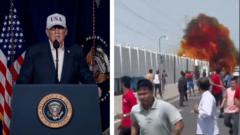
The recent admission by Iranian Foreign Minister Abbas Araghchi that Tehran and Washington were on the verge of a breakthrough before regional violence derailed the process isn't just a lament for what might have been. It is a calculated disclosure. By signaling that a "message exchange" was active through Omani intermediaries until the October 7 attacks and the subsequent regional escalation, Tehran is attempting to frame the current tension as an avoidable tragedy rather than an inevitable collision. The reality, however, is far more jagged. Diplomacy between these two adversaries has never been a straight line, but rather a series of fits and starts defined by domestic political survival and the brutal math of Middle Eastern proxy wars.
For months, the Biden administration and the Raisi government—and later the Pezeshkian administration—maintained a quiet, rhythmic exchange of non-papers and indirect signals. These weren't just polite inquiries. They were substantive efforts to establish a "freeze-for-freeze" framework. The goal was simple: Iran would cap its nuclear enrichment and restrain its regional militias in exchange for the quiet release of frozen assets and a blind eye toward certain oil exports. This was the "informal agreement" that everyone in D.C. and Tehran knew existed but no one could afford to admit out loud. In related developments, take a look at: The Sabotage of the Sultans.
Then the floor fell out.
The Oman Channel and the Mechanics of Silence
Oman has long served as the region's primary post office for messages that neither side wants to put on official letterhead. The "Oman Channel" is unique because it bypasses the theatrical posturing of the United Nations or the high-stakes drama of European mediation. In these rooms, diplomats focus on the technicalities of sanctions waivers and centrifuge counts. USA Today has also covered this critical subject in great detail.
Araghchi’s confirmation that these talks were "making progress" suggests that the technical hurdles were largely cleared. The issues were no longer about how many kilograms of uranium were enriched to 60%. Instead, the obstacles were purely political. In Washington, the proximity of an election year made any formal deal with Iran radioactive. In Tehran, the hardline elements of the Islamic Revolutionary Guard Corps (IRGC) remained deeply skeptical of any arrangement that didn't provide immediate, ironclad relief from the primary sanctions regime.
This diplomatic architecture is fragile. It relies on a specific type of quietude that the Middle East has lacked for over a year. When Araghchi notes that the process has stopped, he is pointing to the fact that the political "space" for these conversations has evaporated. You cannot discuss a nuclear freeze while regional proxies are trading ballistic missiles and drone strikes. The noise of the battlefield has simply become too loud for the whisper of diplomacy to be heard.
The Nuclear Escalation Trap
While the diplomats are silenced, the centrifuges are not. This is the most dangerous byproduct of the current stalemate. Iran’s nuclear program has reached a point where the "breakout time"—the period needed to produce enough weapons-grade material for a single nuclear device—is effectively measured in days, not months.
Experts frequently point to the 60% enrichment level as the critical threshold. While 90% is considered weapons-grade, the jump from 60% to 90% is technically minor. It is a matter of reconfiguring cascades, a process that can be done quickly. By maintaining this level of enrichment, Tehran is holding a metaphorical gun to the head of the international community. It is a leverage play.
The problem with this strategy is that it assumes the other side will always react rationally. In a Washington currently defined by bipartisan hawkishness toward Tehran, the continued advancement of the nuclear program doesn't lead to more concessions; it leads to a hardening of the "maximum pressure" mindset. We are seeing a repeat of the 2018-2019 cycle, but with a significantly more advanced Iranian technical capability.
The Mathematics of Enrichment
To understand the gravity, one must look at the inventory. According to the most recent reports from the International Atomic Energy Agency (IAEA), Iran’s stockpile of highly enriched uranium continues to grow.
| Enrichment Level | Estimated Stockpile (kg) | Significance |
|---|---|---|
| 5% | 3,000+ | Power plant fuel (civilian) |
| 20% | 700+ | Research reactor fuel |
| 60% | 150+ | Strategic leverage / Near-weapons grade |
The jump to 90% (weapons grade) is $x+y=z$ where $y$ is a very small variable. If the Oman channel remains closed, the likelihood of Iran deciding that "nuclear hedging" is no longer sufficient increases. There is a growing faction in Tehran arguing that the only way to deter an Israeli or American strike is to actually possess the deterrent, rather than just the capability to build it.
Proxies and the Limits of Control
A recurring theme in the failed negotiations is the American demand for "regional de-escalation." This is shorthand for Iran reining in the "Axis of Resistance"—Hezbollah in Lebanon, the Houthis in Yemen, and various militias in Iraq and Syria.
The investigative reality is that Tehran's control over these groups is not a simple "on/off" switch. It is a franchise model. While Iran provides the funding, training, and weaponry, these groups have their own local agendas and domestic pressures. When the U.S. demands that Iran "stop" the Houthis from firing on Red Sea shipping, they are asking for a level of micro-management that might be beyond the IRGC’s current operational capacity, or at least beyond what they are willing to risk in terms of internal friction within their alliance.
The failure of the secret talks is partly due to this gap in expectations. Washington wants a "comprehensive" deal that covers everything from drones to ballistic missiles. Tehran wants a "narrow" deal that focuses solely on the nuclear program and sanctions relief. This fundamental disagreement on the scope of the talks ensures that even if progress is made on one front, it is quickly sabotaged by events on another.
The Economic Ghost in the Room
Sanctions have not collapsed the Iranian economy, but they have distorted it beyond recognition. The "resistance economy" touted by the Supreme Leader is a reality of necessity. Iran has become a master of the "grey market," selling oil to China through a complex network of ship-to-ship transfers and shell companies.
However, this shadow trade comes at a massive cost. Iran is forced to sell its oil at a significant discount, often $10 to $15 below market price, just to move the volume. This "sanctions tax" drains billions from the national treasury every year. Araghchi and the reformist-leaning Pezeshkian administration know that without some form of official reintegration into the global financial system, the Iranian economy will remain in a state of permanent stagnation.
The desperation for a deal is real, but it is tempered by the fear of being seen as weak. The Iranian leadership remembers 2018 vividly. They saw a U.S. president walk away from a signed, verified agreement with the stroke of a pen. This has created a "trust deficit" that no amount of Omani mediation can bridge. Tehran now demands guarantees—legal and financial mechanisms that would make it harder for a future U.S. administration to reimpose sanctions. The problem? No U.S. president can bind their successor to a non-treaty agreement.
The Shadow of the U.S. Election
Every diplomatic move made in the Middle East right now is being viewed through the lens of the U.S. electoral calendar. Tehran is paralyzed by the prospect of a return to a "Maximum Pressure" campaign. They are attempting to play a waiting game, hoping to secure enough concessions from the current administration to weather a potential storm later, while simultaneously preparing for a more confrontational stance if necessary.
This creates a paradox. To get a deal, Iran needs to show restraint. But to maintain its domestic and regional standing, it feels the need to show strength through its proxies. You cannot have both. The progress Araghchi speaks of was a delicate balancing act that required both sides to ignore the provocations of the other. Once the scale of the regional conflict tipped past a certain point, that willful blindness became politically impossible.
The "backdoor" isn't locked, but the lights are off. The U.S. and Iran are now in a holding pattern where the risk of miscalculation is at its highest point in decades. Without a functional communication channel, a tactical error by a local commander in the Red Sea or a misfired drone in Iraq could trigger a direct confrontation that neither Washington nor Tehran actually wants.
The Brutal Truth of Modern Diplomacy
We have entered an era where "big deals" are dead. The 2015 JCPOA was a product of a specific geopolitical moment that no longer exists. Today, diplomacy is about "conflict management" rather than "conflict resolution."
Araghchi’s comments shouldn't be read as an olive branch. They are a post-mortem. He is telling the world—and specifically the European powers—that Iran was ready to talk, but the U.S. was unable to keep the regional fires from consuming the table. It is a defensive narrative designed to shift the blame for the next inevitable round of escalation.
The tragedy is that both sides know exactly what the "deal" looks like. The technical parameters haven't changed much in a decade. What has changed is the cost of compromise. In the current climate, a deal is seen as a surrender, and in the high-stakes theater of the Middle East, surrender is a death sentence.
The window for a diplomatic off-ramp is closing, not because the two sides can't find a middle ground on the nuclear issue, but because the nuclear issue is no longer the most important thing on the table. The entire regional order is being re-litigated through fire, and no amount of secret Omani messages can stop that process once it has begun.
The next move isn't a new round of talks. It is a desperate scramble to ensure that the current lack of communication doesn't accidentally ignite a general war. If you want to know how close we are to the edge, look at the silence in Muscat. It is the loudest thing in the room.
Identify the nearest point of contact for unofficial backchanneling and watch the flight paths to Muscat; when the "couriers" stop flying, the missiles usually start.