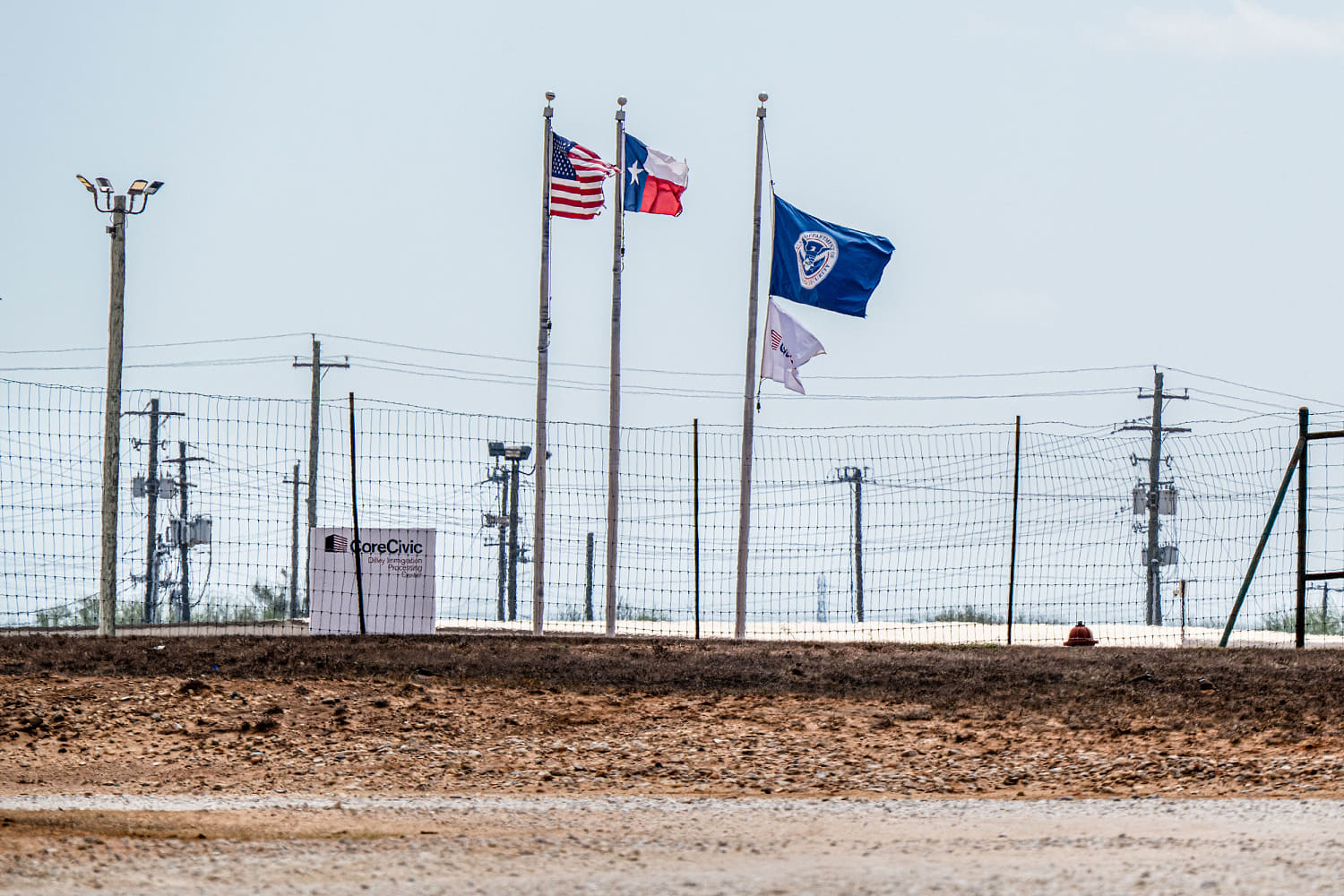
After nine years behind bars without a criminal conviction, the longest-held family in the history of American immigration detention has finally been ordered released. This is not merely a story about a single legal victory. It is an indictment of a system that allowed a bureaucratic loop to swallow a decade of human lives. When a federal judge stepped in to end the detention of this family, the ruling did more than open a cell door. It stripped away the veneer of "administrative necessity" that the government uses to justify indefinite holds on non-citizens.
The family, whose identity has been shielded throughout years of litigation to protect their safety, became a living ghost in the machine. They were held in a specialized facility, caught between the gears of an asylum claim that was neither granted nor definitively denied, but rather frozen in a perpetual state of "pending." This case represents the extreme edge of what happens when the executive branch’s power to detain exceeds the judiciary’s appetite to intervene.
The Architecture of Indefinite Detention
The American immigration system operates on a different legal plane than the criminal justice system. In a criminal court, you have a right to a speedy trial. You have a right to an attorney if you cannot afford one. Most importantly, there is a ceiling on your punishment. In immigration detention—classified as civil, not punitive—those protections often vanish.
The government’s primary argument for holding families for extended periods usually rests on "flight risk." They claim that if released, these individuals will disappear into the interior of the country and never show up for their day in court. However, the data rarely supports this fear. Programs that utilize electronic monitoring or community-based supervision have shown compliance rates north of 90 percent.
In this specific record-breaking case, the family wasn't a flight risk. They were a paperwork risk. Their files sat on desks in Washington and local field offices while different departments argued over jurisdictional nuances. While bureaucrats debated commas, children grew into teenagers behind a perimeter fence. This wasn't a strategic choice by the state; it was a failure of institutional momentum.
The High Cost of the Status Quo
Maintaining a family in detention is an astronomical expense for the taxpayer. It costs significantly more to house a family unit in a secure facility than it does to house a single adult in a standard detention center. Estimates suggest the daily cost per person in these family units can exceed $300. Multiply that by four family members and 3,285 days. We are looking at a multi-million dollar bill for a single case that ended exactly where it could have started a decade ago: with a supervised release.
The financial toll is eclipsed only by the psychological erosion. Independent medical evaluations presented during the final hearings described a phenomenon known as "institutionalized despair." Children who spend their formative years in detention struggle to understand the concept of a world without a schedule dictated by guards. They lose the ability to make basic choices because every choice has been made for them for 3,000 consecutive days.
Why the Courts Finally Broke the Cycle
The turning point in this litigation wasn't a change in the law, but a change in the court's patience. For years, the government successfully argued that "national security interests" and "discretionary authority" barred the court from interfering. They used the legal equivalent of a smoke screen, suggesting that a resolution was always just a few weeks away.
The presiding judge eventually looked at the calendar. When the government's "just a few more weeks" turned into a ninth year, the court invoked the principle of due process. The ruling clarifies a vital boundary: the government's power to detain is not a blank check. If the state cannot move a case forward toward a resolution, it loses the right to deprive the individual of their liberty.
This sets a massive precedent for the thousands of others currently in the system. While few have reached the nine-year mark, hundreds are crossing the two- and three-year thresholds. The ruling signals to the Department of Homeland Security that "administrative backlog" is no longer a valid legal defense for holding human beings in a state of permanent limbo.
The Myth of Deterrence
One of the most persistent arguments for prolonged detention is that it serves as a deterrent. The theory suggests that if the process is miserable enough, others will be discouraged from making the journey. This logic is fundamentally flawed because it ignores the reality of the push factors. People fleeing targeted violence or total economic collapse do not check the average length of detention in South Texas before they leave. They are running toward survival, not toward a streamlined visa process.
The "deterrence" strategy has failed to reduce the numbers, but it has succeeded in creating a massive, self-perpetuating industry. Private prison contractors manage the bulk of these facilities. Their business model relies on "bed mandates"—contractual requirements that the government pay for a certain number of occupied beds regardless of whether they are needed. This creates a financial incentive to keep people locked up. When a bed is worth $300 a day, the system finds a way to keep it filled.
The Invisible Backlog
To understand how a family gets lost for nine years, you have to look at the immigration court backlog, which currently exceeds three million cases. There are simply not enough judges to handle the volume. However, the backlog in the courts is often used as a convenient excuse for delays that actually happen within the enforcement agencies.
In this record-holding case, much of the delay occurred during the "credible fear" and "reasonable fear" screening processes. These are supposed to be preliminary hurdles. Instead, they have become black holes where files go to die. The family was subjected to interview after interview, with different officers reaching different conclusions, leading to a merry-go-round of appeals that never left the station.
Rethinking the Border Industry
If we want to prevent another decade-long detention, the solution isn't just "more judges." It is a fundamental shift in how we categorize "risk." The current system defaults to detention and requires the individual to prove why they should be free. A more rational, cost-effective system would default to supervised release for families and require the government to prove—with actual evidence—why detention is necessary.
We have the technology to track individuals without cages. GPS tethering, phone check-ins, and mandatory reporting at local offices are fractionally cheaper than detention and allow families to remain intact while they wait for their day in court. More importantly, these methods don't destroy the mental health of children who have committed no crime.
A Hollow Victory
The family is free now, but they are stepping into a world they no longer recognize. The parents have lost their prime working years. The children have lost their entire upbringing. While the legal community celebrates this as a win for due process, the reality is much darker. A win after nine years is a failure of the highest order.
This case should serve as the final warning. The immigration detention system is not a security tool; it has become a warehouse for the consequences of political indecision. If the government can't figure out what to do with a person within a year, the answer isn't to wait another eight. The answer is to admit the system is broken and let the people go.
Stop looking at the detention statistics as numbers on a spreadsheet. Look at them as years stolen from people who had the audacity to ask for protection. The court finally did its job. Now the rest of the machine needs to be dismantled before the next family hits the ten-year mark.