The heat of a blast furnace stays in your bones long after you walk out the gate. Even in the dead of an Ontario winter, when the wind whips off Lake Ontario and turns breath into instant frost, a steelworker carries that internal summer home on his skin, mixed with the metallic tang of iron ore and grease.
For generations, that heat was a covenant. You gave your back, your hearing, and your best years to the mill, and in return, the mill gave you a middle-class life, a mortgage paid off before sixty, and a pension that meant you didn't have to eat cat food when your knees finally gave out. Read more on a connected topic: this related article.
Now, that covenant is fracturing in real time, and the tremors are being felt from the union halls of Hamilton to the highest offices in Ottawa.
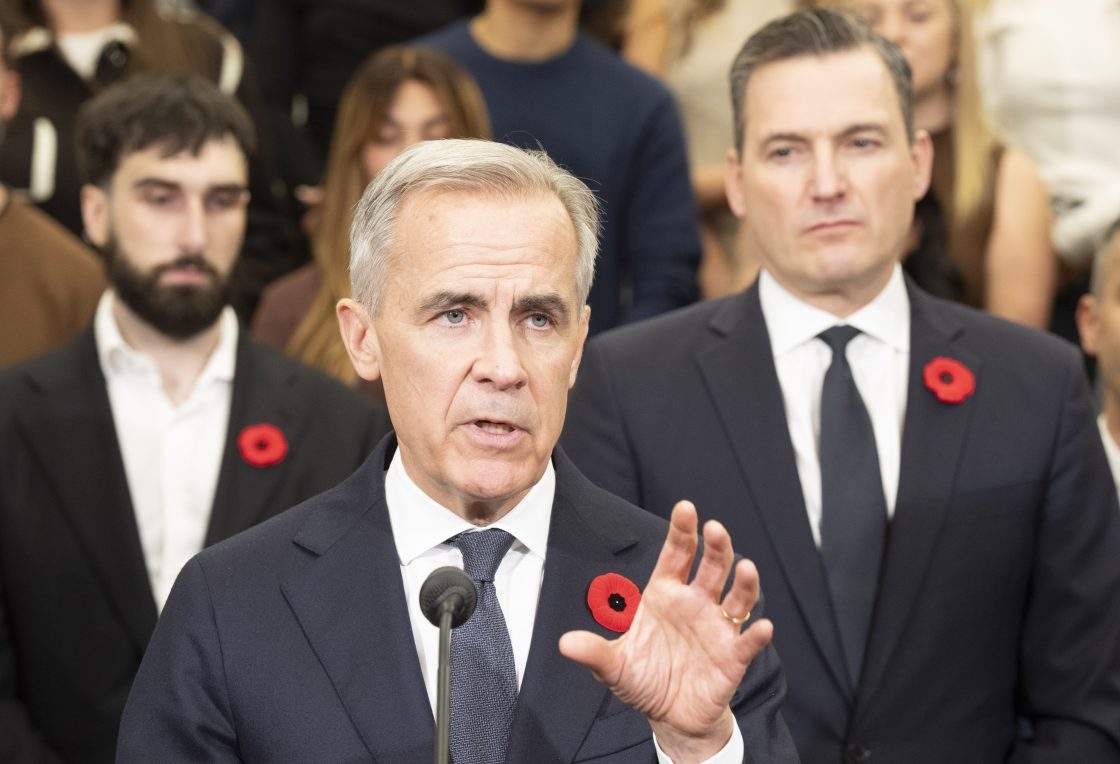
When Canadian Prime Minister Mark Carney stepped up to a microphone recently and delivered a blunt warning to American steel giant Cleveland-Cliffs, the financial press treated it like another routine trade dispute. They printed the dry quotes. They noted that Carney called the company’s decision to walk away from its commitments a "mistake." They mentioned the Investment Canada Act, tariff protections, and corporate restructuring. Further analysis by Reuters Business explores similar views on this issue.
They missed the blood in the water.
Because when a multinational corporation decides that legally binding obligations are merely polite suggestions, it isn't just a line item on a quarterly earnings call. It is a calculated gamble with human lives.
The Architecture of a Broken Handshake
To understand why Carney’s rebuke carries so much weight, you have to understand what happened when Cleveland-Cliffs came knocking at Canada’s door.
In 2024, the Ohio-based steelmaker finalized its massive, multi-billion-dollar acquisition of Stelco—a crown jewel of Canadian industry with deep roots in Hamilton and Nanticoke, Ontario. When a foreign company wants to buy a strategic Canadian asset of that magnitude, they don't just write a check and take the keys. Under the Investment Canada Act, they have to prove the deal is of "net benefit" to the country.
Think of the Investment Canada Act like a prenuptial agreement signed at the altar of national interest. The foreign buyer stands before the federal government and makes solemn, legally enforceable promises: We will keep the lights on. We will maintain Canadian headquarters. We will invest in the plants. We will protect the jobs.
Cleveland-Cliffs CEO Lourenco Goncalves signed that dotted line. He made the pledges. He got the keys to Stelco, instantly cementing Cleveland-Cliffs as one of the dominant flat-rolled steel producers in North America.
Then, the market shifted. Tariffs loomed, trade winds turned hostile, and the cold math of corporate balance sheets began to override the warm promises made during the courtship. Suddenly, the commitments regarding Canadian operations, capital investments, and workforce stability began to look inconvenient to headquarters in Cleveland.
Carney’s message was stripped of diplomatic velvet: Cleveland-Cliffs is making a mistake by not respecting its obligations.
When a Prime Minister uses words like that in public, it means the quiet phone calls behind closed doors have already failed.
Meet Arthur, Who Doesn't Care About EBITDA
If you want to know what an "unmet corporate obligation" actually looks like, forget the stock tickers. Consider a hypothetical composite of the men I’ve met in the diners along Barton Street in Hamilton—let’s call him Arthur.
Arthur is fifty-four. He has worked the hot strip mill for thirty-one years. His left shoulder clicks when it rains, a souvenir from a maintenance shift in 2008, and he knows the sound of a failing bearing over the roar of machinery that would make a jet engine sound like a whisper.
Arthur doesn't read The Wall Street Journal. He doesn't care about Cleveland-Cliffs' debt-to-equity ratio or their strategic pivot toward automotive-grade steel in the American Midwest. What Arthur cares about is whether the promised capital upgrades to his facility are actually going to happen, or if his plant is quietly being starved of investment so it can be shuttered the next time the market dips.
Wait.
Think about what happens to a town when a steel mill stops upgrading its equipment. It doesn't die overnight. It dies by a thousand deferred maintenance orders. A conveyor belt isn't replaced; it's patched. A furnace isn't modernized; it's run until it breaks. And then, three years later, executives fly in from out of town, look around at the decaying infrastructure they refused to fund, and announce with heavy hearts that the facility is "no longer globally competitive."
We have seen this movie before. We saw it in the 1980s across the Rust Belt, and we saw it in Hamilton during the dark days of the U.S. Steel takeover—a painful chapter of Canadian industrial history where foreign owners stripped assets, locked out workers, and left a trail of broken promises that took a decade of bankruptcy courts to untangle.
That history is why Stelco workers were terrified when Cleveland-Cliffs arrived. And it is why Carney’s intervention feels like a line drawn in the slag.
The Illusion of the Borderless Market
For thirty years, the prevailing gospel among economists and politicians was that capital had no nationality. Money was supposed to flow like water, seeking the lowest cost and highest return, and we were all supposed to be richer for it.
It was a seductive theory. It was also a lie.
When crises hit—whether it’s a global pandemic, a supply chain collapse, or a bruising trade war—capital suddenly remembers its passport. When Washington sneezes, corporate boards in Ohio immediately look at their satellite operations in Ontario as the easiest places to cut fat. Without a government willing to bare its teeth, a branch-plant economy is always the first casualty of a boardroom panic.
This is the invisible stake at the heart of the Cleveland-Cliffs standoff. If the Canadian government allows a massive American buyer to shrug off the legally binding undertakings it made under the Investment Canada Act, the law becomes a dead letter. Every future buyer—from mining conglomerates to tech giants—will learn a simple, toxic lesson: Promise Ottawa whatever they want to get the deal approved, and ignore it six months later when the ink is dry.
Carney, a former central banker who spent years navigating the ruthless realities of global finance in both Ottawa and London, knows this game inside and out. He knows that markets don't respect weakness; they respect enforcement. By calling out Cleveland-Cliffs publicly, he isn't just defending a few thousand steelworkers in southern Ontario. He is defending the credibility of the Canadian state as a sovereign regulator that refuses to be played for a fool.
What Actually Happens When a Company Breaks Its Word?
People often ask what a government can realistically do once a foreign company already owns the factory. You can't easily un-bake a cake.
Yet the federal toolkit is sharper than most realize, provided a leader has the nerve to use it. Under the Investment Canada Act, the Minister of Innovation, Science and Industry has the power to issue formal demand letters, haul executives into Federal Court, and seek massive financial penalties—tens of thousands of dollars per day for every day a company remains in breach of its commitments.
Beyond the courtroom, there is the sheer weight of state leverage. Steel doesn't exist in a vacuum. It relies on federal procurement contracts, infrastructure spending, green-transition subsidies, and—most critically right now—tariff protections against cheap, dumped foreign steel. A steelmaker that alienates the federal government while simultaneously begging that same government to shield its market from predatory imports is playing a dangerous game of chicken.
But the real battle isn't won with fines. Fines are just a cost of doing business to a multi-billion-dollar enterprise; they get baked into the budget right next to legal fees and executive bonuses.
The real pressure comes from making the reputational and operational cost of betrayal higher than the cost of compliance. When a Prime Minister stands before the cameras and brands a company’s strategy a mistake, it signals to institutional investors, pension funds, and commercial lenders that regulatory warfare is coming. Uncertainty is poison to a stock price. Suddenly, the tidy savings a CEO thought they were getting by stiffing a Canadian workforce start evaporating in the market.
The Heavy Silence of a Cold Mill
I once walked through a shuttered rolling mill in the dead of winter. If you have never experienced it, you cannot imagine the weight of that silence.
A working steel plant is a living, breathing beast. The floor vibrates beneath your boots. Cranes groan overhead like prehistoric birds. Sparks shower down in brilliant orange arcs, and the air smells sharply of ozone and hot oil. It is loud, dirty, dangerous, and undeniably alive.
A dead mill is a cathedral of rust. Water drips from broken skylights onto cold concrete. Birds nest in the rafters where overhead cranes used to glide. And outside the chain-link fence, the ripple effect spreads outward like poison in a well: the diner across the street closes its lunch counter; the local hardware store loses its biggest account; the young families pack up U-Hauls and head west, leaving behind aging parents and hollowed-out main streets.
That is what sits on the table behind the sterile language of corporate compliance and trade policy.
Steel isn't just another commodity like lumber or wheat. You cannot build a modern nation—its bridges, its wind turbines, its transit systems, its defense infrastructure—without sovereign steelmaking capacity. Once you let your blast furnaces go cold, you don't just flip a switch to turn them back on. Once the institutional knowledge of men like Arthur retires or moves away, it is gone forever.
The Reckoning at the Gate
Cleveland-Cliffs executives likely thought they could weather a few weeks of bad press in Canada, issue a bland statement about "market realities" and "operational efficiency," and wait for the news cycle to move on to the next political scandal.
They miscalculated. They misread the mood of a country tired of being treated like an economic colony, and they underestimated a Prime Minister who understands that if you blink when a giant tests your borders, you will spend the rest of your term on your knees.
The confrontation is far from over. Lawyers will bill thousands of hours arguing over the precise definitions of "capital expenditure" and "employment levels." Behind closed doors, lobbyists will whisper about global headwinds and the necessity of flexibility.
None of that matters to the guy punching his timecard at six in the morning in Hamilton, pulling on his fire-retardant jacket, and tightening the strap on his hard hat. He kept his end of the bargain. He showed up in the snow, stood beside the fire, and poured the iron that built the country.
All he is asking now is for the men in the suits to be half as good as their word.