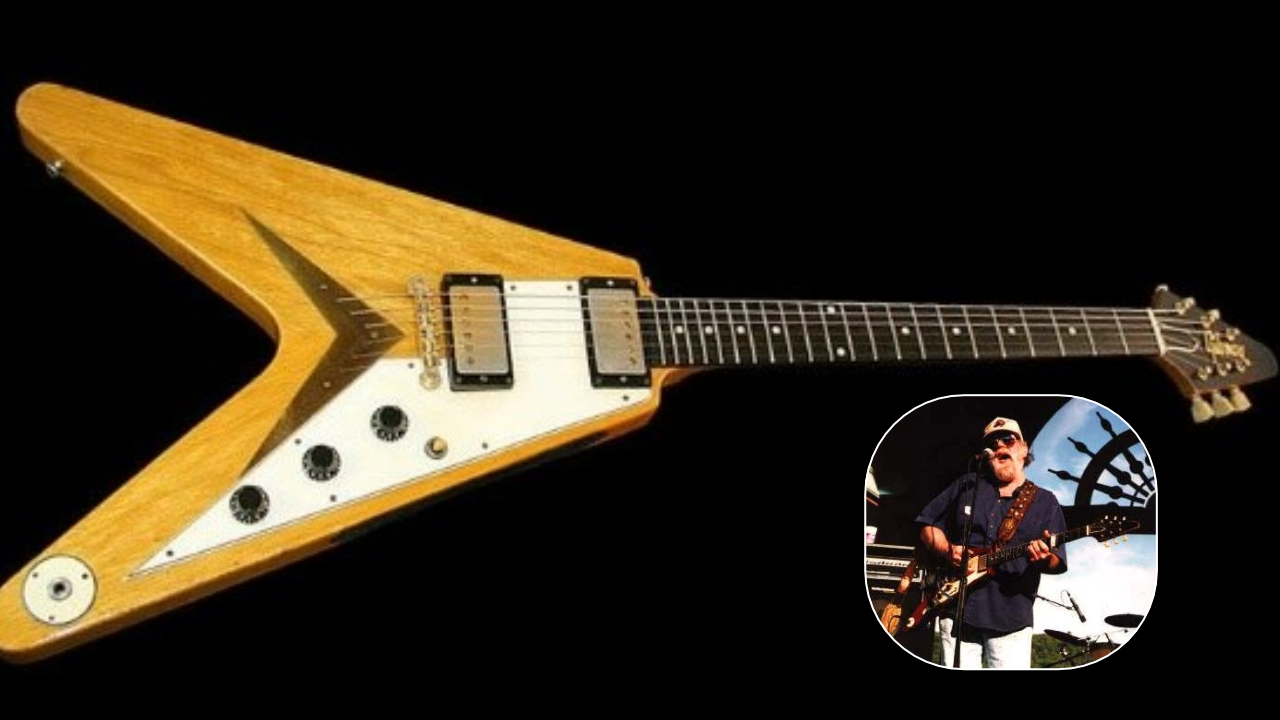
Lonnie Mack’s famous 1958 Gibson Flying V, known as Number 7, sold alongside his 1962 Magnatone Custom 440 amplifier for $550,000 at Heritage Auctions on October 15, 2026. That number looks like a clean victory lap for vintage gear. It is not.
Look closer at what that half-million-dollar hammer price actually bought. A buyer did not get a pristine, untouched factory artifact sitting in a time capsule. They got a heavily altered, repaired workhorse paired with a tube amp, a stage strap, and a hard case. For a more detailed analysis into similar topics, we suggest: this related article.
In the vintage guitar market, repairs normally torch value. Collectors obsess over original solder joints, unmolested finishes, and untouched wood because factory purity is how appraisers grade investments. At the exact same Heritage event, an untouched 1959 Gibson Les Paul Standard with zero celebrity provenance fetched $781,250 on the strength of condition alone.
Mack’s rig broke the normal rulebook. Provenance and cultural weight overrode collector purism, proving that when an instrument carries real musical history, scars can actually validate the story instead of killing the price. For additional information on this issue, extensive analysis is available at Rolling Stone.
Why a Heavily Modified Guitar Cleared Half a Million Dollars
Most buyers walking into a vintage instrument auction act like forensic auditors. They check screw slots, inspect wiring harnesses, and look for finish checking under bright lights.
Mack’s Number 7 fails almost every purist checklist. Gibson refinished the body red around 1963. A neck repair left two korina dowels visible near the heel, and the original string-through-body holes were filled. The bridge is a replacement post-1964 ABR-1, and the installed Kluson tuners are reproductions. Only the pair of original PAF humbuckers stayed put and kept working.
If a nameless 1958 Flying V showed up with those same modifications, dealers would discount it sharply against a clean example. Yet Mack’s guitar still commanded $550,000 with its accompanying rig.
The difference comes down to provenance. Mack was not a studio ghost who owned a cool guitar on paper. He played this instrument hard across decades of club dates, sessions, and records, turning an oddball piece of wood into a signature voice.
A hypothetical example makes the valuation split obvious. Imagine two late-1950s Gibson bodies with identical refinishes and repaired heels: one sat in a garage band basement for forty years, while the other anchored foundational blues-rock recordings. A purist might still pass on both, yet a buyer chasing cultural history will pay up for the one with documented musical fingerprints.
What Bundling the Magnatone Amp Actually Signals
Auction headlines love a single dramatic number. Bundling a guitar with an amplifier complicates the math.
The $550,000 figure covered the combined lot: the 1958 Flying V, the 1962 Magnatone Custom 440 amplifier, Mack’s stage strap, and a hard case. Breaking out a standalone dollar value for the guitar alone is impossible from the top-line result.
Still, keeping the Magnatone Custom 440 in the lot makes total sense for anyone studying Mack’s sound. While plenty of players leaned on Fender amplifiers, Mack favored Magnatone’s pitch-shifting vibrato circuit, which gave his playing an unmistakable wobble and bite.
Separating a signature guitar from its long-time amplifier often strips away context. Keeping them together preserves the signal chain that helped shape early blues-rock.
- Combined lot discipline: Packaging the 1958 Flying V, 1962 Magnatone Custom 440, strap, and case keeps an artist’s working rig intact rather than piecing it out.
- Sonic identity: Pairing the korina-bodied guitar with Magnatone’s vibrato circuitry reflects how Mack actually worked on stage and tape.
- Valuation ambiguity: A single hammer price for a bundle hides how much premium went to the guitar versus the amp and accessories.
How an Unloved 1958 Design Became a Symbol
When Gibson rolled out the Flying V in 1958 alongside the Explorer and Moderne, the market rejected the futuristic push. Guitars were supposed to look like guitars, not space-age arrows.
Early production was tiny, with fewer than one hundred units built during its initial run before Gibson shelved the model and sold off remaining stock into the early 1960s. Ted McCarty’s team had cut a big wedge out of the mahogany prototype to trim weight, creating the sharp V silhouette that looked radical in 1958.
Mack grabbed onto that weirdness early. After getting a look at the arrow-shaped model through a local shop owner, he ended up with serial number 007 and made it part of his identity on stage and on record.
His 1963 debut album, The Wham of That Memphis Man, cemented how people heard the instrument. Tracks like "Wham!" helped turn a quirky design into a blueprint for aggressive electric guitar phrasing, eventually inspiring later reissues and signature runs.
The Gray Areas Every Vintage Buyer Ignores
Anyone treating a $550,000 auction result as a simple price guide for vintage instruments is reading the wrong tea leaves. High-profile sales distort expectations in both directions.
First, celebrity provenance is narrow. Very few instruments carry the sustained historical weight of Lonnie Mack’s Number 7. Most vintage guitars on the market live or die by original parts, clean wood, and documented chain of custody.
Second, player wear is a double-edged sword. Scars and modifications tell a compelling story when an iconic artist put them there. On an ordinary vintage guitar, heavy alterations shrink the pool of serious buyers and cap resale upside.
| Valuation Factor | Condition-Driven Vintage Piece | Artist-Provenance Rig Like Mack’s |
|---|---|---|
| Primary Price Driver | Untouched factory parts and finish | Documented artist history and cultural impact |
| Effect of Repairs & Mods | Usually lowers collector value | Accepted as part of the working history |
| Lot Structure | Often sold as a single instrument | May bundle amp, strap, and case together |
| Buyer Pool | Condition collectors and investors | History buyers, fans, and major collectors |
Even the $550,000 price tag does not sit in a vacuum. At the same Heritage auction, a clean 1959 Les Paul Standard without a famous owner set a record at $781,250, while rock’s biggest trophy sales—such as David Gilmour’s Black Strat at $14.55 million earlier in 2026—operate on an entirely different stratosphere.
If you are evaluating vintage gear to buy, sell, or insure, stop chasing headline numbers and inspect the actual provenance chain, documented repairs, and every item inside the lot before placing a bid.