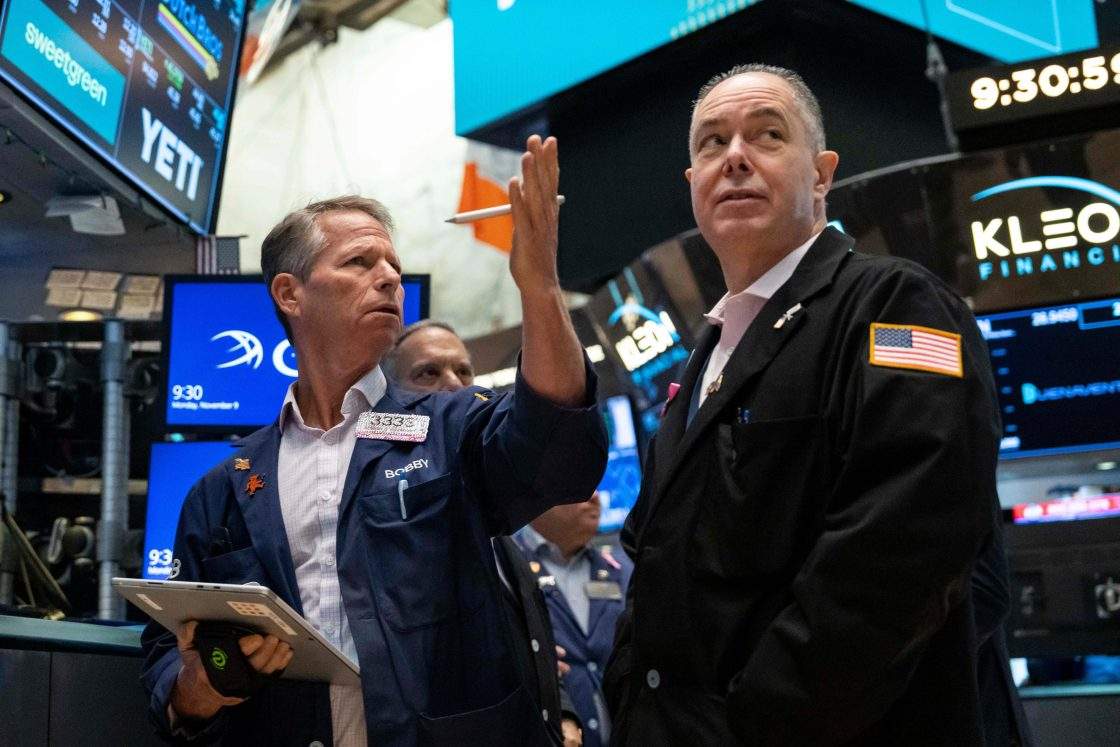
Anthropic reached a roughly $1.3 trillion basic market valuation at the close of its first day as a public company on Nasdaq, capping a record-breaking $81.3 billion initial public offering that briefly made the Claude maker one of the highest-valued businesses on earth. Within days of that November 2026 debut, the stock slid below its $83 offer price and dipped under the $1 trillion mark.
Anyone who has watched mega-cap tech cycles for three decades recognizes this exact sequence. A story moves fast. The capital floods in even faster. Then the balance sheet asks for payment.
Anthropic is no paper tiger. Its nine-month 2026 revenue hit $33.2 billion, with $17 billion arriving in the third quarter alone, compared to $4.6 billion across all of 2025. Enterprise adoption, particularly around software engineering workflows like Claude Code, gave the company genuine commercial gravity rather than a pitch-deck fantasy.
Yet a $1.3 trillion valuation on a public company demands more than hypergrowth. It demands durable unit economics, disciplined capital allocation, and proof that every dollar of silicon turns into cash profit rather than a sunk cost.
How a Four-Year-Old Lab Became a Market Titan
Founded in 2021, Anthropic climbed from an early-stage safety-focused research shop to the centerpiece of the public AI equity trade in less than six years. Its May 2026 Series H round raised $65 billion at a $965 billion post-money valuation, setting the stage for an upsized IPO of 980 million Class A shares under the ticker ANT.
Underwriters priced the offering above its marketed range, and shares jumped on opening day before settling near $97 at the bell. That first-day close put basic market capitalization near $1.3 trillion and diluted value even higher.
Wall Street bought the urgency. Institutional buyers feared missing the defining enterprise AI listing after watching cloud budgets expand across Fortune 500 balance sheets.
Still, momentum is not a moat. Early trading volatility showed how thin the margin for doubt becomes once a company trades in public view every second of the session.
The Nine-Hundred-Billion-Dollar Compute Treadmill
Look past the top-line revenue surge and the real tension inside Anthropic becomes unmistakable. The company disclosed roughly $895 billion to $900.9 billion in compute and infrastructure commitments in its IPO filings.
Compute spending has scaled at roughly four times per year. Anthropic spent $18.8 billion on compute and infrastructure during the first nine months of 2026, including nearly $10 billion in the third quarter alone—an annualized pace approaching $40 billion.
Consider what that means for gross mechanics. In the first nine months of 2026, customer inference costs—reported as cost of revenue—accounted for $4.812 billion, or about 26% of total compute outlays. The rest went toward training future models, reserving capacity, and building out infrastructure ahead of demand.
A frontier model business does not merely buy servers; it rents an industrial future on a clock that keeps ticking whether or not enterprise seats expand on schedule.
The contractual web is sprawling. Public disclosures point to roughly $121 billion in Google Cloud commitments through 2033, $110 billion with Amazon Web Services through 2036, and $45 billion with Microsoft Azure, alongside $161 billion in five-year leases for Broadcom-designed chips and major third-party compute outlays such as roughly $5 billion paid to SpaceX in the third quarter.
Why Timing Mismatches Haunt Capital-Heavy Builders
Fixed obligations arrive on rigid schedules. Enterprise software renewals do not.
Analysis of the prospectus highlights roughly $70 billion in compute commitments coming due by September 2027 and $451.6 billion by the end of 2030. Against those bills sit $91.6 billion in gross IPO proceeds, a $26 billion private placement, and $6.6 billion in operating cash flow generated over the first nine months of 2026.
To make the math work over the long arc, Anthropic has to keep filling expensive clusters while driving down cost per token faster than competitors cut prices. If model efficiency gains outpace demand, compute prices fall and margins compress. If compute supply tightens again, short-term capacity costs spike, just as third-quarter compute expenses jumped 77% even as quarterly revenue grew 47%.
Reading the Red Ink Without Getting Fooled
Headline net losses in the S-1 look staggering at first glance: $104 billion over the first nine months of 2026. Serious analysts separate accounting noise from operational burn, though neither can be ignored.
Roughly $94.3 billion of that nine-month net loss stemmed from non-cash fair-value adjustments tied to convertible notes, derivative liabilities, and SAFEs as the company's implied valuation climbed. Those charges reflect rising equity value on paper rather than cash leaving the bank account.
Operating reality is subtler. Even with a $1.3 billion operating loss across the first nine months of 2026 on $33.2 billion of revenue, the business is operating near breakeven on a narrow GAAP operating slice while absorbing tens of billions in infrastructure commitments and research intensity.
Hypothetical example: Suppose an enterprise AI vendor signs a $500 million annual contract that requires dedicating a dedicated cluster costing $380 million a year in amortized hardware, power, and networking, plus continuous post-training and safety evaluation. If a rival releases a cheaper model six months later and forces a 25% price cut at renewal, the contract's gross margin evaporates before the hardware is half depreciated.
That dynamic explains why public equity investors treat AI leaders differently than classic software-as-a-service companies. Traditional cloud software enjoyed near-zero marginal distribution cost once code was written. Frontier AI requires paying the power and silicon toll on every single query.
Enterprise Strength Versus Hyperscaler Gravity
Anthropic's strongest card is focus. Rather than chasing every consumer social feature, it built deep traction among corporate engineering teams, regulated industries, and technical workflows where reliability and coding precision matter.
- Enterprise workflow stickiness: Once codebases, internal tools, and agentic pipelines are wired into Claude, switching costs rise—provided latency, accuracy, and compliance stay ahead of rivals.
- Cloud partner duality: Hyperscalers like Amazon and Google are both major backers and indispensable infrastructure vendors, creating alignment on distribution alongside concentration risk.
- Rival pressure: OpenAI, valued around $1.25 trillion after a smaller $11 billion raise following an initial $20 billion target, and well-capitalized tech giants keep pressure on pricing and talent.
No single advantage is permanent in frontier AI. Model leadership has repeatedly shifted hands over quarters, not decades, while open-weight alternatives and specialized domain models chip away at generic endpoints.
What Public Market Scrutiny Changes Inside Anthropic
Becoming a public company changes internal discipline overnight. Private rounds reward vision and speed; quarterly earnings calls reward predictability, free cash flow conversion, and capital restraint.
Management now faces tougher questions on every release cycle. How much of each dollar of incremental revenue converts into operating cash flow? Are multi-year cloud and chip commitments matched to locked-in customer backlog, or do they assume aggressive market-share gains years out?
Even a dip below the $83 IPO price within a week of listing carries a useful signal. A $1.3 trillion valuation prices in years of near-flawless execution at industrial scale.
Watch quarterly compute intensity as a share of revenue and compare multi-year lease maturities against firm customer commitments—those two numbers will tell you long before any keynote speech whether Anthropic's public market valuation holds or cracks.