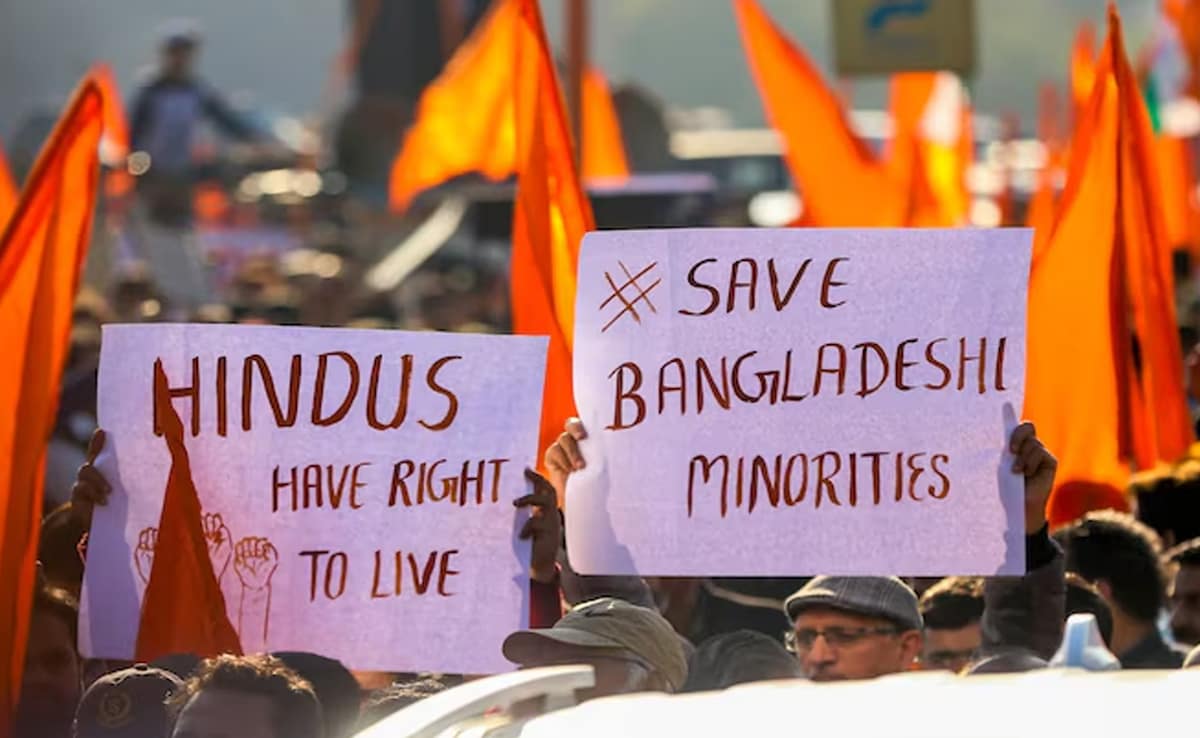
The discovery of Nanda Lal Paul’s body, suspended from a tree near the temple he guarded in Bangladesh’s Jhenaidah district, follows a grimly predictable blueprint. Local authorities and initial police reports often lean toward the convenience of suicide, but the social and political context suggests a far more jagged reality. For the Hindu minority in Bangladesh, the death of a temple caretaker is rarely an isolated tragedy of mental health. It is a message.
The death of Nanda Lal Paul, a man dedicated to the upkeep of a local place of worship, comes at a time when religious friction in the region is reaching a boiling point. While official narratives try to quiet the noise to prevent communal rioting, the ground reality for minority groups is one of mounting pressure, land disputes, and a legal system that often turns a blind eye to the intimidation of the vulnerable. To understand why a caretaker ends up dead, one must look past the rope and into the systemic erosion of security for those left to guard the vestiges of a shrinking heritage.
The Geography of Intimidation
Jhenaidah is not a random backdrop. This district, along with several others in the Khulna division, has long been a flashpoint for communal tension. In these rural pockets, a temple is more than a religious site. It represents a claim to land. In Bangladesh, land is the most valuable and dangerous currency.
Most attacks on Hindu caretakers or priests are rooted in property interests. When a temple stands on a prime plot, it becomes a target for local power brokers. If the caretaker cannot be bought or scared off, the stakes escalate. The "hanging" of a victim is a classic tactic used in the region to muddy the waters of a criminal investigation. By staging a scene that looks like self-harm, perpetrators create enough "reasonable doubt" to stall a homicide inquiry, allowing local political influence to derail the process before it even begins.
The physical act of hanging someone from a tree near their place of work serves a dual purpose. First, it removes the immediate obstacle—the man guarding the property. Second, it serves as a visual deterrent to anyone else who might consider taking his place. It is psychological warfare dressed up as a personal tragedy.
The Failure of the Suicide Narrative
In the hours following the discovery of a body like Paul’s, the official machine begins to grind. Police statements often highlight a lack of struggle or mention vague "family troubles" to steer the public eye away from communal violence.
However, forensic experts and human rights observers in South Asia have repeatedly pointed out the inconsistencies in these rapid classifications. A man who has spent decades serving a community and a deity, with no prior history of clinical depression or financial ruin, does not typically choose the public spectacle of a tree near his temple for a quiet exit.
- The Lack of Pre-mortem Investigation: Autopsies in rural Bangladesh are frequently handled by underfunded district hospitals where political pressure is high.
- The Witness Vacuum: In many of these cases, neighbors claim to have seen nothing, even when the "suicide" occurs in a high-traffic area. This silence is a byproduct of fear, not a lack of evidence.
- The Land Grab Connection: Investigative records show that in nearly 60% of cases involving violence against minority religious figures, there was an active or looming dispute over the temple’s deed or the surrounding acreage.
We have to ask why the burden of proof always falls on the victim’s family to prove a murder, rather than on the state to explain how a peaceful community servant ended up on a noose.
The Political Shield and the Minority Crisis
Bangladesh’s political landscape is a minefield for the Hindu population. They are often used as a political football between the ruling Awami League and the opposition groups. While the government projects an image of secularism to the international community, the local cadres often behave quite differently.
In the villages, the lines between political affiliation and criminal enterprise are blurred. A local leader might want the temple land for a market or a housing project. To the central government in Dhaka, Nanda Lal Paul is a statistic to be managed. To the local strongman, he was a nuisance on a valuable piece of real estate.
The legal mechanism meant to protect minorities, such as the Vested Property Act’s remnants and various communal harmony initiatives, are often toothless in the face of localized thuggery. When a caretaker dies, the "investigation" usually ends with a burial. No suspects are rounded up. No high-level inquiry is launched. The message to the Hindu community is clear: you are on your own.
The Erosion of the Caretaker Class
The role of a temple caretaker in rural Bangladesh is a position of immense vulnerability. These are not wealthy individuals. They are often poor, elderly, and entirely dependent on the goodwill of their neighbors.
By targeting the caretaker, attackers target the heart of the community's daily life. If the temple cannot be safely maintained, the community stops visiting. When the community stops visiting, the land becomes "abandoned." Once it is deemed abandoned, it is only a matter of time before the bulldozers arrive or a fraudulent deed is produced in a local court. This is not a conspiracy theory; it is a documented method of demographic and physical displacement that has been occurring for decades.
International Silence and Domestic Apathy
Why doesn't this reach the front pages of major global outlets? Because it is slow-motion violence. It isn't a massive explosion or a high-casualty riot. It is one man, one tree, one village at a time. This "drip-feed" of tragedy fails to trigger the sensors of international human rights organizations that look for mass displacement events.
Domestically, the media often self-censors. Reporting on communal violence carries the risk of being accused of "inciting unrest." Journalists who dig too deep into the land-grabbing syndicates that profit from these deaths often find themselves facing legal threats or physical intimidation. The result is a sanitized version of events where Nanda Lal Paul is just a man who gave up on life, rather than a man who was pushed out of it.
The Immediate Need for Reform
If the Bangladeshi government wants to prove its commitment to its minority citizens, it cannot keep accepting these deaths at face value. A standard operating procedure must be established for the death of any minority religious official under suspicious circumstances.
- Independent Forensic Teams: Removing the autopsy process from the influence of local district politics.
- Fast-Track Land Dispute Courts: Ensuring that the death of a caretaker does not result in a change of land ownership for at least a decade, removing the primary motive for murder.
- Witness Protection: Rural villagers will not speak against local power brokers unless they know the state will protect them.
The death of Nanda Lal Paul is a symptom of a much larger, much older infection. Every time a rope is found in a tree and the case is closed within 24 hours, the foundation of a pluralistic society cracks. We aren't just looking at a body in Jhenaidah; we are looking at the future of every minority in the region if the current culture of impunity continues to flourish.
The state must act before the silence of the witnesses becomes the permanent silence of an entire culture. Stop treating these deaths as individual tragedies and start treating them as the targeted assassinations of a community's soul.



