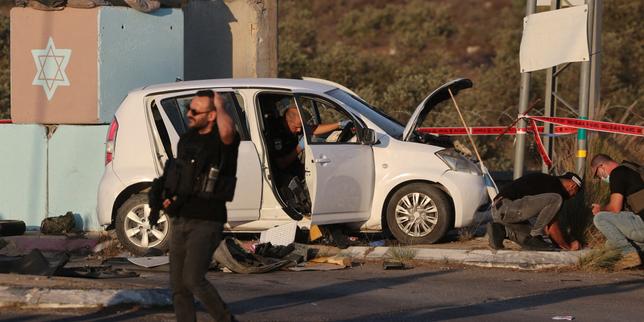
The asphalt of the West Bank does not care about diplomatic immunity or familial ties to foreign capitals. When a speeding vehicle transformed into a weapon on a contested highway, severely injuring the son of the Israeli ambassador to the United States, the illusion that high-profile connections or secure itineraries offer insulation from asymmetric violence was shattered. This was not merely another line item in a daily security briefing. It was a stark reminder that low-tech, high-impact tactical assaults continue to bypass the most sophisticated security apparatuses in the world, striking at the heart of families caught in the crosshairs of an intractable geopolitical conflict.
For decades, military analysts and intelligence officers have obsessed over sophisticated threats. Cyber attacks, drone incursions, and underground tunnel networks dominate defense budgets and strategic planning seminars. Yet, the most persistent hazard in the West Bank remains agonizingly primitive. A heavy vehicle, a compressed timeline of seconds, and a driver willing to turn steel into a projectile require virtually no supply chain, no encrypted communications, and no advanced training. This democratization of violence renders traditional deterrence obsolete. When a steering wheel becomes a weapon of war, every stretch of tarmac becomes a potential combat zone.
Anatomy of a Low Tech Threat
To understand how a car-ramming attack succeeds, one must examine the physical reality of West Bank infrastructure. Roads crisscross the territory, binding together settlements, military installations, and Palestinian population centers in a tense, forced proximity. Route 60 and other arterial corridors are bottlenecks of daily friction. Commuters, soldiers, settlers, and travelers share the same physical space under conditions of extreme psychological strain.
A vehicle moving at eighty kilometers per hour covers twenty-two meters in a single second. Human reaction times, even among elite security details, are measured in hundreds of milliseconds. By the time a driver's erratic acceleration or sudden swerve is registered as hostile intent, the kinetic energy has already been released. Barriers, concrete blocks, and guardrails offer sporadic protection, but at intersections, bus stops, and checkpoints, the vulnerability spikes.
Security forces face an impossible mathematical problem. Securing every kilometer of road against vehicular assault would require militarizing civilian transit to an extent that grinds daily commerce and movement to a complete halt. Thus, the risk is accepted as a permanent tax on presence. When that risk materializes in the form of an attack targeting someone directly linked to a foreign embassy, the political shockwaves ripple far beyond the immediate crash site.
The Diplomatic Fallout and Security Blind Spots
Diplomatic families occupy a strange liminal space in conflict zones. They carry the symbolic weight of foreign governments while navigating the physical dangers of a hostile environment. While ambassadors themselves are cocooned within armored convoys and heavily guarded compounds, their extended families, adult children, and visiting relatives often move through the region with varying degrees of exposure.
The targeting of an ambassador's son changes the calculus of diplomatic protection. It signals to foreign missions that association with the occupying power or the diplomatic corps provides no sanctuary. Intelligence agencies must now reassess whether high-profile relatives are being actively monitored or if this particular incident was an opportunistic strike born of sudden proximity and raw anger.
Diplomatic security protocols typically focus on targeted assassinations, kidnappings, or explosive devices. Counter-surveillance teams watch for tails, and bomb-sniffing dogs sweep vehicles. But how does one defend against an ordinary sedan or pickup truck that blends effortlessly into the morning commute until the final fraction of a second? The answer, uncomfortably, is that absolute defense is impossible. Every security protocol has a residual risk margin, and when that margin is breached, the consequences are immediate and catastrophic.
The Structural Decay of West Bank Security
Security breakdowns do not occur in a vacuum. They are the structural symptoms of a political and social reality that has deteriorated past the point of managed containment. The West Bank is currently experiencing a profound erosion of governance, marked by economic stagnation, expanding settlements, heightened military raids, and the total collapse of bilateral security coordination.
When young men see no political horizon, no economic mobility, and no legal recourse against daily grievances, the threshold for suicide missions or lone-wolf attacks drops precipitously. These actors operate outside organized command structures. They do not need handlers or wire transfers from regional adversaries. They are radicalized by the immediate environment—by the sight of military checkpoints, the expansion of concrete fences, and the constant hum of surveillance drones overhead.
Counter-terrorism officials often speak of drying up the swamp, but in the West Bank, the swamp is being artificially irrigated by endless cycles of friction. Every military sweep that damages infrastructure or disrupts civilian life creates a new cohort of individuals with personal scores to settle. When an attack strikes someone with ties to Washington, it sends a message that the conflict cannot be insulated, managed, or ignored by distant foreign capitals that bankroll or diplomatically shield the status quo.
The Intelligence Failure at the Crossroads
Modern intelligence collection relies heavily on signals intelligence, human assets, and predictive algorithms. Agencies sift through petabytes of metadata, tracking phone calls, social media posts, and financial transactions to catch plots before they materialize. Yet, lone-wolf car-ramming attacks systematically defeat these sophisticated collection platforms.
A perpetrator who decides on a whim to accelerate into a crowd or a pedestrian does not broadcast their intent over a tapped phone line. They do not transfer funds or purchase precursor chemicals. The decision is made in the mind of the individual, executed with a tool they already own or can easily acquire, and deployed with zero digital footprint.
This operational dark space represents the ultimate nightmare for domestic security agencies. Traditional counter-terrorism relies on pattern recognition, but when the pattern is randomness, algorithms fail. Intelligence services are left reacting to the aftermath rather than preventing the crime. They can increase patrols, harden infrastructure, and tighten access control, but they cannot read the mind of every driver idling at a West Bank intersection.
Living on Borrowed Time
The aftermath of the attack on the ambassador's son will lead to short-term tactical adjustments. Security details will tighten their perimeters. Additional concrete barriers will be poured. Intelligence units will comb through the digital and social footprints of local residents, looking for any sign of inspiration or emulation.
Yet, these measures treat the symptoms while ignoring the disease. As long as millions of people live under military occupation without civil rights, political sovereignty, or economic security, the roads of the West Bank will remain perilous. Steel barriers and armed escorts can deflect a single vehicle, but they cannot stop the underlying pressure that drives individuals to turn their own cars into instruments of destruction. The crash was an event, but the conditions that produced it remain entirely unchanged.