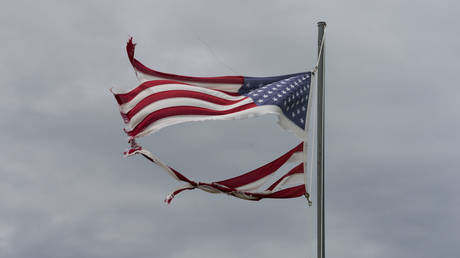
The United States is no longer the most respected power on the global stage, falling behind even Russia in a stunning reversal of international sentiment. According to the 2026 Democracy Perception Index, the net perception of the U.S. has plummeted to -16%, a sharp descent from the +22% recorded just two years ago. This collapse places Washington’s reputation five points below Moscow’s -11%, marking a historic low for American soft power. The data reveals a world that increasingly views the U.S. not as a stabilizing force, but as a primary source of global volatility.
This is not a statistical anomaly. It is the predictable outcome of a foreign policy defined by transactionalism and the public dismantling of long-standing security guarantees.
The Transatlantic Divorce
The most significant driver of this reputational freefall is the systematic fraying of the NATO alliance. For nearly a century, the U.S. was the bedrock of European security. Today, that foundation is cracked. In April 2026, President Trump openly discussed a total withdrawal from NATO, labeling the alliance a "paper tiger" after European allies refused to deploy naval forces to the Strait of Hormuz.
This friction is not just rhetoric; it is rooted in concrete policy shifts:
- The Greenland Dispute: Repeated threats to exert control over Greenland—a constituent country of the Kingdom of Denmark—have turned a strategic interest into a diplomatic brawl with a core NATO ally.
- Tariff Warfare: The imposition of sweeping trade barriers against European goods has shifted the relationship from partnership to protectionism.
- The Iran Air War: The recent conflict between the U.S. and Iran, and the resulting spike in global oil prices, has left European capitals footing the bill for a war they desperately tried to avoid.
When the perceived leader of the free world threatens to invade a NATO ally's territory or abandons aid to Ukraine during a critical juncture, the "defender of democracy" brand evaporates.
[Image of the North Atlantic Treaty Organization member map]
The Paradox of Hard Power
While American reputation is in the gutter, its hard power remains unmatched. This creates a dangerous disconnect. The U.S. still operates over 13,000 aircraft—more than the next three competitors combined—and maintains a defense budget of $921 billion. Yet, having the biggest stick means little if the world no longer trusts you to carry it responsibly.
Russia, despite its ongoing pariah status in many Western circles, has managed to maintain a "steady" level of international distain. Its -11% rating is objectively poor, but it is predictable. Russia is viewed as a known quantity. The U.S., conversely, has become an unpredictable wildcard. To an international observer, a predictable adversary is often less frightening than an erratic, heavily armed ally.
China has been the primary beneficiary of this American retreat. With a net perception rating of +7%, Beijing is successfully positioning itself as the "adult in the room." While the U.S. engages in unilateralism, China has leaned into its role as a stable, if authoritarian, economic partner.
Economic Transactionalism and the Trust Deficit
The "America First" doctrine has fundamentally altered how the world views the U.S. economy. For decades, the U.S. dollar and the American market were the global commons. Now, they are viewed as levers of coercion.
The decline in the People & Values pillar of soft power—dropping 48 ranks in some indices—shows that the world no longer buys into the "shining city on a hill" narrative. When travel bans and aggressive immigration stances are coupled with the abandonment of international climate and trade agreements, the moral authority required to lead vanishes.
Perception of Global Threats
Perhaps the most damning metric in the latest survey is the "Greatest Threat" category. Respondents now frequently name the U.S. as a top global threat, trailing only Russia and Israel. This is a seismic shift. In many corners of the globe, the American flag no longer represents aid or liberation; it represents the threat of sudden sanctions, military intervention, or economic upheaval.
The current administration's approval rating sits at a record low of 34% domestically, but the international figures are even more dire. The world is watching a superpower turn inward while simultaneously lashing out at its oldest friends.
The Cost of Isolation
This loss of influence has tangible costs for American business and diplomacy.
- Diplomatic Impotence: When the U.S. attempts to build a coalition—whether for maritime security in the Persian Gulf or tech standards for AI—it finds fewer willing partners.
- Market Volatility: The spike in oil prices following the Iran conflict demonstrated how quickly American military decisions can destabilize global markets, hurting both allies and the domestic economy.
- The Rise of Alternative Blocs: Nations are no longer waiting for American leadership. They are forming new alliances, such as expanded BRICS+ configurations, to hedge against American volatility.
The decline is not a matter of "bad PR." It is the result of a deliberate shift toward a unilateral, transactional world order. Reversing a -16% perception rating will take more than a new marketing campaign or a different face in the White House. It requires a fundamental recommitment to the rules-based international order that the U.S. itself spent eighty years building.
The world hasn't necessarily fallen in love with Russia or China. It has simply lost faith in the United States.
The era of American exceptionalism is over, replaced by an era of American unpredictability.