On February 28, 2026, the tectonic plates of Middle Eastern geopolitics did not just shift; they fractured. Following a massive, coordinated aerial assault by the United States and Israel, President Donald Trump announced that Ayatollah Ali Khamenei is dead. Iranian state media, after hours of frantic silence and conflicting reports, finally confirmed the 86-year-old Supreme Leader was killed when a "pinpoint" strike leveled his compound in central Tehran. This is no longer a shadow war. It is a decapitation of the Islamic Republic’s head, leaving a forty-year theocracy gasping for air in a vacuum of its own making.
The operation, code-named Roaring Lion by Jerusalem and Epic Fury by the Pentagon, involved more than 200 fighter jets, B-2 stealth bombers, and a swarm of "Scorpion Strike" drones. While the initial headlines focused on the fire and fury, the investigative reality is far more cold-blooded. This was the culmination of months of intelligence "sniffing" that tracked the Supreme Leader’s movements with terrifying precision. Trump, never one for subtlety, framed the assassination as a liberation. He claimed it was the "greatest chance" for the Iranian people to reclaim their country. But for those of us who have watched this region bleed for decades, the questions that follow are much darker than a simple victory lap.
The Architecture of the Strike
Intelligence sources indicate the strike hit during a high-level meeting. It wasn't just Khamenei. The blasts claimed nearly 50 senior officials, including Armed Forces Chief of Staff Abdolrahim Mousavi and Defense Minister Aziz Nasirzadeh. By wiping out the top tier of both the clerical and military leadership in a single hour, the U.S. and Israel didn't just target a man; they targeted the nervous system of the Iranian state.
The technical execution was a display of absolute dominance. Satellite imagery shows the Leadership House compound—once the most guarded hectometre in Iran—reduced to a blackened crater. While Iranian Foreign Minister Abbas Araghchi initially tried to claim the leadership was "safe and sound," the sheer physical evidence of the destruction made the lie impossible to maintain. This was a failure of Iranian counter-intelligence on a catastrophic scale. It suggests that Western agencies had "eyes" inside the room long before the first Tomahawk missile left its tube.
A Republic in Freefall
The death of Khamenei marks only the second leadership transition since the 1979 Revolution. Unlike 1989, when Khamenei himself was groomed as a successor, there is no heir apparent today. The constitutional mechanism for succession—an 88-member Assembly of Experts—is currently a hollow shell. Many of its key members are either dead or in hiding as the "pinpoint bombing" continues.
In the interim, a makeshift council has emerged.
- Masoud Pezeshkian: The current President, now caught between a mourning population and a vengeful military.
- Gholamhossein Mohseni Ejei: The hardline Judiciary Chief, representing the old guard's refusal to bend.
- Alireza Arafi: A senior cleric meant to provide a veneer of religious continuity.
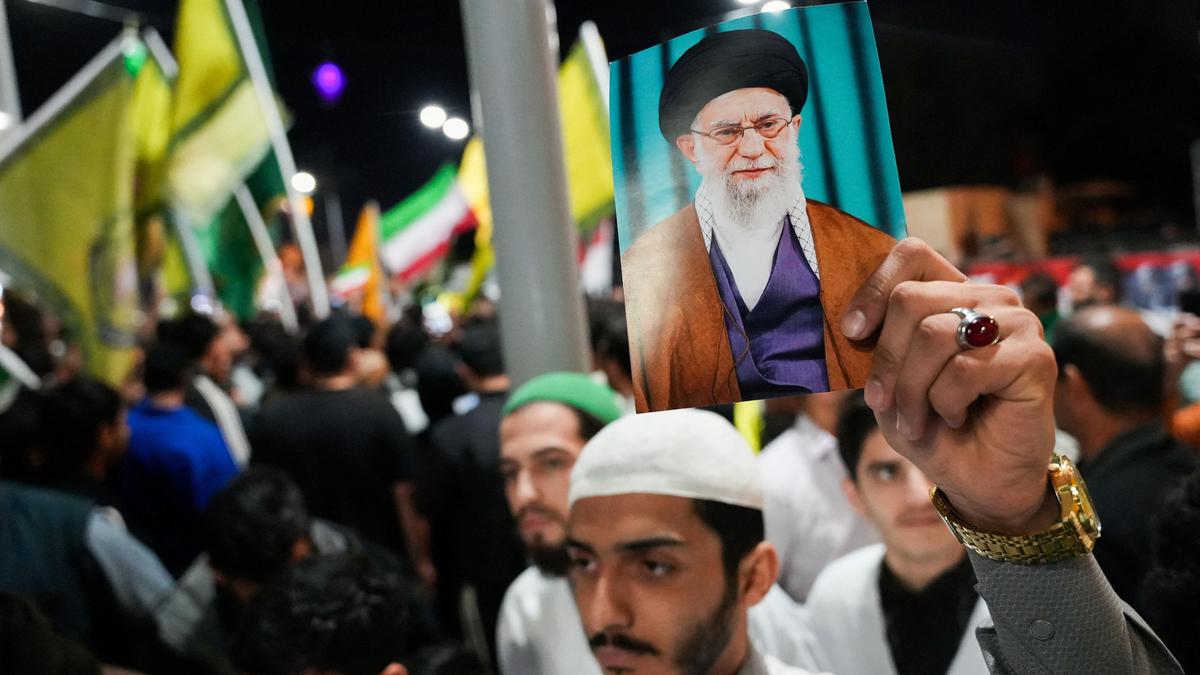
This council is a marriage of convenience in a burning house. They have declared forty days of mourning, but they are governing a country where the streets are already split. In some quarters of Tehran, the sound of celebration—whistles and cheers from rooftops—clashes with the "Death to America" chants in Enqelab Square. The regime is facing a dual threat: external liquidation and internal implosion.
The Regional Wildcard
The fallout is not confined to the borders of Iran. Within hours of the confirmation, Iranian proxies and what remains of the IRGC Navy launched retaliatory strikes against U.S. bases in Bahrain, Qatar, and Kuwait. Global markets are currently in a state of paralysis as the Strait of Hormuz—the world’s most vital oil artery—becomes a live combat zone.
Trump has warned that any further retaliation will be met with "force that has never been seen before." This is a departure from his previous "America First" rhetoric. By involving the U.S. so directly in a regime-change operation, the administration has abandoned the policy of containment for one of active erasure. The goal is no longer to bring Iran to the table; it is to remove the table entirely.
The Successor Crisis
The most overlooked factor in this crisis is the Islamic Revolutionary Guard Corps (IRGC). While the clerics hold the titles, the IRGC holds the guns. With the Supreme Leader gone, the IRGC is likely to bypass the Assembly of Experts and install a military-led transitional government. This would transform Iran from a theocracy into a pure military stratocracy.
If the IRGC feels its survival is at stake, the "rational actor" theory goes out the window. We are looking at a cornered animal with a nuclear-ready infrastructure. The U.S. gamble relies on the belief that the Iranian people will rise and the military will fracture. If they don't, this isn't the end of a war; it’s the beginning of a much wider, more desperate one.
The Cost of the Vacuum
Hundreds of civilians have reportedly been caught in the crossfire. An Iranian diplomat at the UN described the strikes as "unprovoked and premeditated aggression." Meanwhile, the international community is fractured. Russia and China have condemned the assassination as a violation of international law, while some European allies remain in a stunned, silent wait-and-see mode.
The "liberation" Trump speaks of comes at a staggering price. The Iranian state apparatus is currently paralyzed. Hospitals in Israel have moved underground in anticipation of a full-scale missile barrage. Thousands of travelers are stranded across the Middle East as airspace remains closed.
This is the reality of the post-Khamenei era. It is a landscape of rubble, uncertainty, and the very real possibility that the "peace" Trump promises is actually just the silence of a graveyard. The regime spent forty years building an "Axis of Resistance." We are about to find out if that axis can hold together when its center has been vaporized.
Would you like me to analyze the specific economic impact of the Strait of Hormuz closure on global oil prices following these strikes?