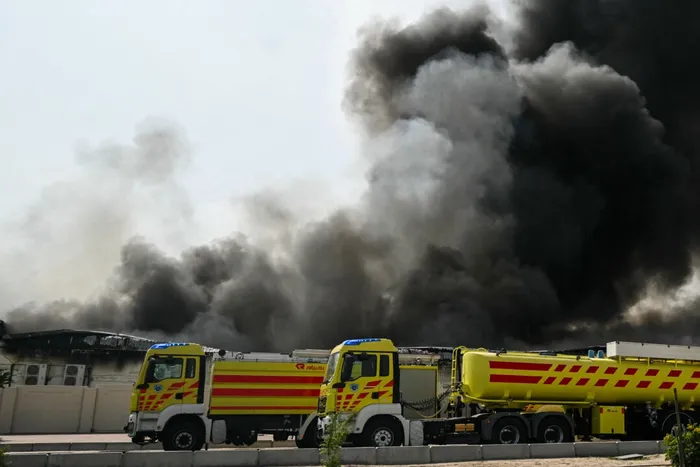
The massive air campaign currently unfolding across Iran, dubbed Operation Epic Fury by the United States and Roaring Lion by Israel, has fundamentally shifted the conversation from "if" a conflict would happen to how long the Iranian regime can endure. Since the opening salvos on February 28, 2026, the question of what weapons Tehran actually has left—and how they work in the face of total electronic suppression—has become the central mystery of the Middle East.
Iran’s primary weapons are not just physical hardware like the Fattah-1 or Haj Qasem missiles; they are rooted in a doctrine of asymmetric attrition. Tehran knows it cannot win a head-to-head conventional battle against two of the world's most advanced militaries. Instead, it relies on a "mosquito fleet" in the Strait of Hormuz, a deeply buried network of missile silos, and a "Halal Net" digital infrastructure designed to keep the state breathing while the rest of the country’s internet goes dark. Meanwhile, you can read other events here: The Calculated Silence Behind the June Strikes on Iran.
The Missile Silos That Refuse to Die
While early reports from the U.S. Central Command (CENTCOM) suggest that nearly 900 strikes hit Iranian targets in the first 12 hours, the reality on the ground is more complex. Iran’s missile force is the largest in the region, and it was built for this exact scenario.
The regime has spent decades constructing "missile cities"—vast, multi-story underground complexes carved into mountain ranges. These facilities are not just warehouses; they are active launch sites. According to technical intelligence from the True Promise 3 operation in 2025, Iran employs a passive defense strategy using over 150 mobile launch platforms spread across 12 fortified underground bunkers. This distribution makes it nearly impossible for a single "shock and awe" strike to decapitate their retaliatory capacity. To understand the bigger picture, check out the recent article by The Guardian.
Hypersonic Realities and Interception Gaps
The crown jewels of the current Iranian counter-offensive are the Fattah-1 and Fattah-2 missiles. These are not your father’s Scuds.
- Fattah-1: A solid-fuel, medium-range ballistic missile (MRBM) capable of reaching speeds up to Mach 15. It uses a thrust-vectoring engine for mid-course guidance and a Maneuverable Re-entry Vehicle (MaRV) to dance around interceptors during the terminal phase.
- Haj Qasem: Named after the late Qasem Soleimani, this missile is designed for rapid deployment. Using solid fuel, it can be pre-loaded and fired within minutes, unlike liquid-fueled variants that require a detectable fueling process at the launch site.
The tactical nightmare for Israeli and U.S. Aegis systems is the "reload gap." If Iran launches a coordinated swarm, they exploit the 11-minute reload time of certain defense batteries. A Fattah missile can travel from an Iranian silo to a target in Israel in roughly 7 minutes. If the timing is precise, the missile arrives while the defense system is still "breathing" between rounds.
The Mosquito Fleet and the Chokepoint Strategy
In the narrow, congested waters of the Strait of Hormuz, tonnage doesn't matter as much as maneuverability. This is where the Islamic Revolutionary Guard Corps Navy (IRGCN) operates. Their strategy is built on the swarm doctrine.
The recent debut of the Heydar-110, a 110-knot carbon-fiber catamaran missile boat, illustrates this shift. These boats are small, have a low radar cross-section, and are unladen with the heavy sensors that make Western destroyers easy to spot. They operate like a pack of wolves, attempting to saturate the defensive systems of a Carrier Strike Group.
The goal isn't necessarily to sink a supercarrier like the USS Gerald R. Ford—a feat that hasn't happened since WWII and would require an astronomical amount of luck. The goal is to hit a commercial tanker, raise insurance premiums to prohibitive levels, and force a global energy crisis. As of March 1, the oil carrier Skylight is reportedly sinking near the Strait, a grim confirmation that this asymmetric strategy is active.
Digital Fortresses and the Stealth Blackout
One of the most overlooked "weapons" in the Iranian arsenal is the National Information Network (NIN), or "Halal Net." On January 8, 2026, weeks before the kinetic war began, Iran executed a "stealth blackout," severing its digital ties with the global internet.
This wasn't just a move to stop protesters from using WhatsApp. It was a military hardening. By whitelisting only specific IP ranges, the regime created a Signal-to-Noise Ratio (SNR) inversion. Normally, state-sponsored cyberattacks are hidden under the massive "noise" of civilian traffic—Netflix streams and e-commerce. By burning away the civilian haystack, the regime can focus 100% of its bandwidth on military command-and-control and offensive cyber operations.
The Pardis Bunker, a massive data center 20 kilometers northeast of Tehran, serves as the central nervous system for this digital survival. Even as U.S. Cyber Command attempts to fracture the regime from within by reaching out to IRGC officials via encrypted channels, the NIN allows the top leadership to maintain a "stealth" presence, launching cyber-retaliation against Gulf state infrastructure like Dubai International Airport.
The Proxy Network under Pressure
Iran’s "Axis of Resistance"—Hezbollah in Lebanon, the Houthis in Yemen, and various militias in Iraq—serves as a force multiplier. However, the 2026 conflict has revealed a significant crack in this weapon's effectiveness.
While the Houthis have continued drone strikes in the Red Sea, the core of the proxy network is reeling from the reported deaths of top Iranian leadership, including Supreme Leader Ali Khamenei. Without a clear "quarterback" in Tehran to coordinate the multi-front timing, the proxy response has been high in volume but low in strategic impact. They are firing, but they aren't always aiming at the same thing at the same time.
The Attrition Calculus
The regime’s current strategy is a war of endurance. They are rationing their most advanced munitions, like the Fattah-2, while flooding the skies with low-cost "suicide" drones like the Shahed-136. This forces the U.S. and Israel to expend million-dollar interceptor missiles to down $20,000 drones.
It is a brutal math problem. Tehran knows they cannot "win" the air war. They are betting that they can survive the strikes long enough to make the economic and political cost of the campaign intolerable for Washington and its regional allies. The strikes on civilian hubs in Dubai and Riyadh are not accidents; they are signals to the Gulf monarchies that hosting U.S. forces comes with a catastrophic price tag.
The war is no longer about who has the biggest jet or the loudest explosion. It is about who runs out of patience—and interceptors—first.
Would you like me to analyze the specific economic impact of the Strait of Hormuz closure on 2026 global energy prices?