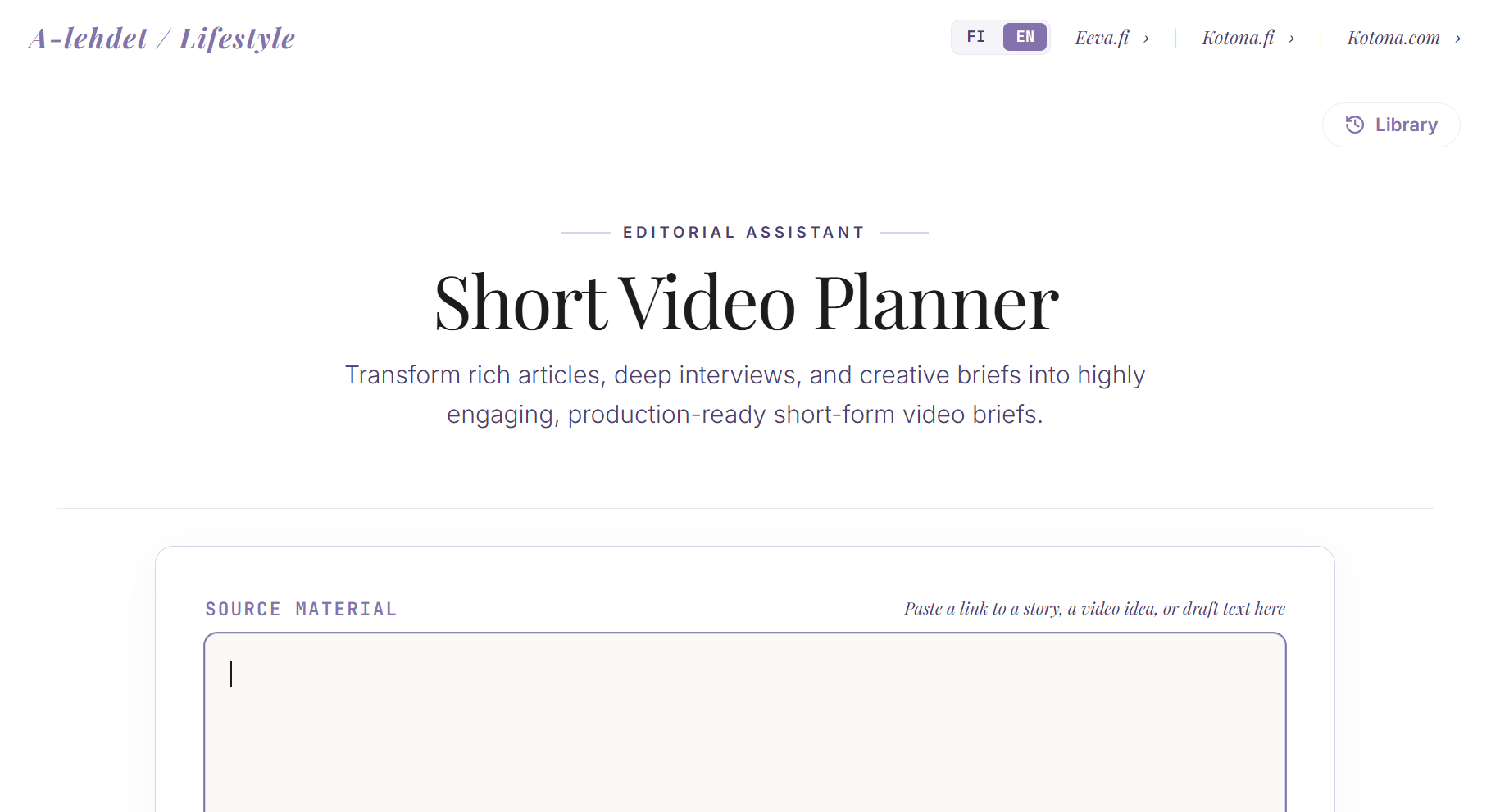
Most media companies buy expensive enterprise AI licenses, drop their journalists into a blank chat window, and wonder why nobody uses the software. Finnish media house A-lehdet took a completely different route. Instead of handing staff another generic prompt box, they built an in-house short video script creator tailored directly to how their editorial teams actually work.
That single decision changes everything about internal AI adoption. When you force writers to become prompt engineers on top of their daily deadlines, they quietly go back to their old workflows. Give them a purpose-built tool that removes the blank-page friction from short-form video, and adoption happens naturally.
Why Generic AI Chatbots Stall Inside Newsrooms
Walk into almost any publishing house right now and you'll see the same pattern. Leadership announces an AI initiative. Everyone gets access to a standard large language model. Two weeks later, usage drops off a cliff.
Here's why that happens. A blank text box demands cognitive effort before it gives you anything back. A journalist working on a tight turnaround doesn't want to spend twenty minutes tweaking system instructions just to get a decent TikTok or Instagram Reels hook. They need a repeatable workflow that already understands brand voice, pacing, and platform constraints.
Short-form video makes this problem even sharper. Writing a print or web article requires a completely different rhythm than scripting a 45-second vertical video. Print rewards nuance and structured buildup. Short video demands an immediate visual or verbal hook in the first two seconds, tight spoken sentences, and clear cues for on-screen text or b-roll.
When A-lehdet focused on an in-house short video script creator, they targeted a specific, high-friction bottleneck. Journalists already had the reporting and the core story. Turning that written reporting into punchy video scripts was the tedious part. Automating the structural translation between text and vertical video solved a real daily headache rather than chasing a vague technology trend.
The Mechanics of an Effective In-House Script Creator
Building an internal tool doesn't mean training a foundation model from scratch. Nobody in media has the budget or need for that. Instead, smart editorial teams wrap existing language models inside a structured, opinionated interface that handles the heavy lifting behind the scenes.
If you're looking at replicating what makes a custom script generator work, the architecture comes down to a few practical layers:
- Input Ingestion: Journalists paste an existing article URL, raw interview notes, or a rough draft directly into the tool without formatting it first.
- Brand and Format Guardrails: Behind the scenes, the system applies pre-tested instructions covering tone of voice, target video length, and specific brand identities across different publications.
- Structured Output: Rather than spitting out a wall of text, the tool separates spoken narration, visual cues, and on-screen captions into distinct, usable blocks.
- Rapid Iteration Controls: One-click adjustments let editors shorten the runtime, shift the angle from informative to provocative, or rewrite the opening hook without starting over.
Think about the difference in user experience. A writer goes from staring at a blinking cursor to editing three distinct script angles in less than thirty seconds. You aren't replacing editorial judgment. You're accelerating the rough-draft phase so human creators can spend their energy on delivery, filming, and fact-checking.
What Most Organizations Get Wrong About AI Adoption
Corporate leaders love talking about "AI transformation," yet they routinely ignore basic human behavior. People adopt tools that save them time today, not tools that promise abstract efficiency next quarter.
One major mistake is treating AI rollout as a training problem rather than a product design problem. Companies host endless workshops teaching employees how to write better prompts. Honestly, most staff members don't care about prompt engineering. They care about hitting their publishing targets without burning out. When you bake the prompt logic directly into an internal application, you eliminate the skill gap overnight.
Another misstep is trying to automate the entire creative process at once. If a tool tries to write the article, generate the video, pick the music, and publish the post automatically, quality tanks and journalists rightfully reject it. A-lehdet's approach works because a short video script creator keeps the human firmly in the director's chair. The software handles the structural formatting; the creator brings the personality, camera presence, and editorial accuracy.
There's also the issue of brand dilution. Media companies survive on distinct editorial voices. A lifestyle magazine shouldn't sound like a financial daily, and neither should sound like a generic internet chatbot. Custom internal tools allow product teams to hardcode those stylistic boundaries into separate templates, ensuring every script feels native to the specific publication.
Measuring Real Impact Beyond Vanity Metrics
When media executives evaluate internal AI projects, they often track the wrong numbers. Counting total logins or total prompts generated tells you almost nothing about editorial value.
What actually matters is throughput and creator confidence. Look at how many written stories successfully make the jump to short-form video compared to six months ago. Track the time elapsed between an article going live and its companion video hitting social feeds. In fast-moving news and lifestyle cycles, cutting production lag from hours down to minutes directly affects reach and engagement.
Just as important is watching who uses the tool. True adoption happens when reporters who previously avoided video production start pitching and filming short clips because the scripting barrier disappeared. That's where real organizational speed comes from—not from making your fastest video producer slightly faster, but from unlocking video output across your entire newsroom.
Limitations You Have to Plan For
No internal AI tool works out of the box forever, and pretending otherwise sets your team up for frustration.
Language nuances remain a constant hurdle, especially in markets outside English-speaking regions. For a Finnish publisher like A-lehdet, ensuring that generated scripts sound like natural, spoken Finnish rather than stiff, translated English requires continuous tuning. Spoken language uses different cadence, slang, and sentence fragments than written journalism. If the output feels robotic, presenters will spend more time rewriting the script than they would have spent writing it from scratch.
Editorial accuracy is the other non-negotiable risk. Language models love to smooth over uncertainty or invent punchy claims that aren't quite supported by the source text. Any in-house script generator needs strict instructions to stick strictly to the provided source material, paired with a culture where presenters verify every single line before hitting record.
Finally, social algorithms change constantly. A hook structure that works wonders on short-form platforms today might feel stale six months from now. Someone on your product or audience team has to own the tool post-launch, updating templates based on actual video retention data rather than leaving the software static.
How to Build Your Own Editorial Workflow Tool
You don't need a massive engineering department to put a focused script creator into your team's hands. Start small, solve one specific bottleneck, and iterate based on real newsroom feedback.
- Audit your current video bottleneck. Sit down with three journalists or social editors and watch how they currently turn a written story into a video script. Identify the exact step where momentum slows down.
- Collect your ten best-performing scripts. Pull transcripts from your highest-retention short videos. Break down their exact structure—how many words the hook uses, where the visual shifts happen, and how they close.
- Build a narrow prototype. Use an internal app builder or a lightweight custom interface connected to a reliable language model API. Restrict the inputs and outputs strictly to the script format you analyzed in step two.
- Test with skeptical editors first. Skip the AI enthusiasts and hand the prototype to your busiest, most pragmatic reporters. If it saves them fifteen minutes on a deadline, you've built something worth scaling.
- Review output monthly against retention metrics. Compare scripts generated with the tool against your platform watch-time data, then refine the underlying templates to reflect what actually holds viewer attention.
Stop buying broad software subscriptions hoping your team will figure out how to use them. Pick one repetitive creative task, build a sharp internal tool around it, and get out of your creators' way.