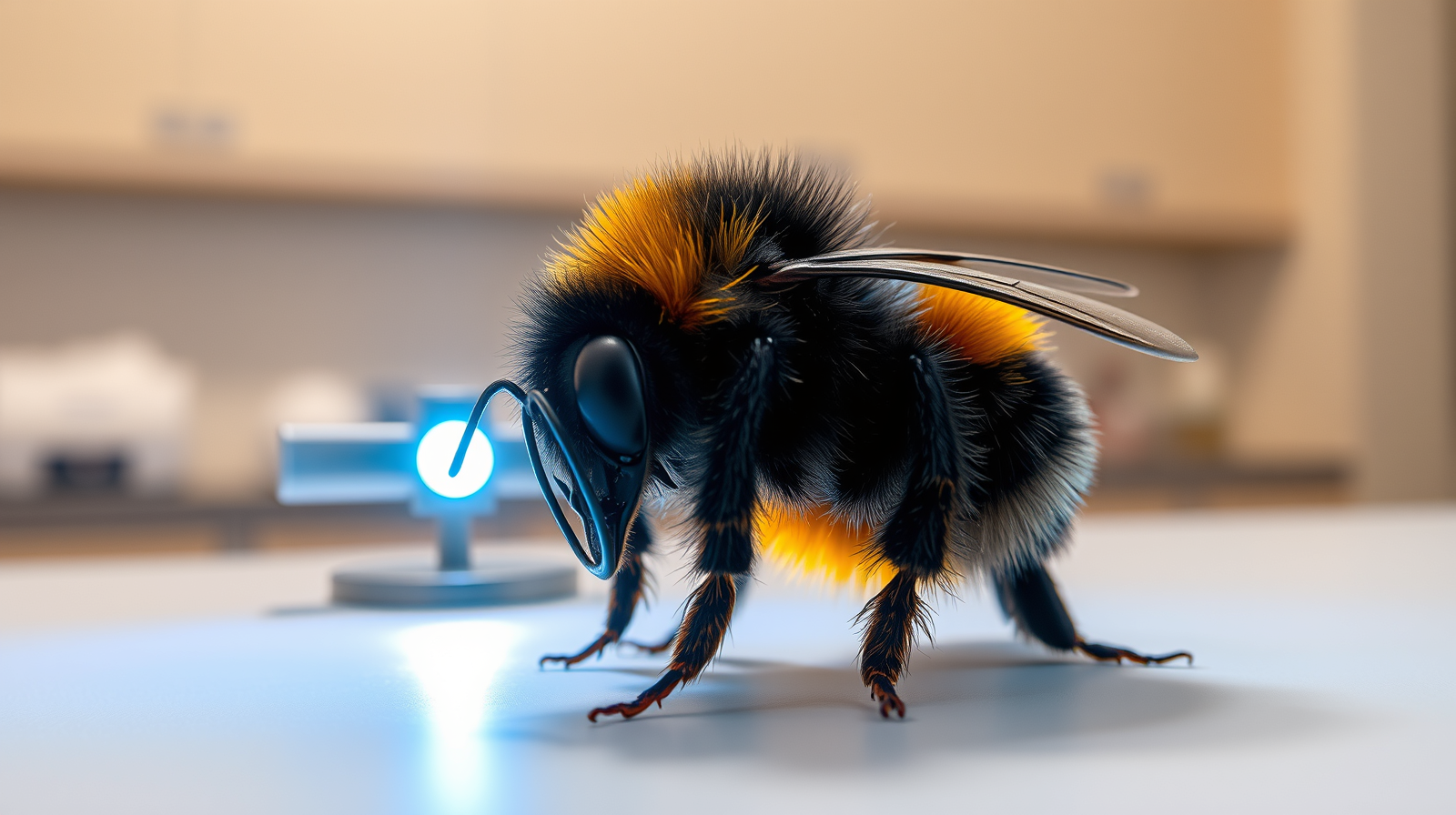
Mainstream science media loves a good anthropomorphic miracle. The latest darling of the biology clickbait circuit is the humble bumblebee, specifically its newly discovered "timing skills." Recent headlines proclaim that insects are breaking new ground, possessing cognitive abilities that baffle researchers. They paint a picture of tiny, furry mathematicians flying around with internal stopwatches, making conscious, strategic decisions about time intervals.
It is a comforting, Disney-fied view of nature. It is also fundamentally wrong.
The lazy consensus among tech-adjacent biology writers is that every time an insect does something complex, it proves a high level of cognitive awareness. They look at a bee calculating a interval between sugar rewards and immediately elevate it to human-like intellect. This is not just bad science; it completely misses the far more interesting, mechanical reality of how decentralized biological systems actually function.
We need to stop projecting human psychology onto organisms that operate on entirely different hardware. The assumption that timing requires a complex, centralized brain is a flaw in our own thinking, not a mystery of the insect world.
The Software Error in Animal Cognition
When researchers observe a bumblebee timing its visits to a flower, they tend to view it through the lens of human experience. We think of timing as a conscious act: looking at a watch, counting seconds, or feeling the passage of minutes. Therefore, when a bee shows temporal precision, commentators assume the bee is "thinking" about time.
This is a classic attribution error. I have spent years analyzing how complex systems—both computational and biological—execute high-level tasks. In the tech sector, engineers frequently build elegant, simple architectures that produce highly complex outputs. We do not look at an automated trading algorithm that executes trades at precise millisecond intervals and declare that the code is "baffled" by its own brilliance or possesses a deep understanding of time. It is running an optimization loop.
Bumblebees possess around one million neurons. For comparison, a human brain has roughly 86 billion. To suggest that a bee is using its microscopic neural real estate to consciously track, analyze, and store abstract temporal data is an insult to biological efficiency. Evolution does not waste energy on elaborate cognitive structures when a simple hardwired feedback loop will do.
The Mechanical Reality of the Insect Clock
So, how do they actually do it if they are not "baffling" the scientific community? The answer lies in biophysics, not psychology.
Organisms do not need an abstract concept of time to measure it. Time measurement in insects is largely a byproduct of metabolic decay and neural exhaustion. Think of it less like a digital stopwatch and more like an hourglass filled with sand.
- Metabolic Depletion: Flying uses an immense amount of energy. A bee’s internal state changes drastically minute by minute as it expends glycogen stores. This physiological depletion serves as a built-in sensory gauge. The bee isn't counting to sixty; its body is responding to a precise internal chemical drop that correlates with the passage of sixty seconds.
- Neural Adaptation: Neurons fire in response to stimuli, but they also habituate. The rate at which a neural circuit recovers from a stimulus is a predictable, physical constant. A bee’s nervous system can measure intervals simply through the predictable decay of neural activity following a specific trigger, like eating nectar.
Imagine a scenario where a factory assembly line has a lever that resets every time a box passes, taking exactly five seconds to return to its original position. The lever does not know what a second is. It does not have a clock. The physical properties of the spring dictate the interval. That is how a bumblebee tracks time. It is a biological spring, wound up by a stimulus and unwinding at a rate dictated by its physics.
Why the Research Community Gets This Wrong
The academic publishing industry thrives on sensationalism. A paper titled "Insect Exhibits Standard Metabolic Feedback Loop" gets zero citations. A paper framed as "Insects Demonstrate Time-Compression Skills That Defy Explanation" gets a write-up in major news outlets.
This sensationalism creates a distorted feedback loop. It encourages researchers to interpret behavioral data through a cognitive lens rather than a mechanistic one. When a bee alters its behavior based on a time interval, it is not demonstrating a "breakthrough" in insect intelligence. It is demonstrating basic operant conditioning modulated by a physical internal clock.
When we look at the work of pioneering neurobiologists like Randolf Menzel, who has spent decades mapping the honeybee brain, we find incredible complexity—but it is a structural, hardwired complexity. Menzel's work shows how miniature brains use specific, identifiable neural pathways to link sensory inputs with motor outputs. It is highly efficient routing, not abstract thought.
The real danger of the current narrative is that it blinds us to the actual genius of the insect brain: extreme efficiency.
The Cost of Cognitive Inflation
There is a downside to my contrarian view. If you accept that bees are highly optimized biological machines rather than tiny, conscious thinkers, the natural world can feel a bit more cold and mechanical. It strips away the romantic notion of animal sentience that makes for great nature documentaries.
But the trade-off is worth it because understanding the true nature of insect efficiency is the key to solving massive problems in human technology, particularly in decentralized computing and robotics.
Right now, Silicon Valley is pouring billions of dollars into massive, power-hungry artificial intelligence models. These systems require data centers using megawatts of electricity just to process basic language structures or navigate a drone through a room.
Meanwhile, a bumblebee navigates three-dimensional space, evades predators, locates resources, communicates locations, and adjusts its behavior based on temporal intervals—all while consuming a fraction of a watt of power derived from flower sugar.
If we keep insisting that the bee is doing this through complex, human-like cognitive processing, we will continue trying to replicate their abilities using massive, complex, human-like AI architectures. We will keep building bigger, heavier, more inefficient systems.
We need to study the bee for what it actually is: a masterclass in radical minimization. We need to learn how to achieve complex, adaptive behavior through simple, interconnected feedback loops rather than bloated computational layers.
Stop Asking If Bees Think
The public interest queries surrounding this research always ask the same flawed questions: "Are bees conscious?" "Do bees have a concept of the future?" "Can bees feel the passage of time?"
These questions assume that our way of interacting with the universe is the only successful blueprint. They assume that to navigate time successfully, an organism must possess a philosophical awareness of it.
Let us answer these queries honestly. No, a bee does not have a concept of the future. No, a bee does not feel the passage of time the way you do when sitting in a boring meeting.
The bee does something far more impressive. It bypasses the need for thought entirely. It interacts with time as a physical constraint, adapting its behavior through automated biological feedback loops that have been refined over millions of years of evolutionary pressure.
Stop looking for human minds inside insect bodies. The brilliance of the bumblebee isn't that its tiny brain can think like a human. It is that its tiny brain doesn't need to.