You do not ruin steaks because your thermometer took three seconds to read instead of one. You ruin steaks because you treat cooking like a passive digital transaction instead of a thermal physics problem.
Every major home-cooking site publishes the exact same recycled listicle every season. They round up seven thermometers, slap affiliate links under glossy studio photos, and promise that spending $99 on a boutique probe will finally rescue your Sunday roast from tasting like shoe leather. It is lazy, consumerist nonsense.
I spent twelve years working commercial lines and testing kitchen hardware, and I have watched home cooks drop hundreds of dollars on Bluetooth-enabled, Wi-Fi-connected, dual-sensor probes only to pull dry, gray pork chops off the grates ten minutes later. A thermometer is a diagnostic tool. Buying a more expensive stethoscope does not make you a cardiologist, and buying a faster thermocouple does not teach you how heat moves through muscle fiber.
If you want to stop overcooking dinner, stop shopping for hardware upgrades and start understanding what the numbers on that screen actually mean.
The Lie of the 1-Second Readout
The centerpiece of every "best meat thermometer" roundup is speed. Marketing departments have convinced home cooks that a 0.5-second response time is the difference between a Michelin-starred ribeye and charcoal.
It is a complete fabrication.
Unless you are working a high-volume steakhouse grill where you are temping forty strip loins in four minutes with your knuckles hovering over 700-degree coals, shaving two seconds off a temperature reading changes nothing. Your dinner does not go from medium-rare to well-done in the time it takes a $25 probe to stabilize.
What actually matters—and what listicles routinely bury beneath talk of backlit screens and magnetic backs—is probe tip diameter and thermistor placement.
Cheap thermometers use thick, blunt probes housing slow, bulky sensors. When you stab a thin piece of meat like a chicken breast or a flank steak with a thick steel rod, two things happen:
- You punch a massive hole in the muscle structure, creating an exit wound for pressurized juices.
- You suffer from thermal conduction error. The thick metal shaft acts as a heat sink, pulling heat away from the tip (or conducting ambient oven heat down into the tip), giving you a false reading unless you bury the probe two inches deep.
A quality thermometer uses a step-down tip—a needle-thin point tapered down to around 1.5 millimeters—with the sensor sitting right at the very tip. That allows you to find the exact thermal center of a thin cut without ruining its structural integrity. You do not need to spend $115 for a step-down tip. Plenty of sub-$35 units use proper Type-K thermocouples or precision thermistors that read within ±0.9°F (±0.5°C). Paying triple for a recognizable brand name buys you splash-proof housing and nicer plastics, not better thermodynamics.
Why Wireless Probes Are Mostly Expensive Toys
The hottest trend in backyard grilling right now is the completely wireless, leave-in smart probe. You shove a thick metal cylinder into a roast, pair it to your phone, and sit on the couch watching a graph climb while your app tells you when dinner is ready.
On paper, it sounds brilliant. In practice, these devices introduce massive blind spots.
First, look at the physical dimensions of a wireless probe. Because it has to house a battery, a Bluetooth transmitter, and multiple sensors inside a waterproof casing, the shaft has to be thick—often 5 to 6 millimeters wide. Shoving that into anything smaller than a whole turkey or a thick prime rib leaves a tunnel the size of a drinking straw through your meat.
Second, wireless probes encourage the worst habit in cooking: relying on a single point of data.
Meat is not uniform. A chicken breast tapers from two inches thick to a quarter-inch flat tail. A beef tenderloin has a thick center and a skinny end. Even a standard ribeye has the longissimus dorsi (the eye) and the spinalis dorsi (the cap), two distinct muscles with different fat contents that cook at different rates.
If you stick a wireless probe into a roast and walk away until your phone buzzes, you are flying blind. You have no idea if one side of your grill is running 75 degrees hotter than the other. You cannot feel the resistance of the muscle fibers—a tactile cue that experienced cooks use alongside temperature to judge collagen breakdown in tough cuts like brisket or pork shoulder.
Leave-in probes have one legitimate use case: monitoring the ambient temperature of a smoker or oven, or tracking the long, slow climb of a massive multi-pound roast so you do not have to keep opening the door and dumping heat. For everyday weeknight dinners—steaks, chops, fish fillets, chicken thighs—they are an expensive distraction.
The Real Reason Your Food Is Overcooked
If you own a functioning digital thermometer and still overcook your food, you are falling victim to two physics principles that no gadget will fix for you: carryover cooking and the time-temperature curve.
1. Ignoring Carryover Cooking
When you pull a roast out of a 400°F oven or a steak off a searing cast-iron skillet, cooking does not stop. The exterior of the meat is vastly hotter than the interior. That thermal energy continues migrating inward toward the cold center for ten to twenty minutes after the meat hits your cutting board.
Imagine a scenario where you want a medium-rare ribeye at 135°F. You stand over the stove with your shiny new instant-read thermometer, wait until the screen flashes 135.0°F, and immediately transfer the steak to a plate. Ten minutes later, you slice into it, and it is medium-well at 148°F.
You blamed the thermometer. The thermometer did its job. You failed to account for the thermal momentum already stored in the outer layers of the beef.
- Thin cuts (under 1 inch): Expect 3°F to 5°F of carryover.
- Thick steaks and chops (1.5 to 2 inches): Expect 5°F to 10°F of carryover.
- Large roasts (prime rib, whole turkey, pork loin): Expect 10°F to 15°F of carryover, sometimes more if roasted at high heat.
If you wait until the screen displays your target serving temperature, you have already lost. You must pull the meat early and let the residual heat finish the job.
2. Worshipping the USDA 165°F Chicken Myth
Nothing destroys more dinners than the blind obedience to 165°F for poultry.
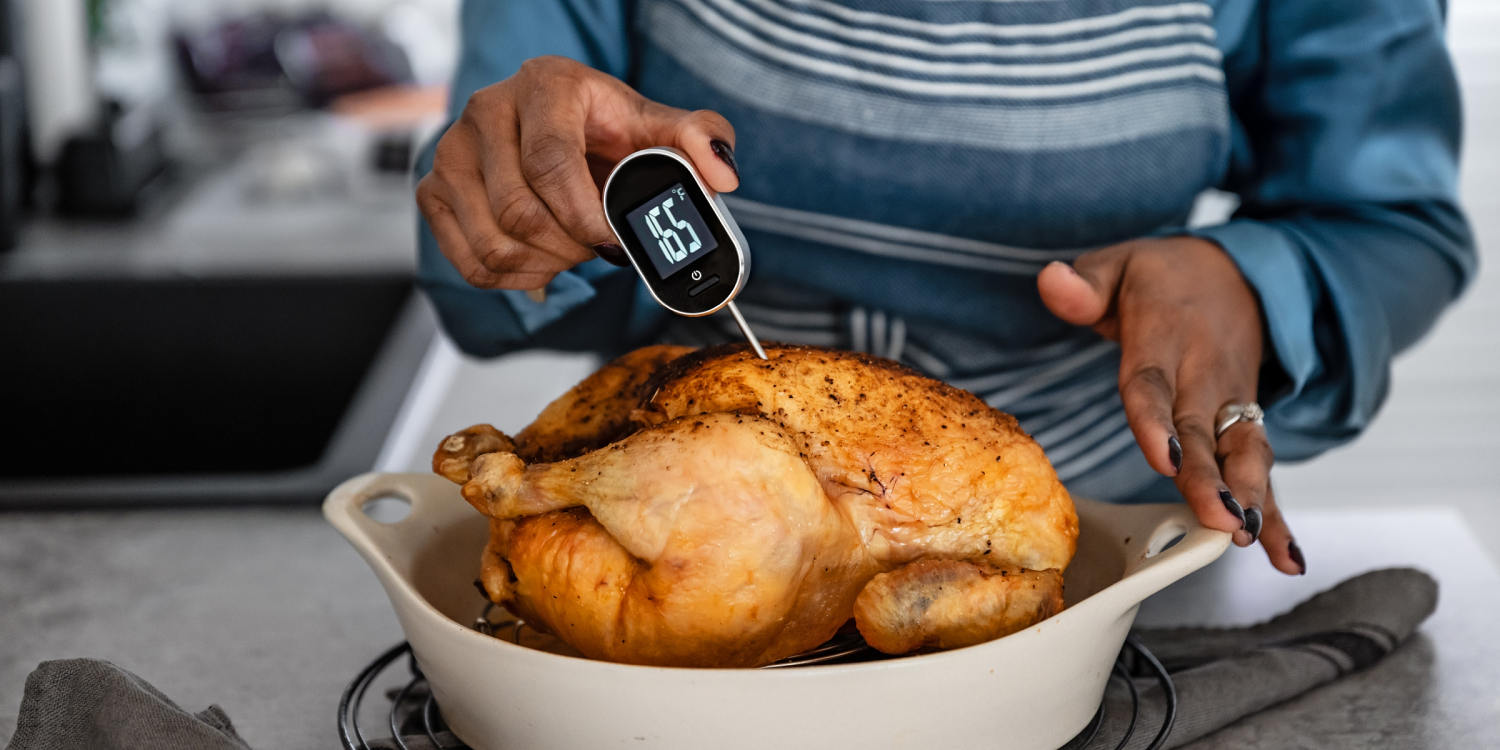
Every thermometer manual and food safety chart prints 165°F in bold letters next to chicken and turkey. Why? Because at 165°F, Salmonella bacteria are destroyed instantaneously—in less than one second. It is a foolproof, lowest-common-denominator number designed by regulators so nobody has to do math.
It is also the exact temperature where chicken breast proteins squeeze out their moisture like a wrung-out sponge, leaving you with chalky, stringy meat.
Food safety is not a single temperature threshold; it is a function of both temperature and time. According to the USDA's own pasteurization tables (the same science detailed extensively by food scientists like J. Kenji López-Alt and Douglas Baldwin), you achieve the exact same 7-log reduction in Salmonella—meaning 99.99999% bacterial death—by holding chicken at:
- 165°F for less than 1 second
- 155°F for 47.7 seconds
- 150°F for 2.8 minutes
- 145°F for 8.4 minutes
When you pull a thick chicken breast off the heat at 152°F and let it rest on the counter for five minutes, carryover heat pushes it to around 156°F–158°F, and it stays above 150°F for far longer than three minutes. It is completely, mathematically safe to eat, and it will be juicier than any chicken you have ever cooked in your life.
Your thermometer did not ruin your chicken. Following the chart printed on the side of your thermometer ruined your chicken.
Dismantling the "Best Thermometer" Questions
Search engines are flooded with anxious buyers asking the exact same questions before pulling out their credit cards. Most of these questions are built on flawed premises.
"Do I need a calibrated thermometer with a certificate?"
No. Unless you are running a commercial food production facility subject to FDA/USDA health inspections, a factory calibration certificate is meaningless vanity paper. Every thermometer drifts over time due to thermal shock and drops on tile floors. What you actually need is a glass of crushed ice topped off with cold tap water. Stir it for two minutes, stick your probe in the middle without touching the glass, and verify it reads 32°F (0°C). If it reads 34°F, either press the calibration button to zero it out or just subtract two degrees in your head. An uncalibrated thermometer that you test in ice water once a month beats a certified $120 unit that you never check.
"Which thermometer is best for thin burgers and fish?"
Stop temping thin burgers. By the time a half-inch patty hits 160°F in the center, the outside is already scorched. Use your thermometer for thick pub-style burgers (1 inch or thicker) and thick fish fillets like salmon or halibut—and stop cooking salmon to 145°F unless you enjoy scraping white albumin protein off your plate. Pull wild salmon at 120°F to 125°F and farmed salmon at 125°F to 130°F. For thin cuts, learn to use visual cues: flaking flesh on fish, clear juices and firm bounce on thin patties.
"Are infrared laser thermometers good for meat?"
Never use an infrared thermometer to check if meat is done. Infrared guns only measure surface temperature. You can point a laser at a chicken breast, get a reading of 185°F on the seared skin, and bite into raw, pink flesh in the center. Infrared thermometers belong in two places: checking the surface heat of a pizza stone or cast-iron skillet before you drop food onto it, and checking the temperature of fryer oil (provided you stir the oil first so you aren't just reading a hot surface layer).
What Actually Belongs in Your Kitchen Drawer
I am not telling you to throw your thermometer in the trash and cook by poking your palm—the "palm test" is culinary folklore that falls apart the second you switch from a lean filet mignon to a heavily marbled ribeye, because fat softens at different temperatures than lean muscle. You absolutely need a digital thermometer. You just need to stop overpaying for irrelevant features and buy the right tool for the job.
Here is the only setup you actually need:
- One fast, step-down instant-read thermometer ($25 to $40). Look for a thin 1.5mm probe tip, a rotating backlit display (vital when you are left-handed or reaching across a hot stove), an IP65 or higher water-resistance rating so you can wash it in the sink without frying the circuit board, and a user-calibration button. Skip the Bluetooth. Skip the app integration.
- One cheap wired oven probe ($20 to $30). A basic braided-steel cable connected to a magnetic base unit that sits outside your oven or smoker. Use it exclusively for large roasts, holiday turkeys, and low-and-slow barbecue where opening the oven door ruins your cooking environment. When the braided cable inevitably frays after two years of getting pinched in the oven door, buy a $10 replacement probe instead of throwing away a $130 wireless ecosystem.
The Honest Trade-Off of Ditching Smart Gear
There is a catch to abandoning smart apps and preset temperature alarms: you actually have to pay attention.
When you use a simple instant-read probe, nobody is going to send a push notification to your phone while you are watching television. You have to learn how your specific stove runs. You have to check your protein earlier than you think you should—usually around the 60% mark of the recipe's estimated cooking time—because recipe cooking times are fiction written for ovens that have never been calibrated. You have to probe multiple spots in the thickest part of the meat, not just jab it once at a random angle and hope for the best.
It requires fifteen seconds of active thought per meal.
Take the $80 you were about to waste on a flagship smart thermometer and buy two dry-aged ribeyes instead. Pull them off the heat ten degrees early, rest them on a warm plate for ten minutes, and stop blaming your tools for a lack of technique.