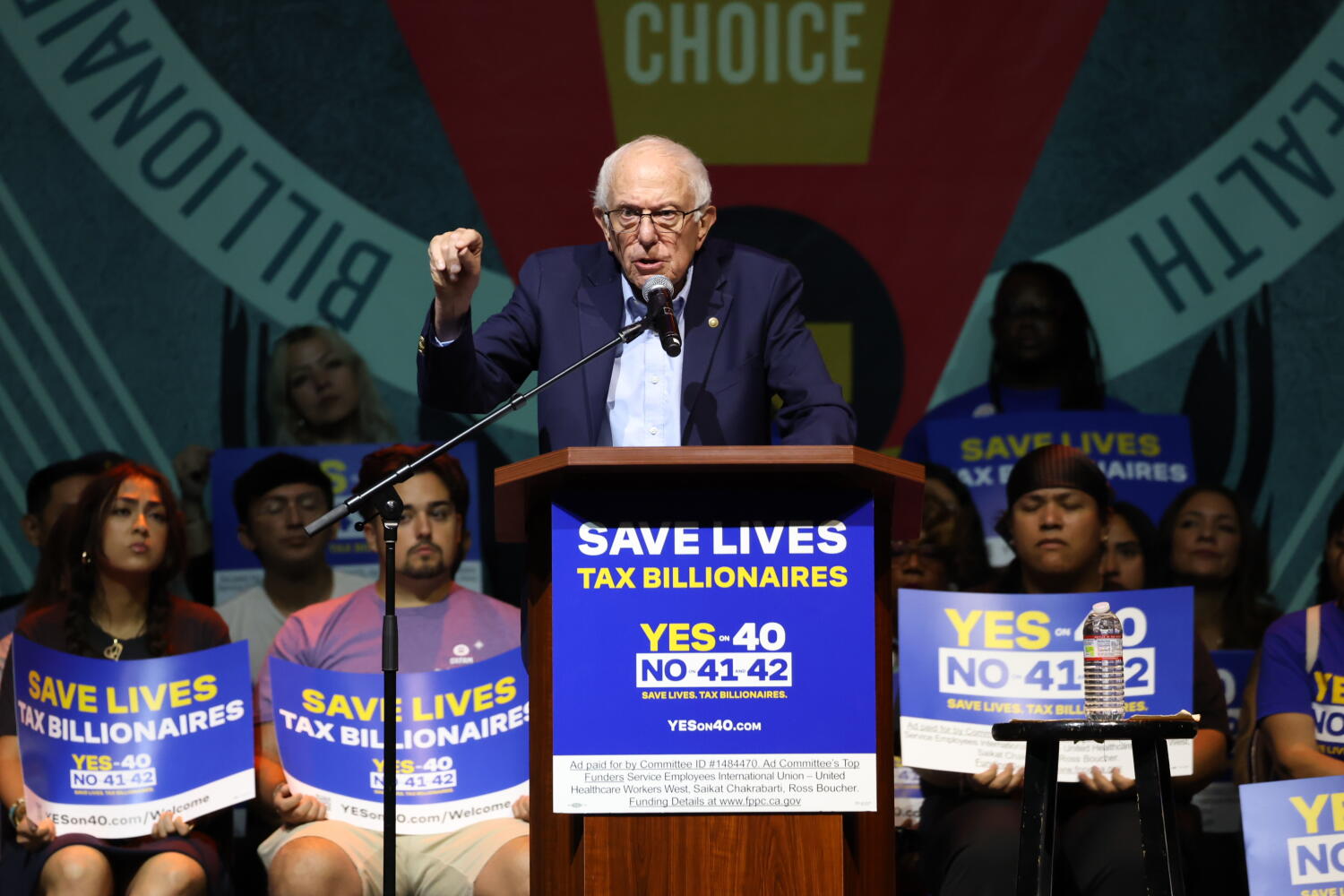
The conventional debate over a California wealth tax is stuck in a false binary. On one side, progressive lawmakers like Senator Bernie Sanders and proponents of state-level wealth taxation argue that taxing extreme net worth is the only way to address historic inequality and fund essential public infrastructure. On the other side, major labor unions—including influential California trade and service worker coalitions—warn alongside business groups that a wealth tax would trigger capital flight, collapse state tax revenues, and destroy working-class jobs.
Both sides are arguing over the surface mechanics while ignoring the structural fragility of California's existing revenue model. You might also find this similar story interesting: Mattel and the Toy Industry Reckoning Behind Investor Pressure for a Sale.
When media coverage frames this battle strictly as "Bernie Sanders versus California labor," it obscures the deeper fiscal reality. The debate is not merely about whether billionaires will pack their bags for Texas or Florida. It is about what happens when an economy built on extreme asset concentration tries to tax illiquid paper valuations in a state whose budget already rises and falls on the whims of the stock market.
The Lazy Consensus on Both Sides
Mainstream reporting usually reduces tax policy to two predictable talking points. As highlighted in latest coverage by The Wall Street Journal, the effects are widespread.
First is the moral redistribution argument, championed by Senator Sanders and economists like Emmanuel Saez and Gabriel Zucman. Their core premise is straightforward: traditional income taxes fail to capture the true economic power of the ultra-wealthy because billionaires accumulate wealth through unrealized capital gains—stocks, private equity, and real estate that appreciate without triggering a taxable event. Under this view, taxing net worth directly closes a massive loophole and forces the wealthiest households to pay a fairer share of public costs.
Second is the capital flight argument, increasingly echoed by California labor leaders who normally align with progressive Democrats. Their concern is pragmatic. California already relies heavily on its top 1% of earners for roughly 40% to 50% of its personal income tax revenue, largely driven by capital gains realizations during tech booms. Labor leaders fear that adding an annual tax on total net worth—especially one that applies to unrealized assets or follows former residents for years after they leave—will drive founders, investors, and corporate headquarters out of the state, shrinking the very tax base that funds public-sector union salaries and infrastructure projects.
Both arguments contain real economic logic. Yet both miss the fundamental flaw in how state-level wealth taxation actually interacts with modern capital markets.
Unrealized Gains Are Not Cash Registers
To understand why a state-level wealth tax creates unique distortions, you have to look at what billionaires actually own. They do not sit on vaults of liquid cash. Their net worth is overwhelmingly tied up in equity stakes—often in private, pre-IPO companies, venture funds, or concentrated founder shares in public corporations.
In corporate finance, there is a vast difference between market capitalization and liquidity.
Imagine a scenario where a Silicon Valley founder owns 15% of a late-stage private tech company valued at $10 billion on paper following a venture funding round. On paper, that founder is worth $1.5 billion. In reality, that stock cannot be easily sold on a public exchange, and dumping shares in a secondary market often triggers steep discounts or violates shareholder agreements.
If a state levies an annual 1% or 1.5% wealth tax on that $1.5 billion valuation, the founder owes $15 million to $22.5 million in cash every single year—regardless of whether the company turns a profit, pays a dividend, or loses half its valuation six months later.
Economists who study public finance, including researchers at the Tax Foundation and the Penn Wharton Budget Model, have repeatedly highlighted this valuation and liquidity problem:
- Forced Liquidation: Founders and major shareholders must sell equity annually just to pay the tax bill, diluting their voting control and putting downward pressure on company valuations.
- Valuation Arbitrage: While publicly traded stocks have clear daily prices, private businesses, commercial real estate, art, and intellectual property do not. Assessing their value annually creates an administrative nightmare, inviting endless litigation and accounting gamesmanship.
- Asymmetric Risk: If an asset surges in value one year, the state collects a massive tax. If the asset crashes the next year, the taxpayer has already paid cash out of pocket on paper gains that vanished.
This is why several European countries—including France, Germany, Sweden, and Denmark—eventually repealed their net wealth taxes between the 1990s and 2010s. According to analyses by the Organisation for Economic Co-operation and Development (OECD), these taxes proved administratively costly, distorted investment decisions, and generated far less revenue than projected because wealthy taxpayers restructured assets or relocated residency.
Why Labor Unions Broke Ranks
The most revealing development in the California debate is not what Bernie Sanders said—his support for wealth taxation has been consistent for decades. It is why powerful California labor unions publicly opposed the measure.
Historically, organized labor and progressive tax advocates have marched in lockstep. Unions depend on robust state budgets to fund public schools, healthcare systems, transit agencies, and state construction contracts. Normally, more tax revenue means stronger bargaining power for public-sector employees and more state-funded projects for building trades.
When union leaders break with progressive orthodoxy, it signals a calculation based on survival rather than ideology.
- Revenue Volatility: California's budget is notoriously boom-and-bust because it taxes capital gains as ordinary income without a preferential rate. During tech rallies, Sacramento enjoys historic surpluses; during market downturns, it faces tens of billions in deficits. Union leaders recognize that making the state even more dependent on a tiny pool of ultra-wealthy residents amplifies that volatility.
- Job Creation Mechanics: Building trades and service unions depend on private capital deployment—new data centers, commercial developments, biotech campuses, and corporate expansions. Union economists worry that if California becomes the only U.S. state with a recurring net wealth tax, institutional capital and venture formation will quietly shift toward rival hubs like Austin, Seattle, New York, or Miami.
- The Exit Tax Trap: Proposals that attempt to prevent relocation by taxing former residents for several years after they move out of California face severe constitutional challenges under the Dormant Commerce Clause and the Due Process Clause of the U.S. Constitution. Labor strategists understand that banking union wages on revenue tied up in multi-year federal court battles is a losing bet.
Answering the Wrong Question Entirely
Most voters and commentators ask: "Will billionaires leave California if we pass a wealth tax?"
That is the wrong question. You do not need a mass exodus of billionaires to damage a state economy.
In economics, marginal behavior drives outcomes. If even 5% to 10% of the state's highest-net-worth taxpayers relocate, or if the next generation of startup founders simply incorporates and establishes residency elsewhere before taking their companies public, the long-term compounding loss to the state's income tax base can exceed whatever revenue the wealth tax brings in.
Research by economists Enrico Moretti and Daniel Wilson, published in the American Economic Review, demonstrated that top earners and star inventors are measurably sensitive to state tax differentials when deciding where to locate. Even modest shifts at the very top of the income distribution carry outsized fiscal consequences because tax collections are so heavily concentrated.
At the same time, critics of the wealth tax often ignore the very real economic problem Sanders and his allies are trying to solve: the compounding concentration of untaxed capital.
Under current federal law, if a billionaire holds appreciated stock until death, their heirs receive a "step-up in basis," permanently wiping out decades of capital gains tax liability. Meanwhile, the ultra-wealthy can borrow against their stock portfolios at low interest rates to fund their lifestyles without ever selling a share or realizing taxable income.
Ignoring that structural loophole fuels public anger and guarantees that radical wealth tax proposals will keep resurfacing on state ballots.
A Smarter Path Than State-Level Wealth Taxes
If the goal is to capture revenue from extreme wealth without destabilizing California's economy or triggering constitutional gridlock, policy experts across the ideological spectrum point to far cleaner mechanisms than an annual net worth tax.
1. Federal Reform Over State Patchworks
A wealth tax—or a minimum tax on unrealized gains—cannot function effectively at the state level because capital and people move freely across state borders. As economists like Gabriel Zucman have acknowledged in their own research, enforcement is dramatically easier at the federal level, where changing tax residency requires renouncing U.S. citizenship and paying a federal exit tax.
2. Taxing Borrowing Against Unrealized Gains
Instead of trying to appraise every private company and art collection every year, lawmakers could treat large loans collateralized by appreciated stock above a high threshold (for example, $10 million or $25 million) as a taxable realization event. This directly targets the "buy, borrow, die" strategy without forcing founders to liquidate equity simply because their company's paper valuation rose.
3. Eliminating the Step-Up in Basis at Death
Reforming estate and capital gains rules so that unrealized gains are taxed upon transfer at death—with exemptions for family farms and small businesses—captures lifetime asset appreciation at a clear, single liquidity event rather than through an annual administrative guessing game.
4. Stabilizing California's Tax Base
For California specifically, fiscal economists have long recommended broadening the tax base—such as modernizing sales taxes to cover high-end services while lowering top marginal income tax rates—to smooth out the extreme boom-and-bust cycles caused by over-reliance on top-bracket capital gains.
The Real Stakes of the Debate
The clash between Bernie Sanders and California labor unions is a warning sign for progressive fiscal policy. It exposes the tension between idealistic redistribution and the practical mechanics of how state economies actually fund public services.
Taxing extreme wealth is a legitimate policy objective in an era of widening inequality. Attempting to do it through a state-level annual tax on unrealized net worth, however, introduces severe valuation distortions, liquidity traps, and revenue instability—risks that even California's largest labor unions decided they could not afford to take.