The Hydraulic Bottleneck in Salmonid Recovery
Ecological restoration projects consistently fail due to a fundamental misunderstanding of hydrological mechanics. Traditional habitat interventions often focus on static additions, such as placing individual logs or boulders into degraded waterways. These interventions treat symptoms rather than systemic root causes. When high-velocity winter flows scour spawning beds, juvenile coho salmon encounter a hydraulic bottleneck. Without structural macro-roughness to dissipate kinetic energy, fish cannot maintain position, find refuge, or secure adequate forage.
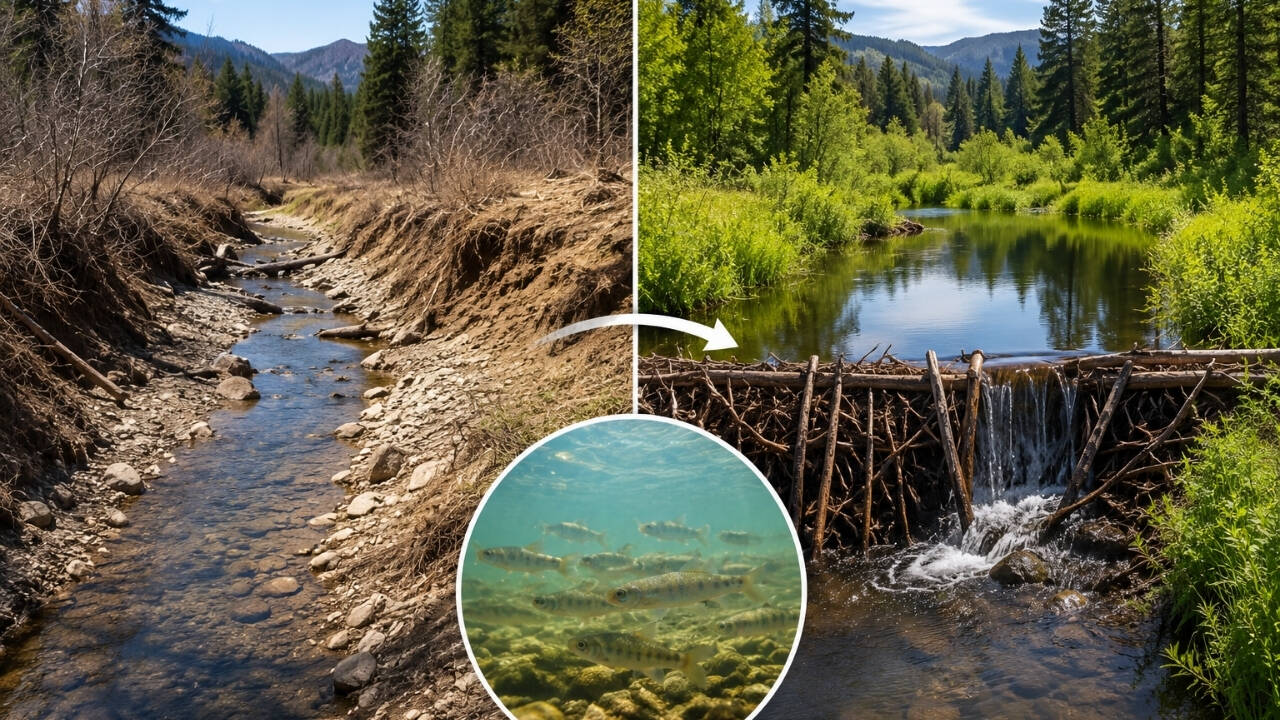
California conservation initiatives targeting endangered coho salmon populations shifted this paradigm by abandoning static placement in favor of dynamic hydraulic modification. Instead of manually constructing artificial shelters that quickly wash away, resource managers deployed beaver dam analogues. These are hand-built post-and-wattle structures designed to mimic the structural complexity and functional outcomes of natural Castor canadensis dams. You might also find this connected article insightful: Mark Carney is Not Soft on Trump He is Playing a High Stakes Bluff.
The resulting shift in survival metrics is not a minor statistical variance. Documented transitions from base survival rates hovering around eight percent up to sixty percent reveal an operational efficiency that demands a rigorous breakdown. This analysis deconstructs the structural mechanics, hydrodynamic impacts, and operational trade-offs of beaver analogue implementation in coho-bearing watersheds.
The Three Operational Pillars of Structural Stream Restoration
Restoring impaired creek architecture requires engineering interventions that replicate historic geomorphic conditions. Natural rivers possessing complex networks of side channels, wood accumulations, and multi-threaded paths have been replaced by incised, uniform channels. Beaver dam analogues counteract this degradation through three distinct operational mechanisms. As reported in detailed articles by The Washington Post, the results are significant.
1. Velocity Management and Hydraulic Refuge
During peak discharge events, juvenile coho salmon face extreme physical displacement risks. High water velocities demand high metabolic expenditure, often exceeding the swimming capacity of young fish. Analogue structures create stepped hydraulic drops. These features dissipate kinetic energy across the width of the channel rather than concentrating force on the streambed.
Behind each structure, low-velocity backwater zones and slack-water eddies form. These areas provide the necessary hydraulic refuge. Fish escape high-shear currents by utilizing marginal zones where velocity drops close to zero. This energy conservation directly correlates to the observed expansion in survival rates. Metabolic reserves are preserved for growth rather than exhausted against relentless stream power.
2. Sediment Aggradation and Bed Elevation Recovery
Incised streams suffer from a disconnected floodplain. When a channel cuts deep into its valley floor, seasonal high flows remain confined within steep banks. This prevents water from spreading onto adjacent riparian zones. Beaver analogues capture bedload sediment moving downstream. Over successive high-flow events, sediment accumulates behind the structures, raising the streambed elevation.
As the bed level rises, the base water table elevates synchronously. This forces subsurface water to upwell into side channels and historical wetlands. The restored hydrological connection transforms a dry, single-thread ditch into a complex, multi-threaded wetland complex. The wetted surface area expands, increasing the total carrying capacity of the ecosystem.
3. Thermal Buffering and Primary Productivity
Shallow, unshaded, incised streams experience severe thermal stress during summer months. High water temperatures reduce dissolved oxygen saturation and accelerate metabolic rates in salmonids. Beaver analogues increase water retention time, forming deep, slow-moving pool habitats. These pools often develop thermal stratification, providing cool-water refugia where fish can escape lethal ambient temperatures.
Furthermore, the retention of organic matter and fine sediment stimulates benthic macroinvertebrate production. Nutrient cycling shifts from an export-dominated system to a retention-dominated system. The proliferation of aquatic insects supplies the high-protein caloric intake required for juvenile salmon to achieve critical smolt size before migrating to the ocean.
Quantifying the Intervention Mechanics
To understand why survival multipliers jump from single digits to sixty percent, the baseline failure modes of degraded streams must be contrasted with the restored state.
| Metric / Variable | Degraded Stream State | Beaver Analogue Restored State | Mechanistic Driver |
|---|---|---|---|
| Hydraulic Roughness | Low; smooth banks and uniform beds | High; structural complexity and macroroughness | Post-and-wattle placement interrupting flow vectors |
| Floodplain Connectivity | Disconnected; deep incision | Connected; aggraded bed and elevated water table | Sediment retention and lateral water dispersion |
| Summer Thermal Regime | Unstable; high diurnal temperature spikes | Stable; deep pools and localized thermal stratification | Increased hydraulic retention time and hyporheic exchange |
| Predation Pressure | High; lack of structural cover and shallow water | Reduced; complex interstitial spaces and deep pools | Visual and physical obstruction for avian and mammalian predators |
The transition from the left column to the right column eliminates multiple mortality filters simultaneously. In a degraded system, juvenile coho face compounded risks: displacement during winter floods, desiccation or thermal stress during summer droughts, and high predation rates due to structural transparency. Beaver analogues act as a multi-vector mitigation tool that addresses these stressors concurrently.
Operational Constraints and Failure Modes
Despite high success metrics, beaver analogue deployment is not a universal panacea. Every ecological intervention introduces trade-offs and specific failure modes that require active management.
Structural Integrity Under Catastrophic Discharge
Post-and-wattle structures rely on wooden stakes driven into the substrate, woven with flexible branches, and sealed with organic material. During extreme flood events exceeding the design return interval, hydraulic shear stress can cause structural blowouts. When an analogue fails catastrophically, it releases a pulse of stored sediment downstream. This downstream sediment wave can temporarily smother benthic communities and spawning gravels if not properly managed through phased implementation strategies.
Upstream and Downstream Migration Barriers
While natural beavers maintain dams that allow fish passage under varying flow conditions, poorly constructed or excessively high artificial analogues can create physical barriers. If the drop height between the downstream water surface and the crest of the analogue exceeds the leaping capability of juvenile coho, population fragmentation occurs. Design specifications must incorporate stepped structures or low-flow notches to maintain longitudinal connectivity across all life stages.
Infrastructure Conflicts and Landowner Dynamics
Raising water tables and reconnecting floodplains introduces significant socio-economic externalities. Elevated groundwater levels can saturate adjacent agricultural lands, threaten rural infrastructure, and impact private property boundaries. Consequently, deployment scales are frequently limited by geopolitical and cadastral boundaries rather than biological imperatives. Strategic placement requires comprehensive hydrological modeling to predict the exact extent of groundwater mounding before installation.
Strategic Implementation Framework
Executing watershed-scale restoration using beaver analogues demands a shift from opportunistic trial-and-error to systematic, data-driven deployment. Practitioners must sequence their operations across distinct developmental phases.
- Hydrological Mapping: Initiate with LiDAR-derived topographic data to identify historic channel incision depths and target reaches with low gradient profiles optimal for sediment retention.
- Geomorphic Sizing: Calculate expected peak discharge rates to determine the required structural density and anchoring depth of post-and-wattle arrays, preventing premature structural failure.
- Biological Monitoring: Establish pre-intervention baseline metrics using PIT telemetry to track individual juvenile growth rates, movement patterns, and thermal refuge utilization before and after construction.
- Adaptive Maintenance: Implement an annual post-winter inspection protocol to repair minor breaches, adjust notch heights for optimal fish passage, and clear debris jams that threaten adjacent infrastructure.
The transformation of coho survival rates from critical lows to resilient highs demonstrates that ecological recovery depends on mimicking fundamental ecosystem engineers. By substituting static engineering with dynamic, process-based analogues, resource managers can rebuild the structural complexity required to sustain wild salmonid populations in the face of climatic volatility.
Resource Allocation Priority Matrix
- High-Gradient Confluences: Target mainstem-tributary junctions where sediment supply is high and structural placement yields immediate hydraulic diversity.
- Thermal Hotspots: Prioritize reaches exhibiting chronic summer temperature exceedances for deep pool excavation via analogue-induced scour.
- Upstream Spawning Reaches: Secure lower-velocity nursery habitats immediately downstream of primary spawning grounds to intercept emerging fry during high-energy spring runoff events.


