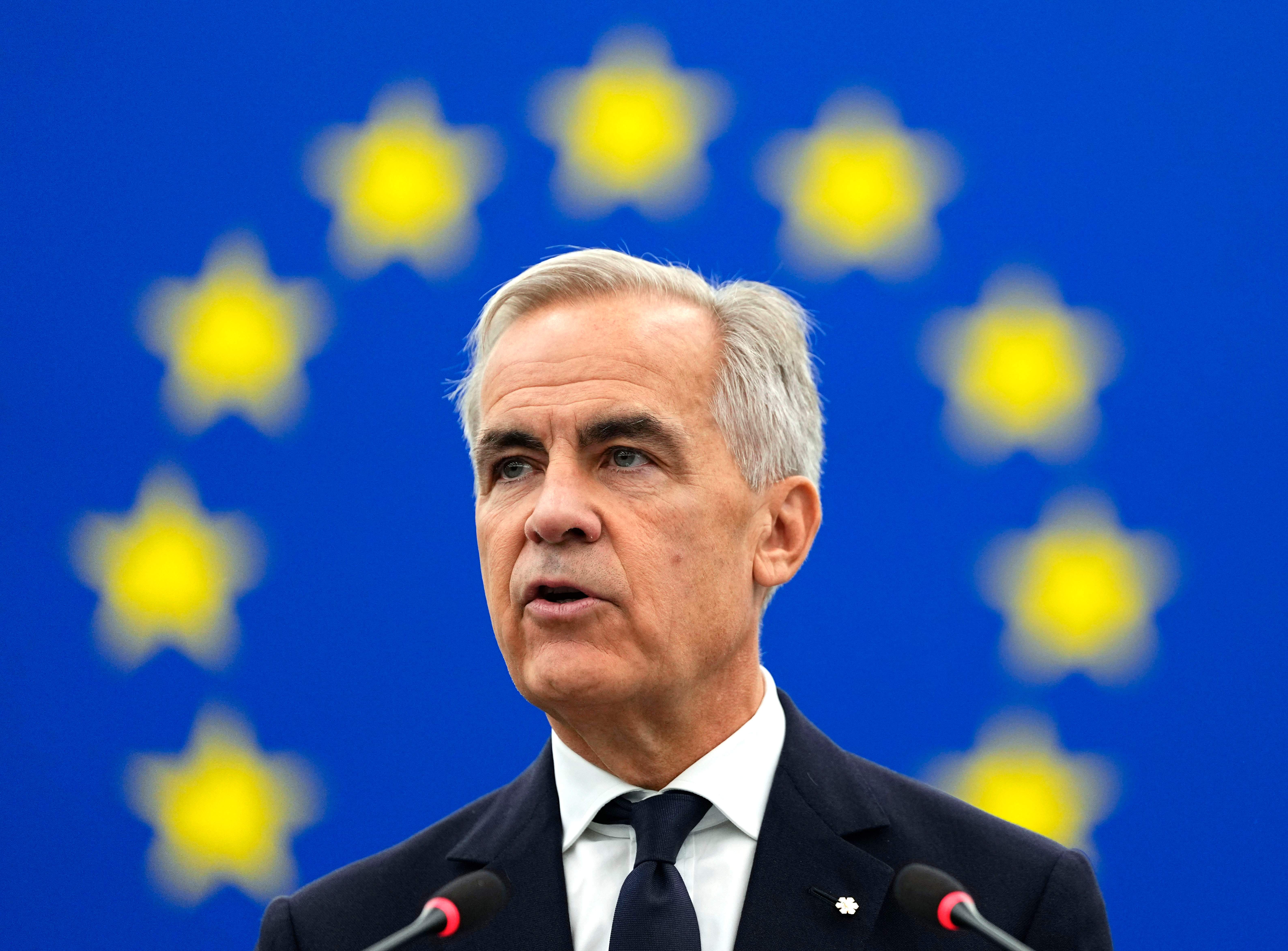
Canada and the European Union are launching formal negotiations to deepen economic, defense, and strategic ties, a move announced by Prime Minister Mark Carney ahead of the upcoming Canada-EU summit. While official statements frame this as a routine diplomatic upgrade, the reality is far sharper. Ottawa is actively scrambling to build an economic lifeboat after years of acute trade vulnerability to Washington, and Brussels is looking for a reliable, resource-rich partner that doesn't rewrite trade rules every four years.
This isn't a polite diplomatic handshake. It is an urgent exercise in geopolitical risk management.
For decades, Canada operated under a comfortable geographic assumption. Being parked next to the world's largest consumer market meant effortless trade flows, integrated supply chains, and an implied security umbrella. You didn't need to look across the Atlantic when your best customer lived right across the street. That era is dead. Punitive tariffs, protectionist industrial subsidies like the U.S. Inflation Reduction Act, and the constant threat of trade disruption have forced Ottawa to confront a brutal truth about over-reliance on a single neighbor. Roughly three-quarters of Canadian exports still head south, leaving the entire national economy exposed to the political whims of Capitol Hill.
Mark Carney, having spent years running both the Bank of Canada and the Bank of England, understands institutional risk better than most politicians. He knows you do not hedge a massive concentrated position by making speeches. You hedge it by signing binding bilateral agreements with other major economic blocs.
The Unfinished Business of CETA
To understand what these new formal talks actually mean, you have to look at why the last big attempt fell short. In 2017, Canada and the EU provisionally implemented the Comprehensive Economic and Trade Agreement, known as CETA. On paper, it eliminated 98 percent of tariffs between the two jurisdictions. Politicians celebrated it as a historic breakthrough.
In practice, CETA remains an incomplete project. Nearly a decade later, roughly a third of EU member states have still failed to ratify the deal in their national parliaments. Why? Because domestic European politics—specifically agricultural lobbies in countries like France and Ireland, alongside skepticism over investor-state dispute settlement mechanisms—stalled the process. Without full ratification, key investment protections remain frozen, and regulatory friction continues to choke off smaller exporters.
Trade volume between Canada and the EU did grow after 2017, crossing the €75 billion mark in goods and services, yet it never fundamentally altered Canada's trade dependency. Canadian businesses quickly realized that removing a tariff at the border means very little if a European regulator refuses to recognize Canadian safety certifications, technical standards, or professional credentials.
The upcoming summit talks are designed to break through those non-tariff barriers. Carney and European leadership are aiming to move past basic tariff elimination toward regulatory alignment, mutual recognition of standards, and deeper integration in sectors that barely existed as strategic priorities when CETA was drafted in the early 2010s.
Critical Minerals and the Energy Squeeze
Follow the money, and you quickly see what Brussels actually wants from Ottawa. Europe has an existential resource problem. Following Russia's invasion of Ukraine, the EU abruptly severed its dependence on cheap Russian pipeline gas, triggering an industrial energy crisis that is still hollowing out European manufacturing. At the same time, Europe's aggressive green transition targets require massive quantities of lithium, cobalt, nickel, copper, and rare earth elements.
Currently, China dominates the processing and refining of almost all of those materials. Brussels is desperate to break that stranglehold before its automotive and clean-tech industries become permanently dependent on Beijing.
Canada has the rocks. What it lacks is the infrastructure to get them out of the ground, refine them, and ship them across the Atlantic at a competitive price.
- Permitting bottlenecks in Canada routinely stretch mine development timelines to 10 or 15 years, far too slow for European automakers facing immediate supply deadlines.
- Processing capacity remains heavily skewed toward sending raw ore to Asia rather than refining it domestically for European buyers.
- Port and rail infrastructure on Canada's east coast was built for a different era of trade, lacking the specialized bulk-handling capacity required for massive transatlantic mineral exports.
If the formal talks at the Canada-EU summit produce concrete results, expect them to center on joint financing mechanisms. European sovereign wealth funds, development banks, and industrial giants want to inject direct capital into Canadian mining and processing projects in exchange for guaranteed long-term off-take agreements. Ottawa gets the capital it desperately needs to build out its northern supply chains; Brussels gets secure, democratically sourced raw materials.
The Liquefied Natural Gas Standoff
Energy remains the most awkward elephant in the room during any Canada-EU negotiation. When European leaders visited Ottawa in 2022 begging for liquefied natural gas to replace Russian supplies, they were famously told there was "no business case" for building east coast LNG export terminals.
That dismissal left a bitter taste in Berlin and Brussels. Since then, Europe has spent billions building import terminals and signing long-term gas contracts with the United States and Qatar. While the immediate panic over winter heating has subsided, European industrial energy prices remain structurally higher than American ones. As Carney enters formal talks, European negotiators will almost certainly push Canada to reconsider its rigid stance on conventional energy infrastructure, or at least accelerate the timeline for clean hydrogen exports—a sector where eastern Canada has massive wind power potential, even if the commercial economics of shipping hydrogen across an ocean remain deeply unproven.
Defense Procurement and the Arctic Reality
Trade deals rarely survive on commerce alone anymore. Security is now the glue holding economic alliances together, and this is where the Canada-EU talks take a sharp turn away from traditional trade policy.
For years, Canada has been the laggard of NATO, chronically failing to meet the alliance's benchmark of spending two percent of GDP on defense. Washington has lost patience with Ottawa's free-riding, and European allies—many of whom are rapidly rearming in response to Russian aggression—view Canada's military underinvestment with growing frustration.
Simultaneously, the EU is building its own defense industrial base through initiatives like the European Defence Industrial Strategy. Brussels wants European tax dollars spent on European weapons, not funneled exclusively to American defense contractors. For Canada, this creates both a threat and an opening.
If Ottawa wants to modernize its aging military hardware—from submarines to artillery and cyber-defense systems—without becoming entirely beholden to the Pentagon, joining European defense procurement frameworks is the logical move. Formalizing closer defense-industrial ties at the summit would allow Canadian aerospace and tech firms to bid on European defense contracts, while giving Canada access to joint European military R&D.
The geopolitical focal point of this security cooperation is the Arctic. As polar ice melts, new shipping lanes are opening up, and both Russia and China are aggressively expanding their Arctic presence. Canada claims sovereignty over the Northwest Passage, a claim the United States has historically refused to recognize, arguing it is an international strait. Europe, facing direct Russian militarization in the High North, shares Canada's acute interest in Arctic surveillance, icebreaker capacity, and northern infrastructure. Aligning with the EU gives Ottawa a powerful diplomatic counterweight in the Arctic that doesn't rely solely on Washington's goodwill.
Digital Sovereignty and AI Governance
Beyond mines and militaries, a quiet regulatory war is reshaping global technology, and Canada is caught right in the middle.
The European Union has positioned itself as the world's regulatory superpower through the AI Act, the Digital Markets Act, and strict data privacy laws under GDPR. Brussels believes that by setting the strictest rules for artificial intelligence, data governance, and platform accountability, it can force global tech companies to adopt European standards everywhere—a phenomenon known as the Brussels Effect.
Canada has attempted to walk a tightrope. On one hand, Ottawa introduced its own Artificial Intelligence and Data Act to mirror European safeguards and ensure Canadian companies maintain "data adequacy" status with the EU, which allows personal data to flow freely between Canadian and European servers without costly legal workarounds. On the other hand, Canada's tech sector is deeply integrated with Silicon Valley, where American venture capitalists and tech giants view European-style regulation as an innovation killer.
Formalizing closer ties with the EU forces Canada to pick a lane. Deeper alignment with Brussels means adopting stricter compliance regimes for Canadian AI startups and digital firms. The payoff is seamless access to a market of 450 million affluent consumers and participation in massive European research grants like Horizon Europe, which Canada formally joined to give its universities and researchers access to nearly €100 billion in funding. The risk is suffocating domestic tech firms under a mountain of European-style red tape while their American competitors race ahead unregulated.
The Structural Flaws Nobody Wants to Admit
Veteran trade negotiators know that grand announcements at international summits frequently collide with ugly domestic realities. While Mark Carney brings immense credibility to the table, several structural obstacles threaten to bog down these formal talks before they yield tangible economic relief.
First, provincial trade barriers inside Canada remain absurdly high. It is often easier for a winery in British Columbia or a construction firm in Ontario to do business with a foreign country than with a neighboring Canadian province. European negotiators have repeatedly pointed out the hypocrisy of Ottawa demanding open access to the European single market while failing to maintain a true single market within its own borders. Brussels will inevitably demand that Canadian provinces open up public procurement and professional licensing as a condition for deeper EU concessions. In Canada's decentralized federation, forcing premiers to give up local protectionism is political suicide.
Second, Europe is distracted and divided. The EU is not a monolith; it is a fragile coalition of 27 nations wrestling with sluggish economic growth, surging right-wing populism, the ongoing war in Ukraine, and fierce internal debates over agricultural subsidies and green mandates. When France faces angry farmers blocking highways with tractors, trade concessions to Canadian beef and grain producers immediately go into the deep freeze. Furthermore, any new agreement that touches upon investment courts or national competencies will once again trigger the nightmare scenario of requiring ratification by dozens of national and regional parliaments across Europe—a process where a single regional assembly, like Belgium's Wallonia in 2016, can hold an entire transatlantic deal hostage.
Third, geography still matters. You cannot repeal the laws of physics or shipping logistics. Moving a shipping container from Montreal to Rotterdam takes roughly a week across the North Atlantic, incurring fuel costs, port fees, and maritime insurance. Moving a truck from Windsor to Detroit takes twenty minutes across a bridge. No amount of diplomatic goodwill or regulatory harmonization can make Europe as frictionless a trading partner for Canada as the United States. At best, the EU can serve as a vital secondary market and a strategic buffer—it cannot replace the American consumer.
What Actually Happens Next
If you strip away the diplomatic pageantry, the success of these formal talks will come down to boring, technical execution rather than sweeping new treaties. Nobody in Ottawa or Brussels has the appetite for another decade-long mega-trade negotiation that gets stuck in parliamentary limbo.
Instead, watch for targeted, sector-specific executive agreements that bypass full ratification hurdles. Look for mutual recognition agreements on engineering, architecture, and pharmaceutical manufacturing—deals that allow a drug approved in Toronto to be sold in Frankfurt without duplicate clinical trials. Watch for bilateral critical mineral financing packages backed by state-owned development banks, and concrete joint procurement contracts for Arctic surveillance drones and naval components.
Carney is betting that by locking Canada into the European regulatory and industrial orbit, he can insulate the Canadian economy from the erratic protectionism of North American politics. It is a calculated, necessary gamble, yet it carries a steep price tag in regulatory complexity and political friction at home. Ottawa is finally realizing that in a fractured global economy, having only one major customer isn't a strategy—it's a single point of failure.