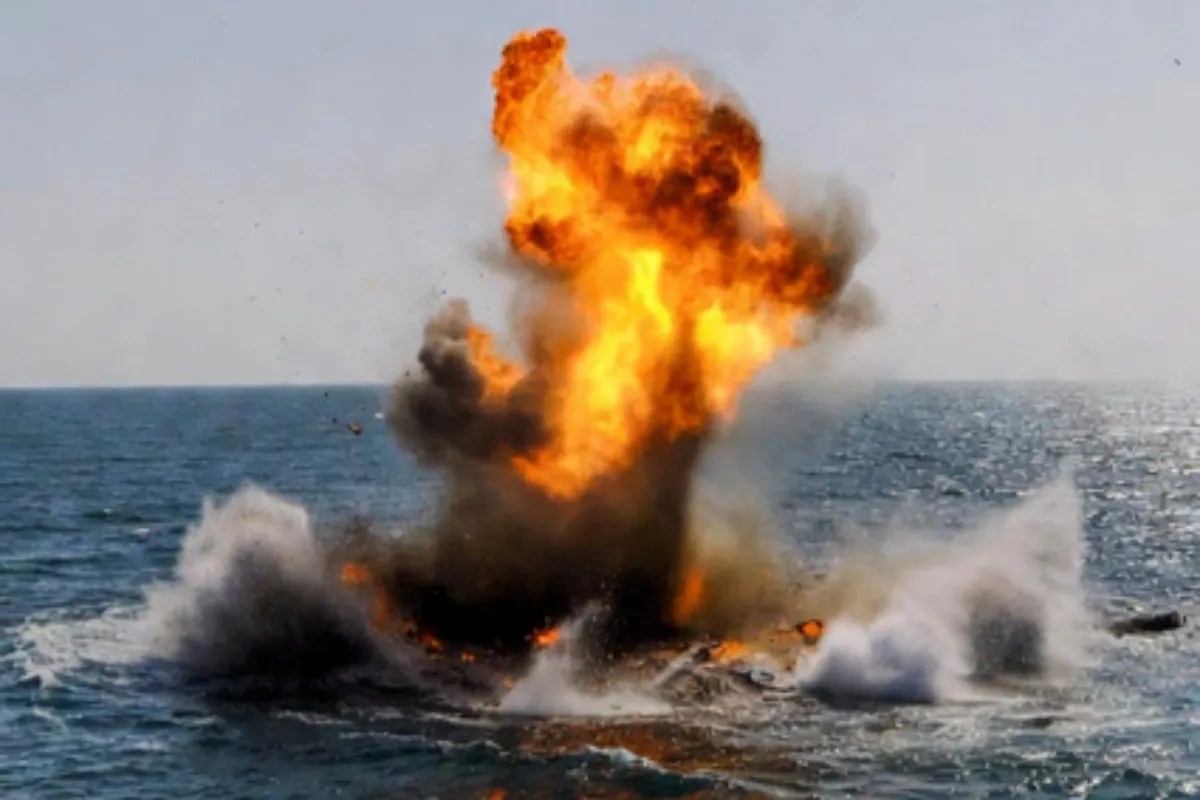
The reported Israeli strike on Russian-Iranian logistics hubs within the Caspian Sea basin marks the collapse of the "sanctuary status" of the International North-South Transport Corridor (INSTC). For decades, the Caspian was viewed by Moscow and Tehran as a friction-less rear area, geographically insulated from Western or Israeli kinetic reach. By introducing precision-guided munitions into this theater, Israel has not merely struck a hardware shipment; it has fundamentally altered the risk-premium of the entire Russo-Iranian defense integration project.
The strategic shift is defined by the transition from "containment at the destination" (interdicting weapons in Syria or Lebanon) to "disruption at the source." This move targets the logistical nexus where Russian Su-35 components, Iranian Shahed-series loitering munitions, and ballistic missile technologies are exchanged.
The Triad of Logistical Vulnerability
To understand why the Caspian has become a focal point, one must categorize the supply chain into three distinct operational pillars. Each pillar represents a specific failure point that Israel is now exploiting.
1. The Maritime Blind Spot
The Caspian Sea operates under a unique legal framework established by the 2018 Convention on the Legal Status of the Caspian Sea, which explicitly bars the presence of non-littoral armed forces. This created a sense of "maritime immunity." Russia and Iran leveraged this to move sensitive military cargo via "dark" vessels—ships that disable their Automatic Identification Systems (AIS) to obscure port calls. The recent kinetic activity proves that electronic obfuscation is no longer a defense against high-altitude surveillance and long-range strike capabilities.
2. The Transshipment Bottleneck
Logistics experts identify the Astrakhan-Makhachkala-Anzali triangle as a critical bottleneck. Cargo must be moved from rail to sea and back to rail. These transshipment points are stationary, high-value targets. Unlike a convoy in the Syrian desert, a port facility cannot be hidden. By targeting the infrastructure of the supply line rather than just the vessels, the aggressor creates a compounding delay in the delivery of critical components needed for the Ukraine theater or the Levant.
3. The Technology Asymmetry
There is a widening gap between the Soviet-era air defense systems protecting Caspian ports and the fifth-generation standoff capabilities employed by Israel. The inability of S-300 or local electronic warfare suites to intercept these strikes suggests a systemic failure in the "Integrated Air Defense System" (IADS) of the region.
The Cost Function of Persistent Interdiction
Every missile fired into the Caspian basin increases the "Cost of Coordination" for Russia and Iran. This cost is not measured solely in rubles or rials, but in three specific variables:
- Insurance and Risk Premiums: Commercial vessels previously used for "dual-use" cargo will now face prohibitive insurance costs or outright refusal of service, forcing the state to rely exclusively on overstretched military hulls.
- Temporal Decay: Modern warfare relies on "Just-in-Time" (JIT) delivery of microelectronics and propulsion units. Interruption of the Caspian flow forces a reversion to slower, overland routes through the Caucasus, which are politically volatile and geographically restrictive.
- Diplomatic Friction: The Caspian involves three other littoral states (Azerbaijan, Kazakhstan, and Turkmenistan). Kinetic activity in their "backyard" forces these nations to recalibrate their neutrality, often tilting away from Moscow to avoid secondary sanctions or collateral damage.
The Mechanics of Standoff Projection
A strike in the Caspian Sea requires solving a complex geometric and political equation. From Israeli airspace to the Caspian port of Anzali is approximately 1,500 kilometers. Executing this requires either long-range air-launched cruise missiles (ALCMs) or the use of forward-operating bases in neighboring territories.
The technical requirement for such a mission involves:
- Stealth Entry: Navigating through or around multiple sovereign airspaces without triggering early warning radars.
- Mid-Course Correction: Utilizing satellite-linked guidance to adjust for the movement of mobile launchers or ships within the harbor.
- Terminal Precision: Ensuring the warhead strikes the specific warehouse or container without damaging civilian infrastructure, thereby minimizing the diplomatic fallout.
This is not a "blind" strike; it is a data-heavy operation that suggests deep intelligence penetration of the Iranian Ministry of Defense and Logistics (MODAFL).
The Erosion of Strategic Depth
For Russia, the Caspian was the last "safe" route to bypass the Bosporus and the European land bridge. For Iran, it was the primary artery for the "Look East" policy. The degradation of this route leaves both powers with few alternatives. The alternative—the terrestrial route through Armenia and Georgia—is increasingly blocked by Western diplomatic pressure and the shifting allegiances of the South Caucasus.
The strike signals that "strategic depth" is an obsolete concept in an era of satellite-cued, long-range precision strikes. Distance no longer equals security.
The Structural Realignment of the Middle East
The expansion of the conflict theater to the Caspian Sea reflects a broader geopolitical reality: the "Shadow War" is no longer localized to the borders of Israel. It has merged with the Great Power competition involving the North Atlantic Treaty Organization (NATO) and the Russo-Chinese axis.
As Iran provides the "mass" (thousands of low-cost drones) and Russia provides the "sophistication" (advanced air defense and cyber tools), Israel’s strategy has evolved into a "Systems-Level Sabotage." By hitting the Caspian nodes, Israel is effectively contributing to the degradation of Russian capabilities in Europe while simultaneously weakening Iranian proxies in the Middle East.
The Kinetic Forecast
The operational logic suggests that these strikes are not a one-off event but the beginning of a "Caspian Attrition" campaign. The goal is to make the INSTC economically and militarily unviable for high-value defense transfers.
The next phase of this escalation will likely move toward the "Industrial Sabotage" of the port facilities themselves. If the ports of Enzeli (Iran) or Astrakhan (Russia) are rendered inoperable through kinetic or cyber means, the entire $25 billion investment in the North-South corridor becomes a stranded asset.
Strategic planners must now account for the fact that any point of convergence between Russian and Iranian military interests is a legitimate and reachable target. The "sanctuary of the North" has been permanently dissolved.
Maintain focus on the hardening of alternative routes through Central Asia; if the Caspian is contested, the burden shifts to the rail networks of Turkmenistan and Uzbekistan. Monitor these nodes for similar patterns of logistical friction or "unexplained" technical failures. This is the new geography of the conflict.