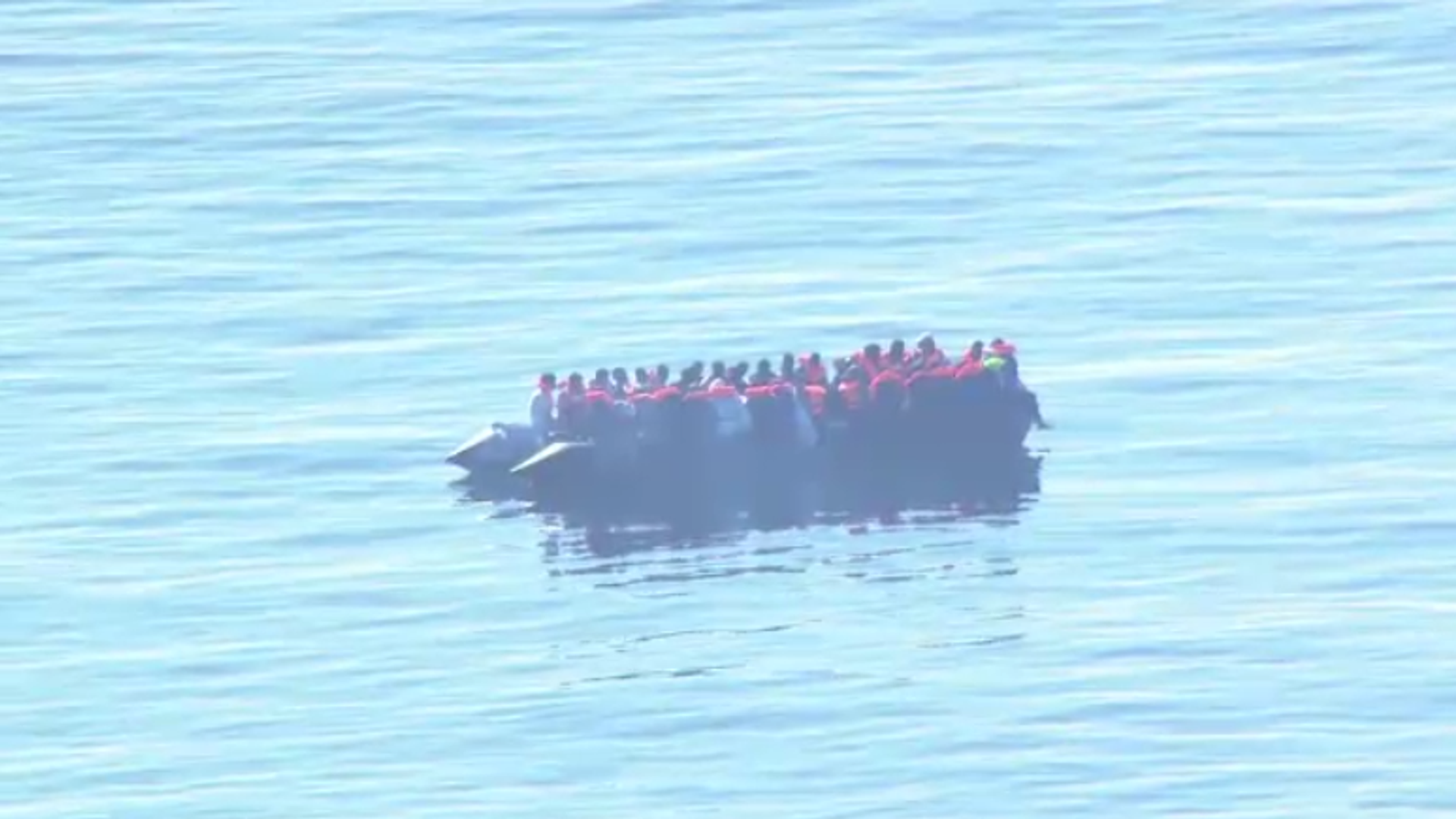
A migrant dinghy drifting across the English Channel for more than twenty-three hours is not an anomaly of maritime misfortune. It is the predictable outcome of an industrial-scale smuggling apparatus that turns rubber tubes, faulty outboard motors, and human desperation into a high-stakes, multi-million-euro enterprise. When a vessel remains at sea for nearly a full day, enduring freezing temperatures, shifting tides, and international shipping lanes, it exposes the brutal mechanics of an irregular transit network operating with impunity along the northern coast of France.
For years, public debate has ossified into a polarized shouting match between border enforcement hawks and humanitarian advocates. Both sides routinely miss the structural reality. The small boat phenomenon is sustained by organized supply chains, porous border enforcement, and an economic model where demand vastly outstrips any deterrent policy devised in Westminster or Paris.
The Logistics of the Launchpad
To understand why a dinghy stays at sea for twenty-three hours, one must look inland to the clandestine depots scattered across northern France. These are not improvised operations run by amateurs. They function as transnational franchises managed by decentralized syndicates with deep roots across Europe, the Middle East, and East Africa.
The equipment tells the story. Cheap, unbranded PVC dinghies imported in bulk from East Asian manufacturing hubs arrive via container ports, stripped of branding and shipped inland. Chinese-made outboard engines, typically lacking the horsepower or reliability required for open marine navigation in the English Channel, are procured through shell companies and distributed to stash houses near Calais and Dunkirk.
Smugglers treat human cargo as perishable inventory. Profit margins depend on minimizing overhead while maximizing passenger volume per crossing. A standard rubber raft, designed safely for perhaps eight recreational users, is routinely crammed with fifty to seventy individuals. Life jackets are frequently substandard—cheap foam blocks wrapped in nylon that offer minimal buoyancy in freezing water, sold to desperate travelers at inflated markups as mandatory safety gear.
The timing of these departures is dictated less by weather forecasts and more by police patrols. When French security forces increase presence on a specific stretch of beach, smugglers simply shift launch sites eastward toward Gravelines or westward toward the cliffs of Cap Blanc-Nez. The twenty-three-hour drift often begins not with a bold voyage, but with a botched launch where the engine fails within minutes of leaving the shoreline, leaving the vessel at the mercy of opposing tidal streams.
The Enforcement Paradox
Governments love simplistic solutions because they photograph well. Deterrence campaigns, naval patrol increases, and multi-million-pound bilateral funding packages promise absolute control. Yet, the physics of maritime law enforcement render these measures largely symbolic.
Under international maritime law, the overriding obligation for any vessel or aircraft encountering a craft in distress is rescue. Smugglers know this rule intimately and exploit it as a core component of their business model. They calculate that once a boat clears the surf zone and enters international waters or the UK search-and-rescue zone, interception by a border force cutter or a commercial vessel is virtually guaranteed.
This creates a perverse incentive structure. The crossing does not need to be seaworthy enough to reach a British port under its own power. It merely needs to stay afloat long enough to trigger a rescue operation. The smugglers outsource the final, most dangerous leg of the journey to the very state authorities tasked with stopping them.
Financial penalties and asset freezes against supply networks have proven similarly porous. Syndicate leaders rarely touch the cash directly. Payments are funneled through underground hawala networks, cryptocurrency transactions, or complex peer-to-peer transfers spanning multiple jurisdictions. By the time law enforcement tracks a payment from a family member in London or Germany to a handler in Istanbul, the digital trail has splintered into dozens of dead ends.
The Human Cost of Policy Inertia
Behind the geopolitical rhetoric and naval statistics lie the human choices that fuel this trade. Most individuals paying thousands of euros for a seat in an unseaworthy dinghy are fully aware of the mortality risks. They have survived protracted conflicts, economic devastation in state-collapsed regions, or prolonged detention in transit countries like Libya and Sudan.
For them, a twenty-three-hour ordeal on the Channel is calculated risk management. The alternative—remaining in legal limbo across Europe under the Dublin Regulation, facing indefinite asylum backlogs or deportation threats—presents a worse horizon than the gamble of the water.
European asylum systems are buckling under administrative backlogs, creating an invisible magnet for irregular crossings. When legal pathways are choked by years of bureaucratic delay and hostile political rhetoric, black-market operators fill the vacuum with immediate, albeit lethal, alternatives.
Breaking the Cycle
If policymakers genuinely want to dismantle the small boat trade, the playbook of muscular rhetoric and tactical enforcement at sea must be abandoned for systemic structural reform.
First, law enforcement agencies must pivot away from chasing individual rubber boats on the water and target the financial and supply choke points on land. Shutting down the importation channels for uncertified outboard motors and industrial-grade inflatable hulls starves the syndicates of their physical infrastructure.
Second, processing centers must be established outside destination borders—regional hubs where legitimate asylum claims can be evaluated swiftly, transparently, and safely before individuals ever reach the northern French coastline. As long as irregular entry remains the only viable path to a fair hearing, smugglers will continue to find willing customers.
Third, maritime authorities need a unified intelligence framework that shares real-time data across borders, tracking the movement of organized crime syndicates rather than reacting to individual distress calls after they occur.
Until these structural realities are confronted honestly, dinghies will continue to drift for twenty-three hours in the dark, caught between the failure of international policy and the resilience of human desperation.