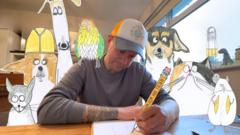
The success of Phil Heckels—operating under the pseudonym "Hercule Van Wolfwinkle"—in raising over £500,000 for the charity Turning Tides demonstrates a rare specimen of market-driven irony. While the narrative is often framed as a "feel-good" human interest story, the underlying mechanism is a sophisticated intersection of digital virality, philanthropic gamification, and the deliberate subversion of aesthetic value. This £500,000 figure is not merely a donation total; it is the result of a precise economic phenomenon where the "negative value" of a product (intentionally poor art) generates a disproportionate emotional ROI for the consumer.
The Mechanism of Value Inversion
In traditional art markets, value is derived from technical proficiency, scarcity, and historical provenance. Heckels inverted this model by commodifying unskilled labor. The "rubbish" nature of the pet portraits removes the barrier of pretension, creating a low-friction entry point for donors.
The value proposition shifts from the physical object to the participation in a collective joke.
- The Frictionless Donation Funnel: By utilizing social media platforms to display the "bad" art, Heckels created a high-velocity feedback loop. Each "bad" drawing serves as a micro-advertisement for the cause.
- The Scarcity of Attention vs. Output: While the drawings are technically easy to produce, the artist’s time is the limiting factor. This creates a backlog of demand that transforms a simple request into an exclusive digital asset.
- The Counter-Signal: Owning a "Hercule Van Wolfwinkle" portrait signals that the owner possesses both a sense of humor and a charitable disposition. It is a form of social signaling that rejects the elitism of the traditional art world while retaining the status associated with philanthropy.
The Revenue Structure of Viral Philanthropy
The transition from a single joke to a £500,000 capital raise requires a scalable operational model. Heckels moved beyond simple direct donations to a multi-tiered revenue strategy.
- Direct Commission Donations: The primary driver where users donate to Turning Tides in exchange for a "shitty" portrait. This operates on a pay-what-you-want model, which often results in higher average contributions than a fixed-price model due to the social pressure of public altruism.
- Merchandising and Licensing: The translation of digital "bad art" into physical goods (calendars, books, clothing) introduces a traditional retail revenue stream. This provides a tangible product for those who may not want a custom drawing but wish to support the brand.
- Corporate Matching and Gift Aid: The £500,000 milestone is bolstered by tax-efficient giving mechanisms like Gift Aid in the UK, which adds 25% to eligible donations. Corporate sponsors often "piggyback" on high-visibility viral movements to fulfill Corporate Social Responsibility (CSR) quotas, providing lump-sum injections that accelerate the total.
Psychological Triggers of the "Bad Art" Economy
The success of this campaign rests on three psychological pillars that traditional charity appeals often fail to activate.
I. The Benign Violation Theory
Humor occurs when something is perceived as a "violation" (in this case, the violation of artistic standards) but is simultaneously "benign" (it is for a good cause and features cute pets). The cognitive dissonance between the earnestness of a pet owner and the absurdity of the resulting drawing triggers a dopamine response that encourages social sharing.
II. The Democratic Aesthetic
High art is exclusionary. By labeling his work "rubbish," Heckels removes the fear of judgment. Donors are not "buying art"; they are "buying in" to a community. This inclusivity expands the donor base from traditional philanthropists to a mass-market demographic.
III. Radical Transparency
The "No-Frills" nature of the operation creates a perception of high trust. Because the artist isn't pretending to be a professional, there is an implicit assumption that the operation is authentic and the funds are directed appropriately. The lack of polished marketing materials—ironically—acts as a trust signal.
Structural Bottlenecks and Scalability Limits
Despite the impressive £500,000 figure, this model faces inherent "Scaling Decay." The very thing that makes it successful—the personal touch of the artist's specific brand of "badness"—is the primary bottleneck.
- Artist Burnout: Unlike a traditional business, the "product" cannot be outsourced without losing the brand's core identity. If Heckels hired other "bad" artists, the authenticity of the "Hercule" persona would be diluted.
- Novelty Saturation: Viral philanthropy typically follows a standard decay curve. As the "bad art" becomes ubiquitous, the irony fades, and the "violation" becomes expected rather than surprising.
- Platform Dependency: The campaign relies heavily on the algorithms of social media giants. A shift in how "charity content" is prioritized can result in a sudden collapse of the donation funnel.
Strategic Optimization of the "Rubbish" Model
To sustain the £500,000 momentum and push toward a seven-figure target, the operation must transition from a personality-driven project to a decentralized movement. This involves shifting the focus from the artist to the methodology.
The second phase of such a campaign should focus on "The Democratization of Bad Art." By encouraging others to create and "sell" their own intentionally poor art for the same cause, the campaign can overcome the production bottleneck. This transforms the artist from a sole producer into a curator or "Chief Incompetence Officer."
The primary risk in this transition is the loss of quality control over the "badness." If the art becomes too good, it loses the irony; if it becomes too lazy, it loses the charm. The sweet spot of "sincerely bad" is difficult to replicate at scale.
Future Implications for Charitable Fundraising
The Heckels case study suggests that the future of fundraising lies in Value-Added Absurdity. Charities can no longer rely solely on guilt or empathy; they must compete in the attention economy.
The "Hercule" model proves that:
- Low-Fidelity is High-Trust: In an era of AI-generated perfection, human-generated "rubbish" has a premium value.
- Irony as a Currency: Humor is a more effective long-term engagement tool than tragedy for certain demographics.
- Community-Driven Validation: The social proof of a pet portrait being shared by a peer is more powerful than a celebrity endorsement.
The terminal state of this campaign will not be determined by the artist's ability to draw, but by the charity's ability to integrate this influx of unconventional donors into their long-term donor retention funnel. Once the joke ends, the relationship with the donor must be transitioned from "funny" to "functional."
The strategic imperative now is to leverage the £500,000 "social proof" to secure institutional partnerships that can provide a permanent endowment for Turning Tides. The "rubbish" art was the hook; the data-driven proof of a massive, engaged, and empathetic audience is the real asset.