The Strait of Hormuz is currently a powder charge with a very short fuse, and everyone expects Beijing to reach for the fire extinguisher. But if you're looking for China to suddenly become the world’s policeman or pick a definitive side between Donald Trump and the Iranian leadership, you’re going to be disappointed. Beijing isn't playing that game. They’re playing a much longer, much more calculated game of survival and energy security that makes the Western "with us or against us" binary look like checkers.
Right now, the situation is grim. Following the collapse of peace talks in Islamabad this April, the US has moved to enforce a maritime blockade. It's a move aimed squarely at Tehran’s jugular, but the shrapnel is hitting Beijing. China relies on this tiny strip of water for roughly 40-50% of its crude oil imports. If the Strait closes or becomes a permanent no-go zone, the Chinese economy doesn't just slow down; it hits a wall. Yet, despite the massive stakes, President Xi Jinping is keeping his cards remarkably close to his chest.
The Oil Math That Keeps Beijing Awake
China’s relationship with Iran isn't about shared ideology or some grand anti-Western brotherhood. It’s about the math. Specifically, the math of 1.38 million barrels of Iranian crude per day that China was pulling in last year. Most of this oil travels through a "dark fleet" of tankers that ignore US sanctions, often rebranding the cargo as "Malaysian" or "Middle Eastern" to get it into Chinese ports.
For a long time, this was a win-win. Iran got a lifeline, and China got discounted oil that lowered its domestic production costs. But the 2026 crisis changed the risk profile.
- The Supply Shock: In March alone, Chinese crude imports dropped nearly 3% as the Gulf turmoil started biting.
- The LNG Problem: It’s not just oil. Nearly a third of China’s Liquified Natural Gas (LNG) comes through Hormuz. You can’t just swap out a specialized LNG tanker for a train from Russia overnight.
- The Stockpile Buffer: Here’s where China has a hidden hand. Beijing has spent years building a massive Strategic Petroleum Reserve. They’re currently sitting on about 1.39 billion barrels. That’s enough to keep the lights on for 120 days even if every ship in the Strait stopped moving tomorrow.
Balancing Trump and the Ayatollahs
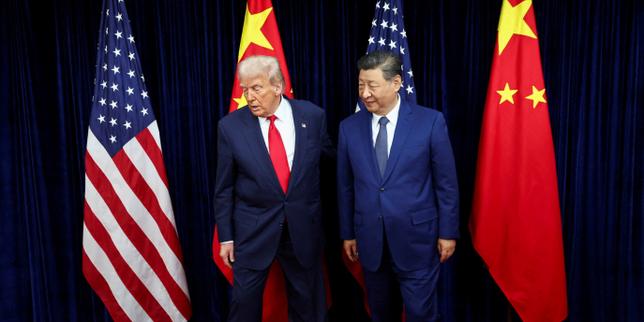
Donald Trump is betting that by choking Iranian exports, he can force Beijing to do his dirty work. The logic in Washington is simple: if China feels the pain of the blockade, they’ll lean on Tehran to cave. But Trump is also trying to play the "peacekeeper" role, occasionally crediting Chinese diplomacy for ceasefires to keep the door open for his own trade negotiations with Xi later this year.
China’s response is a masterclass in diplomatic gymnastics. On one hand, Chinese state media and UN delegations blast US-Israeli military actions as "lacking legitimacy". They’ve even signed a 25-year Comprehensive Strategic Partnership with Iran, promising up to $400 billion in investment. On the other hand, they aren't lifting a finger to physically challenge the US Navy.
Why? Because China’s trade with the rest of the Gulf—Saudi Arabia, the UAE, and Iraq—is actually much larger than its trade with Iran. If Beijing goes "all in" on Iran, they risk alienating the very countries that provide the other 40% of their energy. They need the region stable, not just the Iranian regime safe.
The Proxy Peacekeeper Strategy
Instead of joining the blockade or defying it with warships, China is positioning itself as the "rational" alternative to American "maximum pressure". By backing mediation efforts in Pakistan and pushing for a return to the "Five-Point Initiative," Beijing is telling the world: "The US brings the bombs, we bring the table".
There’s a cynical side to this, too. Some analysts argue that Beijing is perfectly happy to see the US bogged down in another Middle Eastern quagmire. Every hour the US Navy spends policing the Gulf of Oman is an hour they aren't focused on the South China Sea or Taiwan.
What Actually Happens Next
If you’re waiting for a dramatic resolution, don't. We're likely heading into a period of "controlled conflict" where the price of oil stays structurally high for months.
For China, the playbook is clear:
- Tap the Reserves: Expect Beijing to start drawing down its 1.39 billion-barrel stockpile rather than confronting the US blockade directly.
- Push the Yuan: Watch for Iran to start demanding payment in Chinese Yuan for what little oil does get through, or as a condition for future transit. This would be a massive win for the internationalization of the Renminbi.
- Double Down on Land Routes: The failure of the sea lanes will accelerate China’s push for overland pipelines through Russia and Central Asia, though those won't be ready to pick up the slack until at least 2027.
Don't expect Beijing to save the day or ruin it. They'll continue to issue statements about "restraint" while quietly filling their tanks and waiting for the US election cycle to move the goalposts again. If you're an investor or a business reliant on global energy prices, the "Hormuz Premium" is the new reality. Start diversifying your energy sources now, because the Strait isn't becoming "safe" anytime soon.