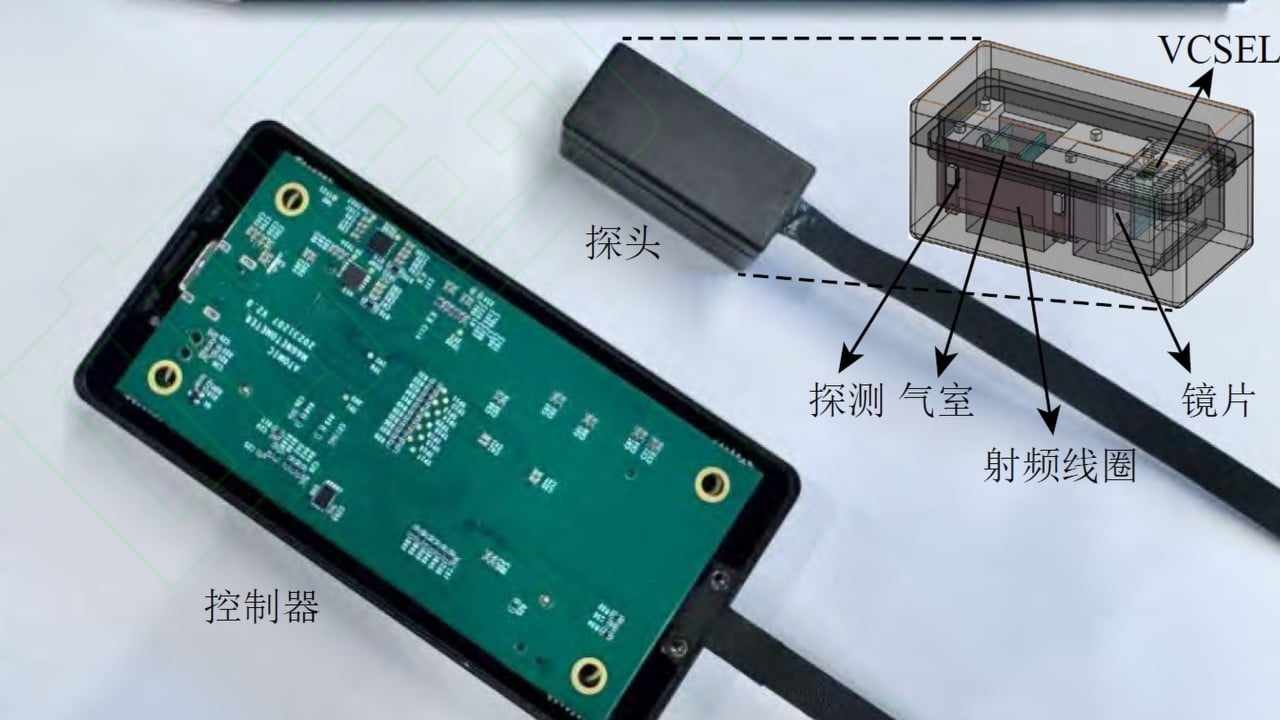
You might think stealth is about hiding from radar or absorbing sound waves in the deep ocean. But heavy metal leaves fingerprints. Massive chunks of iron moving through the earth create ripples in the local magnetic field that are almost impossible to hide. Recently, researchers in China demonstrated just how sensitive modern magnetic sensors have become by taking a device originally engineered to hunt submarines and using it to track an underground subway train from the surface.
It sounds like science fiction. It is actually raw physics meeting extreme engineering.
When you stand above a subway tunnel, tons of steel are hurtling past beneath your feet. That train isn't just making noise and shaking the ground. It is warping the ambient magnetic field of the Earth. Every railcar, motor, and chassis acts like a moving distortion. Most magnetometers used in everyday electronics are way too weak to notice. They get drowned out by urban noise, power lines, and passing cars.
Military-grade sensors operate in an entirely different league. These instruments use ultra-sensitive magnetic anomaly detection principles. They measure minute fluctuations in flux density down to fractions of a nanotesla. When researchers pointed this submarine-hunting hardware at a civilian transit line, they didn't just get a fuzzy reading. They tracked the train's exact position, speed, and acceleration profile in real time.
The Physics of Detecting Invisible Steel
Earth has a massive magnetic field. It guides compasses and protects the planet from solar radiation. Anything made of ferromagnetic material disrupts this field. A submarine cruising through the Pacific displaces water and creates a localized magnetic shadow because its steel hull interacts with Earth's lines of flux.
Detecting that shadow requires overcoming massive noise. The ocean isn't quiet magnetically. Waves move salt water, which conducts electricity and generates its own secondary magnetic fields. Minerals in the seabed create static anomalies. To find a sub, engineers built sensors that filter out background chatter with absurd precision.
When you scale that technology down into a handheld unit, you create a tool that reacts to any major concentration of iron or steel. A subway train is essentially a long, loud, moving iron bar. As it accelerates, brakes, and rolls down the track, it produces a dynamic magnetic signature. The handheld sensor reads these shifts instantly. You don't need line of sight. You don't need cameras. You just need to listen to the magnetic echoes bouncing through the earth.
Why Submarine Detectors Work Underground
People often assume that solid earth and concrete block electromagnetic signals. They block radio frequencies and light, sure. Magnetic fields behave differently. Low-frequency magnetic fields pass right through soil, rock, and concrete as if they were air.
This is why the experiment worked so well. The subway tunnel provided no acoustic barrier to the magnetic flux generated by the train's massive electric traction motors and steel body. The earth above the tunnel acted as a transparent window for magnetic lines of force.
Think about how defense contractors design anti-submarine warfare gear. They mount high-end magnetometers on maritime patrol aircraft or tow them behind ships. The goal is spotting minute distortions miles away in the open ocean. Adapting that same sensitivity for terrestrial use means you can pick up vehicles, trains, or even large underground infrastructure without digging a single hole or attaching sensors to the tracks.
The breakthrough isn't just that the sensor detected metal. Metal detectors have existed for a century. The breakthrough lies in resolution and range. The device isolates the specific magnetic signature of the train from thousands of ambient distractions. It separates the signal of a moving train from parked cars on the street above, overhead power grids, and local geological anomalies.
The Real World Implications Beyond Transit Tracking
Tracking a subway train proves a point. It shows that portable magnetic anomaly detection has reached a level of maturity that changes how we map the subterranean world.
Think about urban planning and infrastructure monitoring. Engineers spend billions inspecting tunnels, pipelines, and hidden underground spaces. Traditional methods require physical access, ground-penetrating radar, or seismic imaging. These techniques take time and disrupt traffic. A high-precision handheld detector opens up new diagnostic workflows. You can walk down a city street and map underground assets or detect structural stress changes in buried steel reinforcement without ever breaking asphalt.
On the defense side, the implications are stark. Submarines rely heavily on stealth. They coat their hulls in special anechoic tiles to absorb sonar pings. They quiet their reactor pumps to avoid acoustic detection. But a nuclear-powered attack submarine or a diesel-electric sub still contains thousands of tons of steel moving through the water. Magnetic signatures remain one of the hardest things for a submarine to completely zero out. If handheld or easily deployable sensors can track a subway train with this level of fidelity, military surveillance is getting a lot harder to evade.
Limitations and Obstacles Engineers Still Field Test
Before you picture every soldier carrying a wand that can scan through mountains, remember the real world is messy. Physics imposes strict limits.
Urban environments are an electromagnetic nightmare. Every building has rebar. Every tram line, electric vehicle, and utility cable pumps alternating currents into the ground. These sources create massive interference fields that can easily blind sensitive instruments. Filtering out a subway train works because a train is massive and moves in a predictable pattern. Picking out smaller, stationary, or distant objects in a busy city remains an uphill battle.
Power consumption is another major hurdle. Ultra-sensitive quantum magnetometers or cryogenic sensors require complex cooling or massive battery banks. Shrinking them into a truly portable handheld form factor means balancing sensitivity with power limits and weight. You can't lug a liquid helium rig down a hiking trail or patrol route.
Calibration is also brutal. Earth's magnetic field isn't uniform. It shifts based on solar activity, local geology, and mineral deposits. A sensor calibrated in one region might register false positives or lose sensitivity somewhere else unless it constantly recalibrates against baseline noise.
What This Means for Future Sensor Development
The demonstration with the subway train signals a shift in sensor technology. We are moving past the era where heavy, room-sized equipment was required for high-resolution geophysical sensing.
As material science improves and quantum sensors become more stable at room temperature, portable detection devices will only get sharper. We will likely see these tools become standard gear for geological surveys, search and rescue operations, and security applications.
You don't need to look at this through a purely military lens. The ability to read invisible forces beneath our feet gives us X-ray vision for the modern city. Whether it's mapping old utility lines, monitoring structural integrity in transit systems, or tracking movement where traditional cameras cannot see, magnetic sensing is stepping out of the specialized laboratory and into the field.
The next time you ride a subway underground, remember that you are riding inside a massive moving magnet. And somewhere above you, technology is watching your invisible wake.