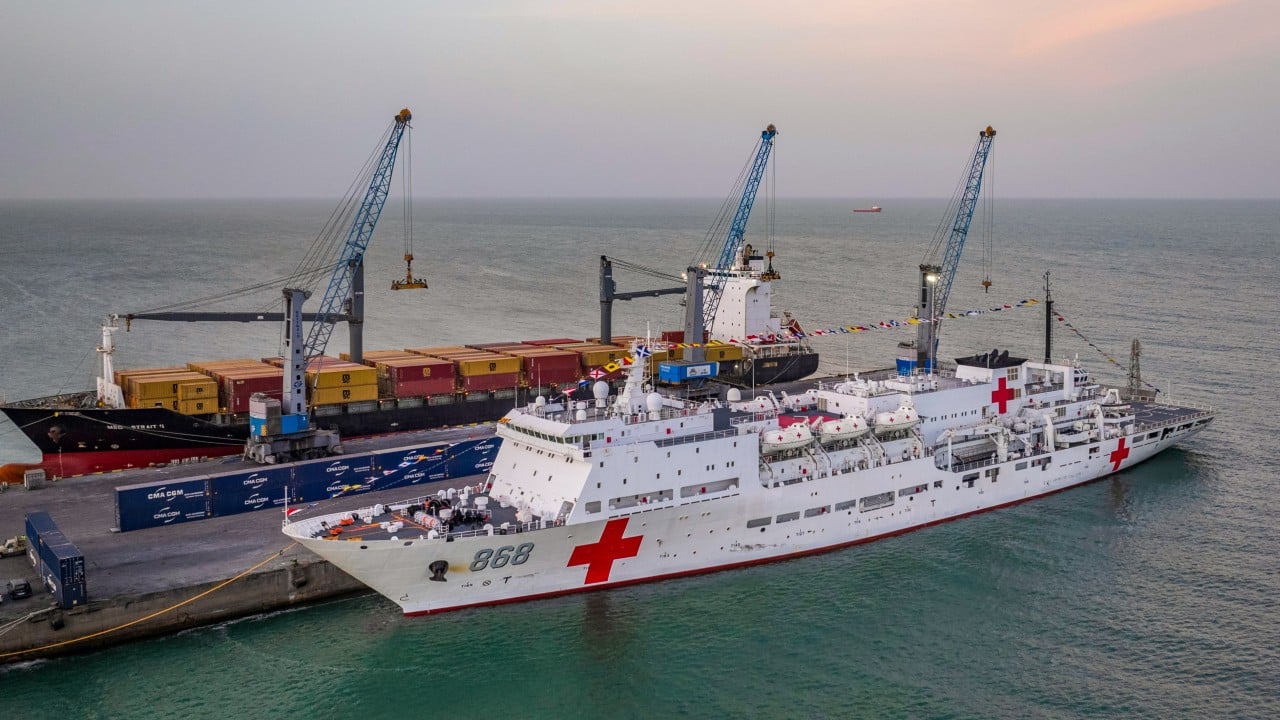
Call a hospital ship a strategic masterstroke if you want lazy clicks. Call it what it actually is: an expensive floating photo-op that does almost nothing to secure Beijing's real interests in Africa.
Every time a white-hulled vessel pulls into a port on the continent, analysts rush to declare a grand health diplomacy triumph. Soft power! Hearts and minds! Long-term geopolitical dominance via cataract surgeries and dental cleanings! It makes for tidy headlines. It also confuses theater with power.
I have spent years watching governments and corporations burn budgets on high-visibility gestures while ignoring the boring, brutal mechanics that actually move capital, cargo, and political alignment. People love a neat story. A floating clinic fits right into the neatest story of all: aid buys allegiance.
Except aid rarely buys allegiance on its own. And a ship that stays in port for a week or two before steaming away for months on end cannot build durable institutional influence. If you think a medical deployment is the engine of China's strategic mission in Africa, you are looking at the hood ornament and calling it the drivetrain.
The Lazy Consensus Around Medical Diplomacy
The standard commentary goes something like this: Beijing sends a hospital ship to coastal African states, treats hundreds or thousands of patients free of charge, poses with local officials, and walks away with goodwill that translates into diplomatic backing at the United Nations, port access, or mining concessions.
That argument sounds plausible until you test it against how statecraft and commercial infrastructure actually work.
Goodwill is perishable. A patient whose hernia gets repaired or whose teeth get scaled feels grateful in the moment. A health minister who cuts a ribbon on a pier feels a brief boost in public visibility. Neither of those events rewires a country's sovereign debt structure, customs administration, railway gauge, energy grid, or defense procurement pipeline.
Even on public health itself, episodic visits from a single ship have narrow structural reach. National health systems live or die on supply chains, primary care clinics, trained local clinicians, cold-chain logistics, and recurring budgets. A visiting vessel brings surgical capacity and goodwill, not permanent primary care infrastructure across a province of ten million people.
Calling that a cornerstone of grand strategy overstates what a ship can do and understates what actually anchors influence on the ground.
Soft Power Without Structural Lock-In Is Cheap PR
Political scientists and defense commentators use "soft power" so loosely that the term has lost its edge. Joseph Nye coined the phrase to describe the ability to get others to want the outcomes you want through attraction and persuasion rather than coercion or payment.
Attraction is real. Nobody hates getting free medical care. Still, attraction without structural lock-in is fragile. Governments change. Public attention shifts within weeks. Rival powers show up with competing offers, emergency loans, security training, or diplomatic cover.
When a country builds a deep-water port, lays thousands of kilometers of rail, finances a power plant, or trains a military officer corps over a decade, the switching costs rise sharply. Contracts span decades. Spare parts come from one supplier. Maintenance crews learn one system. Port authorities organize around specific crane specs and logistics software.
A hospital ship creates zero switching costs. Once it sails over the horizon, daily life and state policy snap back to harder realities.
You Are Asking the Wrong Question About Africa
Most coverage frames the issue around whether China's medical outreach wins over African publics and governments. That is the wrong question.
The right question is: what problems actually keep African leaders awake at night, and which external actors help solve the costly, unglamorous bottlenecks behind those problems?
Leaders in capitals from Nairobi and Dar es Salaam to Luanda and Abidjan deal every day with sovereign financing constraints, infrastructure deficits, power shortages, trade corridors, security threats, and domestic job creation. Healthcare matters deeply to citizens, yet budgets for hospitals and clinics are chronically squeezed by debt service, civil service wages, and immediate fiscal pressures.
When external powers compete for influence in Africa, the decisive contests rarely hinge on a two-week medical mission. They hinge on:
- Capital and credit terms: Who lends when commercial markets charge punitive rates, and under what conditions?
- Physical logistics: Who builds or upgrades the ports, roads, rail lines, and industrial parks that move goods to market?
- Resource and commodity trade: Who buys minerals, oil, gas, and agricultural output reliably, and who processes them?
- Security and diplomatic alignment: Who supplies equipment, training, and multilateral backing when governments face pressure?
A hospital ship touches none of those levers at scale. Treating it as a primary instrument of strategic leverage mistakes a spotlight for a floodlight.
What People Also Ask (And Why the Usual Answers Miss the Mark)
Does a hospital ship win lasting political loyalty in African capitals?
No lasting political loyalty comes from a brief visit alone. Foreign ministries in Africa are sharp, transactional, and seasoned. They welcome medical assistance, just as they welcome scholarships, infrastructure loans, or joint exercises from any partner. Loyalty in international politics tracks recurring material interests, security guarantees, economic integration, and predictable diplomacy—not a single port call.
Is medical outreach mostly about helping locals or boosting Beijing's image?
It is a mix of genuine care on the decks and image management on the dock. Doctors and nurses aboard any hospital vessel do real clinical work, and patients receive real care. Pretending there is zero strategic signaling attached to a state-backed deployment is naive. Pretending that signaling automatically converts into strategic dominance is equally naive.
Why use a ship instead of just funding clinics on land?
A ship moves. It can show up at multiple coastal capitals on one voyage, generate high-visibility coverage in each stop, and operate with tight state control over logistics and messaging. Land-based health projects require slower local coordination, ongoing maintenance, and less dramatic photo opportunities. One serves visibility; the other serves durability.
The Mechanics Behind the Float
To understand where a hospital ship actually fits, look at how maritime deployments interact with broader statecraft.
Imagine a scenario where a naval medical vessel docks at a major port in East or West Africa. For ten days, local residents line up for screenings and procedures. Joint medical exchanges take place with host-nation doctors. Television crews film smiling patients and handshakes between officials.
Now trace what happens on day eleven. The ship departs. The port still operates under its existing commercial agreements. Local clinics still face shortages of essential drugs and diagnostic gear. The central bank still weighs debt repayments and foreign currency reserves.
That gap—between high-visibility arrival and post-departure reality—is the exact measure of a hospital ship's strategic ceiling.
Where It Actually Helps (Without Overstating It)
I am not saying the deployment has zero value. That would be sloppy analysis. It has specific, bounded uses:
- Coastal visibility along key shipping lanes: Stopping at strategic littoral states keeps a visible presence near busy maritime routes without requiring a permanent overseas base on every coast.
- Low-friction diplomatic icebreaking: Health is less threatening than arms transfers or contentious resource talks. It gives diplomats an easy reason to meet senior officials and build rapport.
- Disaster or humanitarian surge signaling: A vessel with medical bays and relief supplies can arrive quickly after storms, floods, or coastal emergencies, signaling responsiveness when speed matters.
Notice what is missing from that list: transforming regional balance of power, locking up resource supply chains on its own, or replacing hard economic and security ties.
The Battle Scars of Confusing Optics With Leverage
I have watched plenty of organizations—both corporate and institutional—fall in love with optics because optics are easy to measure. You can count press mentions, ribbon cuttings, and visitor numbers. You cannot easily fake deep commercial integration or long-term institutional trust.
Companies spend millions on splashy sponsorships and high-profile summits while neglecting product reliability, after-sales service, or local distribution. States do the exact same thing when they treat symbolic gestures as substitutes for hard capacity.
In Africa, the actors with real staying power are the ones embedded in everyday operations: telecom networks, power utilities, logistics operators, banks, mining and agricultural buyers, and training programs that run year after year regardless of media cycles.
If you measure influence by applause at a dockside ceremony, you will overestimate every hospital ship visit. If you measure influence by who shapes trade flows, infrastructure bottlenecks, and diplomatic coalitions over a decade, the ship drops down the list fast.
The Blind Spots of My Own Contrarian Take
A contrarian argument that ignores its own weaknesses deserves to be challenged. Here is where pushing back on "medical diplomacy" can go too far.
First, dismissing symbolic gestures completely misses how narratives accumulate over time. Repeated appearances over many years do shape baseline familiarity. Familiarity does not equal control, yet total invisibility makes persuasion harder.
Second, health security in Africa is not a side issue forever. Emerging infectious diseases, cross-border outbreaks, and demographic pressures carry real economic and political weight. Any partner that helps build resilient health capacity—rather than running one-off showcases—addresses a genuine vulnerability.
Third, focusing strictly on big-ticket infrastructure and finance can blind analysts to smaller, incremental ties that quietly pave the way for larger deals later. Sometimes a low-stakes engagement opens a door that a hard commercial pitch could not pry open cold.
Still, acknowledging nuance does not rescue the inflated hype around a single hospital ship. A door opener is not the house.
What Smart Observers and Strategists Should Do Instead
If you are tracking geopolitical competition in Africa—or advising a business or policy team operating there—stop treating hospital ships as the main event.
- Track the follow-through, not the arrival: Look at what happens six months after the vessel leaves. Did any joint training, supply link, or institutional partnership stick, or did everything revert to baseline?
- Follow the infrastructure and finance bottlenecks: Watch port concessions, rail links, power generation, grid transmission, and lending terms. That is where multi-decade leverage lives.
- Separate public warmth from policy alignment: A warm reception for medical aid does not automatically translate into aligned votes, exclusive contracts, or security concessions. Always test alignment against hard interests.
- Invest in durability over spectacle: Whether in statecraft or business strategy, recurring capability beats a flashy one-off appearance every single time.
Stop mistaking a gleaming hull in harbor for a master key to a continent. The real contest plays out in contracts, supply chains, power lines, and cold political calculus long after the ship sails away.