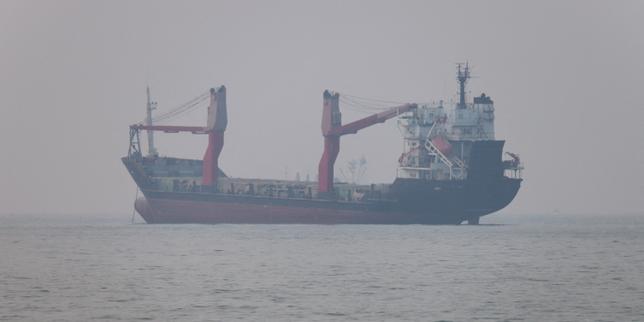
The steel hull of a massive crude carrier vibrates beneath your boots, a low, rhythmic thrum that feels less like machinery and more like a collective heartbeat. Around you, the water is an intense, bruised blue. To the north rise the jagged, sun-bleached cliffs of Iran’s Musandam Peninsula; to the south, the arid coast of Oman. This is the Strait of Hormuz. At its narrowest point, the shipping lanes are just two miles wide. If you stood on the deck of a container ship, you could look out and know that nearly a fifth of the world’s petroleum consumption is squeezing through the exact same corridor of water right alongside you.
It is a terrifyingly fragile place.
For months, the diplomatic air between Washington and Tehran has been thick, stagnant, and entirely locked in place. The headlines call it an impasse. Bureaucrats use words like "stalemate" or "diplomatic friction." But out here on the water, the reality isn't abstract. It is measured in the tense silence of radar rooms, the sudden scramble of fast-attack craft, and the realization that a single miscalculation in this narrow strip of sea could instantly spike global energy prices, halt manufacturing across continents, and disrupt the quiet daily lives of families who have never even heard of this strait.
The current negotiations between Iran and the United States have become deeply encysted around a single, uncompromising question: who controls the future of this chokepoint?
To understand how a few miles of water can paralyze the world’s greatest superpowers, consider a hypothetical merchant captain we will call Marcus. Marcus has spent thirty years navigating the globe, but entering the Persian Gulf always changes the air in the bridge. His crew isn't just watching the depth finders; they are scanning the horizon for the distinctive, high-speed hulls of the Islamic Revolutionary Guard Corps Navy. When those small, heavily armed speedboats buzz past a commercial tanker, it isn't just a local maneuver. It is a message sent directly to the negotiating tables in Geneva and New York.
Iran views the strait as its ultimate geopolitical lever. It is their backyard, their shield, and their leverage against suffocating economic sanctions. For the United States, ensuring the unhindered flow of commerce through these international waters is a foundational pillar of global economic stability.
When the talks stall, the friction manifests physically on the water.
The core of the disagreement lies in what happens next to the security architecture of the region. Tehran demands a complete withdrawal of foreign naval forces, arguing that regional powers should secure their own waters. Washington views that proposition as giving a wolf the keys to the sheep pen. The United States insists on ironclad guarantees of free navigation, backed by a persistent international naval presence. Neither side is willing to blink, because blinking means relinquishing the power to choke or protect the global economy at will.
The complexity deepens when you look at the technology modernizing this ancient maritime standoff. This is no longer just a game of naval artillery and traditional mines. The Strait of Hormuz has become a testing ground for asymmetric warfare. Cheap, explosive-laden drone boats, sophisticated anti-ship missiles hidden in coastal caves, and cyber-warfare capabilities designed to blind GPS tracking systems have fundamentally changed the mathematics of control.
Imagine the economic domino effect of a single day’s closure. It begins with a sudden, sharp spike in insurance premiums for maritime transport. Suddenly, shipping companies refuse to send vessels into the Gulf. Tankers drop anchor outside the Gulf of Oman, waiting. Within forty-eight hours, oil refineries in Asia and Europe face supply anxieties. Within a week, the cost of gas at a local pump thousands of miles away begins to climb. It is a chain reaction that proves how intimately connected a truck driver in Ohio or a factory worker in Tokyo is to the tense diplomatic maneuvering over a few miles of water.
The tragedy of the current deadlock is that both sides are operating on entirely different definitions of security.
For the American negotiators, security is status quo, predictability, and the uninterrupted flow of goods. For the Iranian counterparts, security is the removal of what they perceive as an existential threat parked right off their beaches. They are speaking different languages, using different currencies of power, and reading from entirely different historical scripts.
But while the diplomats argue in air-conditioned rooms over clause adjustments and sanctions relief sequencing, the tension on the water continues to simmer. The sailors on the tankers, the pilots flying surveillance maritime patrols, and the coast guardsmen patrolling the shallows all know that peace here is maintained by the thinnest of margins.
The sun begins to set over the jagged cliffs, casting long, dark shadows across the water. The shipping lanes look deceptively peaceful in the fading amber light, a line of silent giants carrying the lifeblood of global industry slowly moving toward the open ocean. But the calm is an illusion. Until the political deadlock cracks, the world remains entirely dependent on a fragile, uneasy silence kept alive in the narrowest stretch of an unpredictable sea.