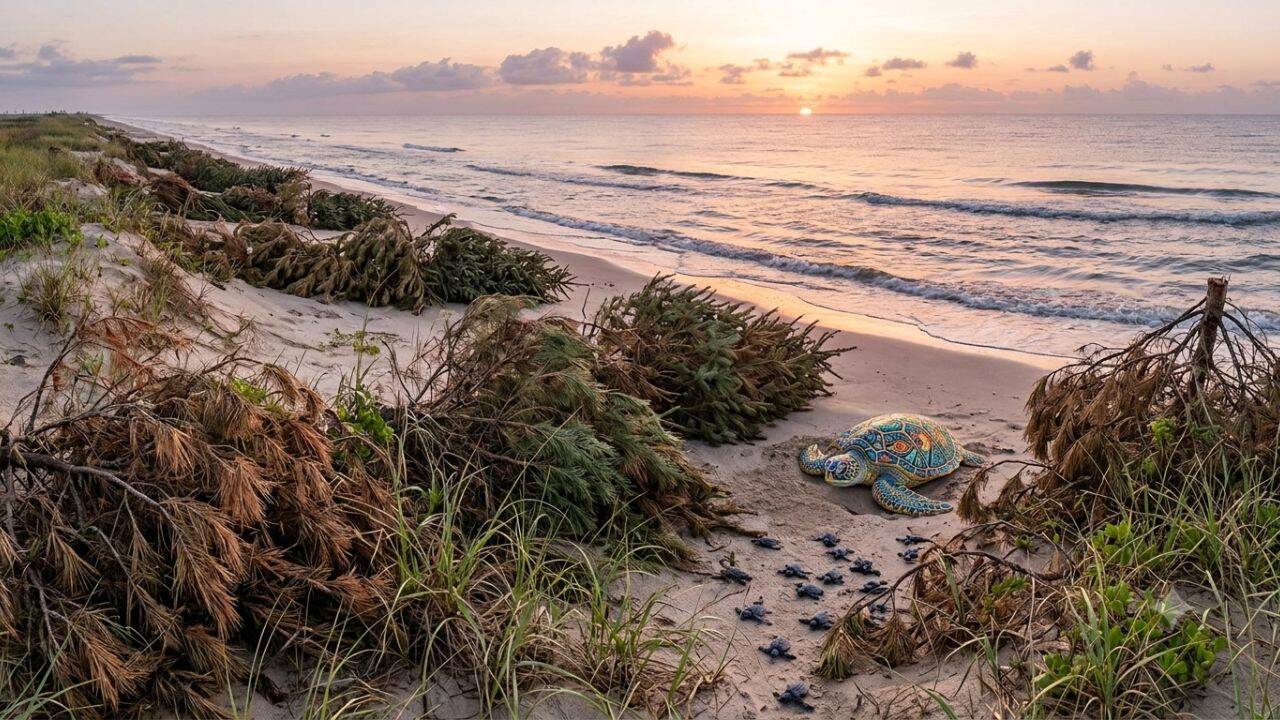
Coastal erosion presents a persistent structural deficit for shorelines worldwide. When high tides and tropical storm surges collide with vulnerable beaches, natural barriers degrade faster than they can regenerate. Addressing this deficit requires physical interventions that work with, rather than against, prevailing aerodynamic forces. On South Padre Island in Texas, conservation operations utilize discarded organic matter to solve this hydrodynamic challenge. By deploying hundreds of post-holiday evergreen trees into strategic littoral zones, organizations engineer low-cost, high-efficiency sand accumulation systems to protect endangered Kemp's ridley sea turtle nesting grounds.
The mechanics of this intervention rely on fluid dynamics and sediment transport principles. Bare coastal sand lacks the surface friction necessary to resist sustained wind vectors. When unobstructed, high-velocity coastal gales transport fine sediment away from the shoreline, causing continuous land regression.
Introducing complex, multi-branched organic structures alters local boundary layer wind profiles. As wind encounters the dense needle networks of a conifer, the flow velocity drops. This sudden reduction in kinetic energy creates a localized drop-out zone where wind-driven sand particles lose momentum and settle out of suspension.
The Three Variables of Organic Sediment Capture
Deploying biological debris for littoral management depends on three discrete physical parameters. Controlling these variables determines whether the intervention results in structural dune growth or material displacement.
- Aerodynamic Porosity: The spatial density of branches must permit air penetration while maximizing drag. Solid barriers cause destructive turbulence and severe scouring around their bases. Permeable organic matrices diffuse wind energy evenly.
- Spatial Orientation: Positioning arrays perpendicular to dominant seasonal wind vectors optimizes particle interception rates. Random placement fails to establish consistent deposition channels.
- Decay Kinetics: Because the material is biological, its structural integrity degrades over time. The rate of wood and needle decomposition must align with the timeline of natural sand accretion and native vegetation root establishment.
When these factors align, blowing sand accumulates incrementally around the branches. Over several months, sediment buries the structure, transforming a temporary wood barrier into a permanent geological landform.
The Cost Function of Shoreline Defense
Traditional engineering approaches to coastal preservation rely heavily on capital-intensive grey infrastructure. Heavy machinery, synthetic geotextile tubes, and mechanical sand hauling incur massive upfront expenditures and ongoing maintenance liabilities.
Using organic waste products transforms the economic model of dune restoration by inverting input costs.
- Zero Material Cost: Municipal waste streams routinely generate millions of discarded conifers annually. Sourcing raw materials from post-holiday collection programs eliminates procurement expenses.
- Minimized Transport Overhead: Localized collection within regional municipal zones reduces long-haul logistics and diverts heavy organic matter away from municipal landfills, reducing regional tipping fees.
- Elimination of Heavy Machinery: Placing trees manually avoids the soil compaction and habitat destruction caused by bulldozers and heavy trucks on fragile beach ecosystems.
This cost structure achieves high asset performance with near-zero capital investment, maximizing the return on investment for resource-constrained wildlife protection groups.
Protecting the Hatchery Ecosystem
The physical barrier generated by these accumulated sand dunes serves a vital downstream function for the local wildlife infrastructure. Sea Turtle Inc., a primary rehabilitation and conservation entity on South Padre Island, maintains a secure beachside hatchery corral. This facility houses relocated eggs gathered from wild nests across the barrier island to protect them from predators and tidal inundation.
Marine turtle incubation success depends on stable thermal environments and moisture levels. Tidal flooding introduces saltwater intrusion into the substrate, saturating nests and suffocating developing embryos through oxygen displacement.
By increasing the vertical height and cross-sectional volume of the dunes directly adjacent to the hatchery corral, the organic wind traps create an elevated topographic buffer. When storm surges raise sea levels, the reinforced dunes absorb wave energy and block lateral water flow. This prevents catastrophic flooding events from destroying entire cohorts of endangered hatchlings.
Operational Limitations and System Vulnerabilities
While the deployment of organic wind traps offers clear tactical advantages, the methodology possesses distinct operational boundaries. Ignoring these constraints leads to structural failure.
The primary limitation is volumetric capacity. A single tree can only capture a finite volume of sand before its structural footprint is entirely submerged. Once buried, its capacity to intercept further windborne sediment drops to zero unless secondary layers are added.
Scale presents another systemic constraint. A small pilot installation of two hundred and fifty trees can successfully protect a localized hatchery perimeter, but the approach cannot substitute for macro-scale coastal engineering along sprawling, high-energy coastlines experiencing rapid sea-level rise. The intervention is a localized tactical patch, not a regional macroeconomic fix.
Furthermore, public participation introduces logistical variance. If community collection networks fail to filter out non-biodegradable plastics, synthetic tinsel, or metallic fragments, introducing contaminated trees into a protected wildlife habitat introduces severe ecological hazards. Quality control at the intake stage remains an operational bottleneck.
Scale the intake capacity of municipal tree collection programs by partnering directly with regional waste management contractors, establishing dedicated drop-off hubs before public disposal deadlines pass, and embedding automated sorting protocols to guarantee 100 percent organic purity prior to beach deployment.