The generator in a Kharkiv basement does not hum; it coughs.
If you have ever spent a winter night three stories underground while frost creeps across concrete walls like a living thing, you know that sound. It is the metallic rattle of a small engine burning precious, rationed diesel just to keep a single space heater alive and a row of medical batteries charged. Above ground, the air smells of cordite and wet ash. Somewhere beyond the horizon, another substation has just been reduced to twisted copper and boiling transformer oil.
Cold. Dark. Quiet.
For millions of Ukrainians, darkness is not a metaphor for despair; it is a physical weight that presses against your chest when the grid goes down at four in the afternoon and the radiators begin to tick as the water inside them cools. Yet, thousands of miles away, in the climate-controlled quiet of Washington boardrooms and diplomatic briefing halls, that same energy grid is discussed in the language of commodities, barrels per day, and electoral math.
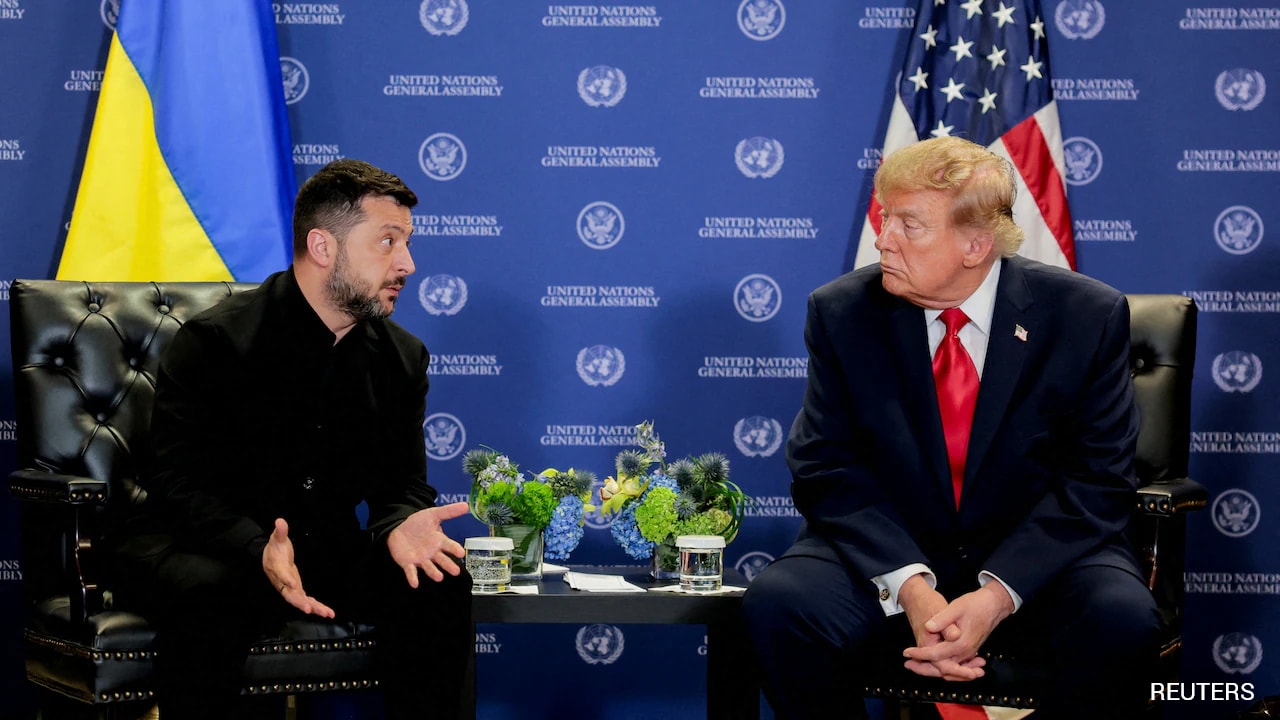
Consider the friction that now defines the war’s sharpest diplomatic edge. On one side stands Volodymyr Zelensky, a wartime president whose country has spent years absorbing ballistic missiles aimed squarely at its power plants, dams, and heating networks. His message to Western capitals has stripped away every layer of diplomatic velvet until only raw steel remains: give us the missiles to strike back, or watch us freeze while our cities are systematically dismantled. On the other side sits Donald Trump, returning to the center of American foreign policy with a deeply transactional instinct and a clear warning—leave Russian oil refineries alone.
To understand why those two positions collide so violently, you have to step outside the cable-news shouting match and look at the invisible machinery connecting a refinery in Ryazan to a gas pump in Ohio and a freezing apartment in Kyiv.
The Geography of Asymmetry
Imagine, for a moment, two neighbors locked in a brutal fistfight inside a shared house. One neighbor is permitted to swing a sledgehammer at every load-bearing wall in the other’s bedroom, smashing the furnace, shattering the pipes, and caving in the roof. Meanwhile, the neighbor holding the sledgehammer is protected by a house rule enforced by the landlord: you may defend yourself, yes, you may even patch your walls, but you must never touch his kitchen stove, because if his stove breaks, the whole street might pay more for groceries.
That hypothetical scenario is not an exaggeration. It is the exact strategic reality Ukraine has navigated since the full-scale invasion began.
Russia’s war machine runs on two distinct currencies: iron and hydrocarbons. The iron comes from Soviet stockpiles, refurbished factories in the Urals, and shells shipped across borders from authoritarian partners. The hydrocarbons—crude oil, refined diesel, aviation fuel—pay for all of it. Every ruble collected from petroleum exports funds the salaries of contract soldiers, buys microchips routed through shell companies, and finances the glide bombs falling on frontline towns.
For over two years, Ukraine fought with one hand tied behind its back by range restrictions. Western partners supplied air defense batteries and artillery, saving tens of thousands of lives, yet repeatedly hesitated when Kyiv asked for long-range strike capabilities—specifically, weapons like American ATACMS or European cruise missiles—with permission to hit deep inside Russian territory. Even when Ukraine bypassed those limits by building its own fleet of long-range, explosive-laden drones capable of flying over a thousand kilometers, the strikes on Russian oil refineries triggered immediate anxiety in Washington.
Why? Because oil is the nervous system of the global economy.
When Ukrainian drones began tearing holes in Russian distillation towers—the tall, complex steel columns that turn crude oil into usable gasoline and diesel—the damage was surgical and devastating. Unlike an oil well, which can sometimes be capped and restarted, a high-tech cracking unit relies on specialized Western engineering components that Russia can no longer legally import under sanctions. Knock out a distillation tower, and you do not just pause production for a weekend; you cripple a facility for months. At the peak of those strikes, analysts estimated that roughly fourteen percent of Russia’s refining capacity had been knocked offline, forcing Moscow to temporarily ban gasoline exports just to keep its own domestic market from boiling over.
Kyiv saw proof of concept. If Russia was going to weaponize winter against Ukrainian civilians, Ukraine would weaponize fuel shortages against the Kremlin’s war chest.
Then came the pushback.
The Pump Price Paradox
Let us be honest about something that makes strategic thinkers deeply uncomfortable: energy markets do not care about moral symmetry. They care about supply, demand, and panic.
If you are sitting in a suburban driveway in Pennsylvania or Michigan, watching the digital numbers spin faster on a gas station pump, you are not thinking about the thermodynamic efficiency of a thermal power plant outside Dnipro. You are thinking about your commute, your grocery bill, and whether your paycheck stretches to Friday. Donald Trump understands this visceral, kitchen-table psychology better than almost any modern politician. Throughout his political career, low energy prices have served as both his signature economic metric and his primary geopolitical lever.
From Trump’s vantage point, encouraging or allowing strikes on Russian oil infrastructure introduces a wildcard into global energy markets that he cannot afford. Even though sanctions technically cap the price of Russian seaborne crude, global oil operates like a single, massive swimming pool. You cannot splash water out of one corner without waves hitting the far wall. If Russian refineries burn, Moscow dumps more unrefined crude onto world markets—or, worse, retaliates by threatening shipping lanes or disrupting energy flows elsewhere—causing traders in London, New York, and Singapore to bid up prices out of sheer fear.
Trump’s approach to ending the war hinges on forcing both sides to the negotiating table through pressure and deal-making. In his calculus, if oil prices spike, inflation roars back, American consumers revolt, and his leverage evaporates before a single diplomatic envoy even lands in Europe. Furthermore, Trump has repeatedly argued that high oil prices are the very thing that kept Vladimir Putin financially afloat in the first place. To him, protecting global energy stability while squeezing Russia through increased American drilling makes clean, commercial sense.
But sit in Kyiv for ten minutes, and that commercial logic feels like a slow-motion death sentence.
What Happens When the Transformers Burn
To truly grasp Zelensky’s desperation when he demands missiles, you have to understand how an electrical grid dies.
People often picture power outages as a flipped switch—annoying, inconvenient, easily fixed when the storm passes. Modern warfare has turned grid destruction into an exact, merciless science. Russia has not merely targeted power lines; it has hunted autotransformers. These are massive, house-sized pieces of equipment filled with thousands of gallons of cooling oil that step electricity up and down so it can travel across regions. You cannot order one off a shelf. Each unit is custom-built, takes up to a year to manufacture, and weighs hundreds of tons.
By the autumn of 2024 and into the hard freezes that followed, Russian missile and drone barrages had wiped out roughly half of Ukraine’s power-generating capacity. Thermal plants were hollowed out into skeletal ruins. Hydroelectric dams suffered severe structural blows.
Consider what happens next in a city like Odesa or Kryvyi Rih when rolling blackouts stretch to twelve or sixteen hours a day.
Without electricity, water pumps stop pushing water up to the tenth floor of apartment blocks. Elderly residents carry plastic buckets up pitch-black stairwells, counting every step by the weak glow of a dying phone screen. Hospitals switch to backup generators, rationing power between operating rooms and neonatal incubators. Food spoils in unplugged refrigerators. Small bakeries, metal workshops, and local businesses—the fragile economic heartbeat keeping the country solvent—burn through their cash reserves just buying fuel to keep their lights flickering.
I remember talking to an electrical engineer from central Ukraine who described the exhaustion of repairing the same substation three times in four months. His hands were permanently stained dark gray under the fingernails, the skin cracked from working outdoors in sub-zero wind. He told me that the hardest part was not the danger of double-tap missile strikes aimed at repair crews. It was knowing that two hundred miles away, across an invisible line on a map, the bombers taking off to hit his substation were fueling up at airbases supplied by refineries Ukraine was being asked not to touch.
"You cannot win a boxing match," he said quietly, stirring lukewarm instant coffee in a paper cup, "if the referee only lets you block."
That is the emotional core behind Zelensky’s blunt demand: Give us missiles.
The Fallacy of Escalation Management
For years, Western foreign policy toward the war has been governed by a doctrine known in Washington as "escalation management." The theory goes like this: give Ukraine enough weapons to survive and bleed the Russian army, but withhold the tools that might humiliate Putin or trigger a wider conflict between nuclear-armed powers.
On paper, inside a think-tank white paper, escalation management looks prudent, measured, and responsible. In the mud of the Donbas and the ruined boiler rooms of Ukrainian cities, it looks like protracted agony.
History offers a sobering lesson about half-measures in industrial warfare. In the early stages of major twentieth-century conflicts, democratic nations frequently hesitated to strike the economic arteries of aggressors out of fear of widening the war or disrupting international trade. Every time, that hesitation granted the aggressor sanctuary—a safe rear area where factories ran three shifts a day, untouched by the reality of the war they had started.
When Zelensky asks for long-range missiles and lifts on targeting restrictions, he is not asking to conquer Moscow. He is asking to remove Russia’s sanctuary.
Think about the psychology of a war when the home front feels zero consequences. For millions of residents in Moscow and St. Petersburg, the invasion has remained largely a television spectacle—something happening far away to other people’s sons. As long as fuel flows cheaply, cafés stay warm, and flights depart on time, the political cost to the Kremlin stays manageable. The moment fuel queues form outside Russian cities, or diesel shortages stall agricultural harvests and military logistics, the war ceases to be an abstraction. It becomes a bill that must be paid at home.
Zelensky knows that Ukraine cannot out-produce Russia in artillery shells or out-number Russia in infantry. Ukraine’s only viable path to a just peace—one that does not simply freeze the front lines and hand Putin five years to rearm for a third invasion—is to make the war economically unbearable for the Kremlin. And you cannot make the war economically unbearable while leaving Russia’s most lucrative, vulnerable infrastructure off-limits.
The Collision of Two Clocks
We are watching a collision between two completely different clocks.
Donald Trump’s clock is measured in political quarters, election cycles, market openings, and quick diplomatic wins. In that world, stability means keeping oil flowing, avoiding sudden price shocks, and bringing an immediate halt to the shooting, even if the resulting map leaves deep, festering wounds. From his perspective, pressing pause on strikes against Russian oil plants is a practical down payment toward a ceasefire—a gesture showing Moscow that economic relief is possible if it comes to the table.
Volodymyr Zelensky’s clock is measured in megawatts, air-raid sirens, and degrees below freezing. In his world, pausing strikes on Russian energy while Russia continues obliterating Ukrainian heating infrastructure is not a step toward peace; it is unilateral disarmament. If Ukraine stops hitting Russian refineries without an ironclad guarantee that Russia will stop hitting Ukrainian power plants—and without the missiles needed to enforce deterrence if Moscow breaks its word—Kyiv loses its strongest bargaining chip before negotiations even begin.
It is easy to feel dizzy looking at this stalemate, because both arguments carry an undeniable internal logic. Nobody wants global energy markets to spiral into chaos, triggering recessions that hurt working families from Nairobi to Ohio. At the same time, asking a besieged democracy to sit quietly in the dark while its attacker profits from uninterrupted fuel sales feels morally hollow.
Where does that leave the people actually living inside the blast radius?
The Arithmetic of Survival
Strip away the press conferences, the leaked diplomatic cables, and the cable-news panels, and the arithmetic comes down to a brutal question of leverage.
In any negotiation with an authoritarian power, concessions offered upfront without a credible threat behind them are rarely pocketed as goodwill; they are pocketed as weakness. Throughout twenty-five years in power, Vladimir Putin has consistently respected only one language: tangible cost. When pipelines are threatened, when refineries burn, when long-range missiles put command bunkers and logistics hubs at risk, the Kremlin calculates the price of continuing the war. When those threats are voluntarily taken off the table by Western restraint, the price drops, and the war drags on.
Zelensky understands that missiles are not merely instruments of destruction; they are instruments of persuasion. You do not even have to fire every missile in your inventory for it to change an adversary’s behavior. Simply possessing the capability—and the sovereign permission—to strike critical energy and military nodes forces an enemy to pull air defenses back from the front lines to protect its own territory, stretching its forces thin and creating openings where none existed before.
Without those missiles, and without the freedom to target the financial lifeblood of the invasion, Ukraine is left trying to bail out a sinking boat with a tin cup while someone else decides whether it is polite to plug the hole.
Back in that Kharkiv basement, nobody is reading geopolitical risk assessments or tracking Brent crude futures. They are listening to the cough of the diesel generator, watching the thermometer taped to the concrete pillar, and waiting to see if the lights will come back on before midnight. Outside, the wind sweeps across dark avenues where traffic lights hang dead above empty intersections, and the frost settles deeper into the stone.