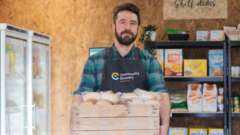
Low-cost community food stores are the junk food of economic policy. They feel good in the moment, they provide immediate relief, and they are slowly rotting the financial independence of the neighborhoods they claim to serve.
The standard narrative is simple. A "social supermarket" or community shop opens in a deprived area. It sells surplus stock—the stuff Big Supermarkets couldn't shift—at a fraction of the retail price. The local press runs a heartwarming story about "lowering food bills." Everyone claps.
They shouldn't.
By focusing on the price of a tin of beans, these initiatives ignore the structural rot that makes the beans unaffordable in the first place. Worse, they provide a convenient "out" for the very corporations and local governments that should be under fire for systemic failures. We are subsidizing low wages with surplus yogurt, and calling it progress.
The Surplus Trap
The core logic of the community food store relies on "surplus" food. This is the waste of the industrial food complex.
When a community relies on surplus, it becomes an appendage to the inefficiency of the mainstream market. If the major retailers finally fix their supply chains—using better inventory management—the "charity" stock dries up. You cannot build a resilient local economy on the crumbs of a wasteful global one.
I’ve spent years analyzing supply chain logistics. Efficiency is the enemy of the community store. If a store’s business model requires a massive corporation to make a mistake in ordering too many pallets of off-brand cereal, that store is not a solution. It is a parasite on a dying system.
The Hidden Costs of Cheap Food
- The Dignity Deficit: These stores often require "membership" based on proof of hardship. We have gamified poverty, asking people to perform their struggle for the right to buy dented cans of soup.
- Nutritional Redlining: Surplus food is rarely fresh produce. It is shelf-stable, highly processed, and heavy in sodium. We are solving a "hunger" crisis by fueling a "health" crisis.
- Economic Stagnation: When a low-cost community store opens, it often kills off the last remaining independent grocers who actually pay taxes and employ locals. You replace a fragile business ecosystem with a subsidized warehouse.
The Convenience of Charity
Why do politicians love community food stores? Because they are cheaper than policy.
If you can point to a local "social grocery," you don't have to talk about why real wages have been stagnant for a decade. You don't have to address the "food desert" created by urban planning that prioritizes highways over walkable high streets.
It’s the "Band-Aid" effect. By lowering the cost of survival by $20 a week, you reduce the immediate political pressure to raise the floor of the economy. These stores function as a pressure valve for social unrest. They make poverty just tolerable enough that people stop demanding change.
The Math of Marginal Gains
Let’s look at the actual numbers. A typical household might save 30% on their grocery bill at one of these outlets. On a $100 shop, that’s $30.
In a scenario where rent has increased by $400 a month and energy bills have doubled, that $30 is statistically insignificant. It is a rounding error in the budget of a struggling family. Yet, we treat these stores as if they are the primary lever for economic mobility. They aren't. They are a distraction from the escalating costs of housing and utilities—the true drivers of the cost-of-living crisis.
Stop Subsidizing Low Wages
Big Retail loves these schemes. They get to donate their "waste" (which they would otherwise have to pay to dispose of) and claim a tax write-off or a PR win.
Meanwhile, many of the people shopping at these community stores are the very employees working at the big-box retailers. We have reached a point of peak absurdity where workers at a multi-billion dollar supermarket chain have to go to a community store to buy the surplus food they stocked on shelves earlier that day.
We are essentially using "surplus" food to supplement the insufficient wages paid by the private sector. It is a backdoor subsidy for corporations that refuse to pay a living wage.
What Actually Works
If we actually wanted to lower food bills, we wouldn't build more sheds full of cheap crackers. We would do three things immediately:
- Universal Basic Services: Instead of "cheap food," we need accessible, publicly-funded transport and childcare. These are the "fixed" costs that eat the majority of a low-income budget.
- Land Reform: We need to break the monopoly that the "Big Four" supermarkets have on land banking in urban areas. This would allow smaller, competitive, and truly local food co-ops to exist without needing "surplus" to survive.
- The Living Wage: Any business that requires its employees to use a food pantry or a community store to survive is a failed business. Period.
The Myth of the "Smart" Shopper
The "People Also Ask" section of any search engine is filled with queries like "How can I save money on my food shop?" or "Where is the cheapest place to buy groceries?"
The premise of these questions is flawed. It assumes that the problem is a lack of "smart shopping" or "budgeting skills." It shifts the burden of a failing economy onto the individual.
The honest answer? You can't budget your way out of a systemic collapse.
When we tell people to go to a community food store, we are telling them to spend their time—their most valuable resource—traveling to a specific location, waiting in line, and picking through leftovers to save a handful of dollars. It is an enormous tax on the time of the poor.
The Downside of the Contrarian View
I realize the risk in this stance. If you shut down every community store tomorrow, people would go hungry on Friday. I am not suggesting we burn the stores down.
I am suggesting we stop celebrating them.
We should view the existence of a community food store as a mark of shame for a city, not a point of pride. Every ribbon-cutting ceremony for a "new low-cost grocery" is a funeral for the idea that people should be able to afford food from a regular shop using the money from their regular job.
Reclaim the High Street
The goal shouldn't be "lower food bills" via charity. The goal should be "higher purchasing power" via structural change.
We need to stop romanticizing the "surplus" economy. It is a secondary market for a broken primary market. By propping up these stores, we are just helping the primary market stay broken for longer.
If you want to help your neighbor, don't just donate a can of soup to a community shop. Demand why that shop needs to exist in a country with the fifth-largest GDP on the planet.
The community store isn't the solution to the fire; it's just the smoke.
Stop buying the PR. Start demanding an economy where "surplus" food is a waste product again, not a lifeline.