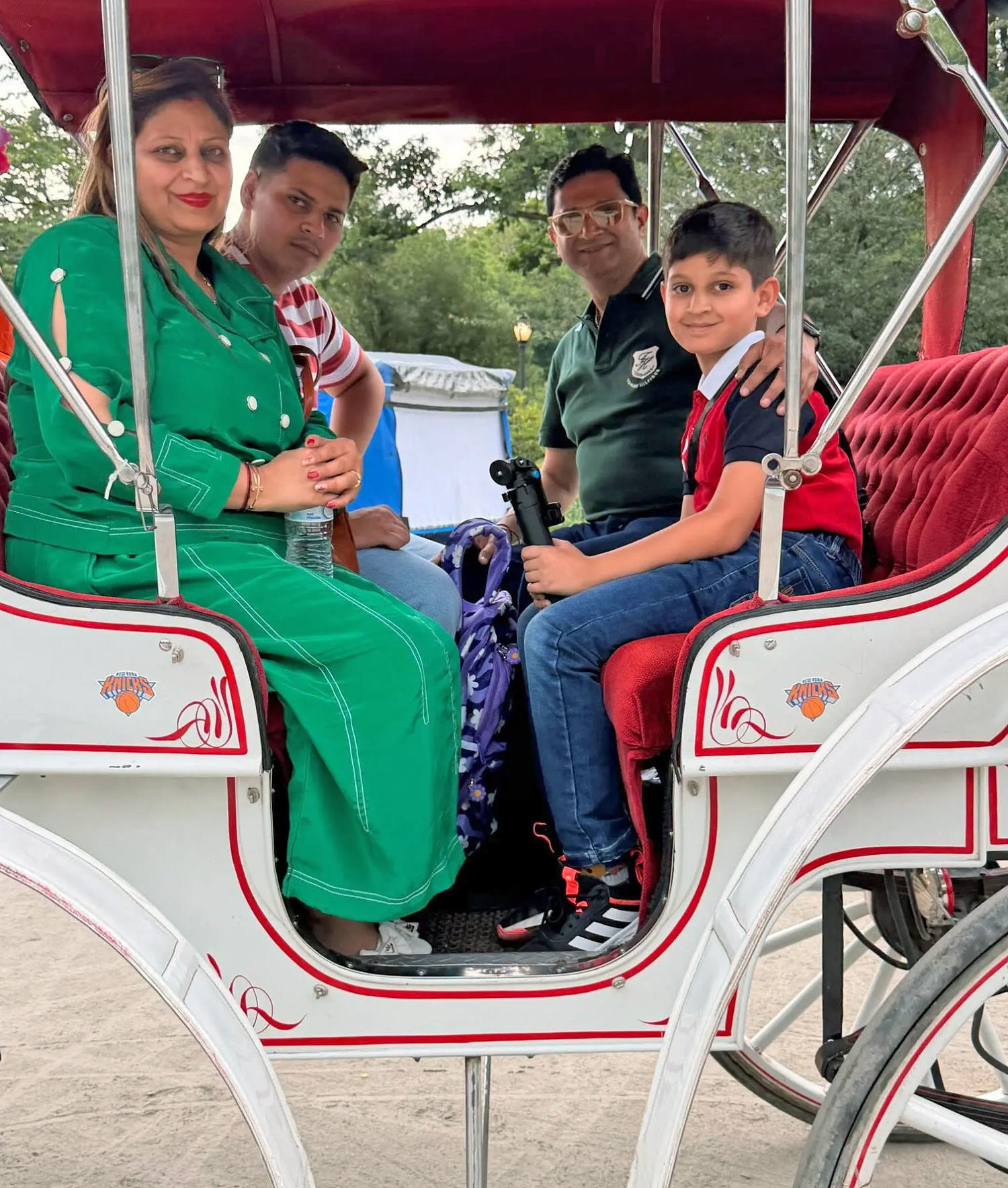
The sound of Central Park at dusk is supposed to be a sanctuary. It is a carefully engineered illusion of the wild, nestled tightly inside a grid of unforgiving granite and glass. If you stand near the paths long enough, the city noises blur into a low, oceanic hum. You hear the crunch of gravel under running shoes. You hear the laughter of tourists. And, inevitably, you hear the rhythmic, hypnotic rhythmic clip-clop of horse hooves against asphalt.
For generations, that sound has been marketed as romance. It is sold on postcards. It is featured in the background of silver-screen proposals. But to those who know the mechanics of the city, that sound carries a different weight. It is the sound of two entirely different eras colliding on a narrow strip of pavement.
When a family loses a child to that collision, the world slows down to a agonizing crawl. The headlines that follow are always clinical. They report the age, the location, the time of day, and the brief, sterile summary of the incident. "Teenager struck." "Tragic accident." But headlines are built to compress human agony into a column width. They omit the smell of the grass that evening. They leave out the unfinished conversation, the text message left on "read," and the impossibly heavy silence that settles into a bedroom that will never be slept in again.
To understand what was lost, you have to look past the cold police reports and look at the spaces a person leaves behind.
The Anatomy of an Echo
Every home has a specific geography defined by the people who inhabit it. There is the dent in the couch. There is the specific pitch of a bedroom door hinge. For one family, the geography of their daily life was completely anchored by a teenager whose presence was loud, vibrant, and fiercely protective.
He was the kind of kid who filled a room without trying. He did not navigate the world quietly; he bounded through it. His laughter was a constant baseline in a chaotic city. Neighbors knew him by the way he leaped down the front steps, always in a hurry, always chasing the next moment.
Then comes the phone call. It is the call that every parent carries a subconscious dread of from the moment they cut the umbilical cord. The voice on the other end is always too calm. It uses institutional vocabulary. "An incident." "Emergency care."
The transition from a living, breathing human being to a subject of public debate is brutally swift. One day you are arguing about curfews and messy desks. The next, your child’s name is being invoked by strangers on evening news broadcasts, transformed into a talking point for urban policy.
Consider the reality of that grief. It does not look like a movie scene with dramatic rain and perfectly timed tears. It looks like standing in a kitchen holding a half-empty carton of milk, realizing that the person who would have finished it is gone. It is the sensory shock of absolute stillness.
The Illusion of the Past in the Present
We tend to romanticize the preservation of history in our cities. The horse-drawn carriages of Central Park are treated as living museum pieces, a sweet nod to a gentler nineteenth century. We look at the velvet-lined seats and the drivers in their top hats, and we choose to forget what the nineteenth century actually looked like. It was a time of mud, disease, and unregulated chaos.
Putting a one-thousand-pound animal into the middle of modern Manhattan traffic is not a historical reenactment. It is a high-stakes gamble against probability.
Horses are prey animals. Their entire evolutionary biology is hardwired around a single imperative: run away from the unfamiliar. A car backfiring, a sudden flash of a camera, a dropped metal construction barrier—any of these can trigger an ancient, unstoppable instinct to flee. When that instinct kicks in on a path crowded with pedestrians, scooters, and cyclists, the carriage ceases to be a novelty. It becomes a projectile.
The argument for keeping these carriages alive usually centers on tradition and livelihood. We are told that it is a staple of the city's identity. But we have to ask ourselves what we are willing to pay to maintain a postcard aesthetic.
The data tells us one thing about traffic safety and animal welfare, but data lacks a pulse. The real cost is measured in the quiet rooms of a family apartment where a mother sits with a pair of worn-out sneakers pinned against her chest. She is not thinking about city ordinances or tourism revenue. She is remembering the exact cadence of her son's voice when he said goodbye that morning.
The Invisible Stakes of Public Space
Cities are general agreements. We agree to stop at red lights. We agree to pay our fares. We agree to share the sidewalk. This collective contract is designed to keep us safe in an environment where millions of lives overlap by mere inches every single day.
But some agreements are outdated.
When the news cycle moves on—as it always does, hungry for the next flash of breaking news—the family is left with the debris of the agreement that failed them. The public moves on to the next debate, but for the survivors, the event is not a past tense. It is a permanent present.
I remember walking through that exact section of the park a few weeks after the incident. The carriages were back. The tourists were smiling, holding their phones up to capture the perfect New York moment. The drivers were calling out out to passersby. The smell of horse manure and hot asphalt hung heavy in the air.
It felt like a betrayal of the dirt itself. How could the wheels keep turning over the exact spot where a young life was violently cut short? How could the city absorb a tragedy so massive and simply wash the pavement clean before the next morning's joggers arrived?
The truth is, the city does not have a memory. Only people do.
What Remains in the Quiet
The family doesn't want their boy to be remembered as a statistic or a cautionary tale used in a political campaign to ban carriages. They want him remembered for his fierce loyalty, his terrible jokes, and the way he could make an ordinary Tuesday feel like an adventure.
They remember him through the things he touched. The skateboard leaning against the wall. The jacket still hanging on the hook by the door, retaining the faint scent of laundry detergent and fresh air. These items possess a terrible, beautiful permanence. They outlive their owners. They mock the concept of time.
People often ask how a family survives this kind of loss. The honest answer is that they do not. The family that existed before the accident dies along with the child. A new family has to be built from the pieces left behind, and that new family will always walk with a limp. They will always look at the empty chair at Thanksgiving. They will always calculate how old he would have been this year, next year, a decade from now.
The debate over the safety of Central Park’s carriages will continue in city hall. Lawyers will argue over liability, and activists will hold press conferences. But the definitive truth of the matter does not belong to the politicians or the carriage operators.
It belongs to a family sitting together in a quiet living room, looking at photographs of a boy who should have had fifty more years of New York autumns, whose entire future was traded for a moment of preventable chaos on a paved path.
The sun goes down over the tree line, casting long, dark shadows across the lawns where children play. The horses continue their rounds, their hooves striking the ground over and over, an eternal, heavy countdown in the heart of the city.