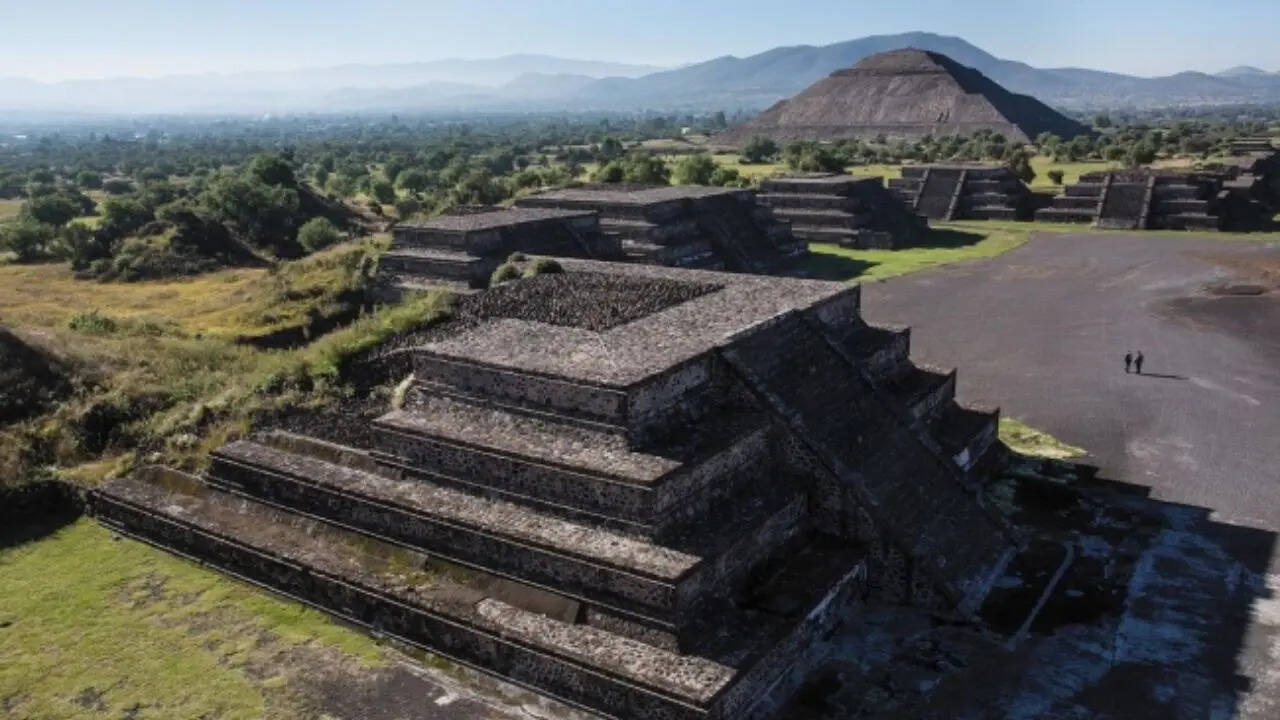
Mexico City is quite literally sinking into its own past, a massive urban sprawl crushing the remains of the Aztec empire, Tenochtitlan. While tourists flock to the visible ruins of the Templo Mayor, a far more complex struggle plays out inches beneath the asphalt of the Zócalo and the foundations of crumbling colonial churches. The city sits on a layered cake of civilizations where every subway expansion, basement renovation, or water line repair triggers a high-stakes standoff between modern infrastructure needs and the desperate scramble to salvage a disappearing heritage.
This is not a romanticized treasure hunt. It is a logistical nightmare. You might also find this related story insightful: The Sweet Weight of Desert Gold And Why We Still Need the Date Palm.
The Engineering War Against Time
When the Spanish conquistadors razed Tenochtitlan in 1521, they didn't just destroy a city; they attempted to bury a worldview. They used the stones of Aztec pyramids to build their cathedrals, effectively pinning the old world under the weight of the new. Today, that weight is a literal physical threat. The lakebed on which the city rests is composed of soft, clay-rich soil that is drying out as the metropolis pumps groundwater to feed 22 million people.
As the water leaves the soil, the earth compacts. The city sinks. As discussed in latest coverage by Lonely Planet, the results are significant.
But it does not sink evenly. Heavy stone structures like the Metropolitan Cathedral tilt at alarming angles because they are anchored to different layers of the underground strata. Some parts of a building might rest on a solid Aztec platform, while another corner sits on soft mud. This differential settling cracks open the "concrete sarcophagus" of the modern city, occasionally revealing what lies beneath: ritual deposits, tzompantli (skull racks), and the foundations of houses that belonged to a nobility long forgotten.
Archaeologists in Mexico City do not have the luxury of slow, methodical digs. They work in "salvage archaeology" mode. They are often called in when a construction crew hits a wall of volcanic rock or a cache of obsidian blades. They have weeks, sometimes only days, to document a site before the requirements of a modern mega-city force the trench to be filled back in.
The Tzompantli and the Politics of Death
In 2015, workers stumbled upon the Huey Tzompantli, a massive circular tower of human skulls near the Templo Mayor. It was a grisly, awe-inspiring find that upended previous academic assumptions about the scale of Aztec ritual sacrifice. To the public, it was a sensational headline. To the analysts on the ground, it was a reminder of how little we actually know about the density of the pre-Hispanic urban center.
The discovery of the skull rack highlighted a friction point in Mexican identity. The government frequently uses these "underground secrets" to bolster national pride and promote tourism, yet the funding for the actual preservation of these sites is perennially on the chopping block. There is a sharp irony in a nation that celebrates its "hidden temples" while simultaneously building train lines and luxury condos that risk obliterating the very history they claim to cherish.
The skulls found beneath the street tell a story of a highly organized, deeply religious society that integrated death into the public square. Modern Mexico City, by contrast, tries to pave over it. We are seeing a clash between a civilization that built for eternity and a modern economy that builds for the next fiscal quarter.
The Infrastructure Trap
The biggest threat to the "hidden world" isn't looting or neglect; it is the sheer necessity of keeping Mexico City functional. The Metro system, particularly Line 1 and Line 2, runs through the heart of the ancient sacred precinct. During the initial construction of the subway in the late 1960s, workers discovered a small temple dedicated to Ehécatl, the god of wind.
Today, that temple sits inside the Pino Suárez station. Millions of commuters pass it every day, most without looking up from their phones. It is a sterile, caged version of history.
This sets a dangerous precedent for how we handle urban archaeology. When a find is made, the options are limited:
- Extract and Move: Removing the artifacts to a museum, which strips them of their geographic context.
- In-Situ Preservation: Building around the find, which is prohibitively expensive and often complicates building safety codes.
- Re-burial: Documenting the site and then covering it back up to protect it from oxygen and humidity.
Re-burial is the most common outcome, meaning the "secret world" remains secret by design. We are creating a digital map of a city we will never actually see with our own eyes.
The Water Crisis is an Archaeological Crisis
The most overlooked factor in the destruction of Mexico City’s underground heritage is the hydrological collapse of the Valley of Mexico. As the city sinks, the shifting earth shears through unrecorded archaeological layers like a slow-motion earthquake.
When the ground shifts, the chemical composition of the soil changes. The introduction of oxygen into previously waterlogged anaerobic environments causes organic materials—wood, textiles, and botanical offerings—to rot instantly. Archaeologists are finding that items preserved for 500 years in the mud are disintegrating within months of the water table dropping.
We are losing the "soft" history of the Aztecs. We have their stone statues, but we are losing their wooden tools, their clothing, and the remains of the food they ate. This isn't just about missing out on pretty objects; it's about losing the data required to understand how a city of 200,000 people managed to survive in the middle of a lake without destroying its environment—a lesson the modern city desperately needs to learn.
The Myth of the Untouched Temple
It is a mistake to think of the underground world as a pristine time capsule. It is a mess. Centuries of colonial sewage systems, 20th-century electrical grids, and fiber-optic cables have sliced through the ruins. In many places, an Aztec floor might be pierced by a 1950s lead pipe, which is itself leaning against a 17th-century brick foundation.
This layering makes excavation a surgical process. You cannot simply dig a hole; you have to peel back the skin of the city one century at a time. The "secret world" is actually a mangled fusion of eras.
The industry reality is that we will never "uncover" Tenochtitlan. It is structurally impossible to remove the Spanish colonial city or the modern Republic without destroying the homes and livelihoods of millions. The hidden city is destined to remain a ghost, visible only in fragments and through the lens of ground-penetrating radar.
The Cost of Looking Down
Developers in the historic center live in fear of the "INAH halt." The National Institute of Anthropology and History (INAH) has the power to stop any construction project the moment an artifact is found. This has led to a "don't ask, don't tell" culture among smaller contractors. If a backhoe unearths a carved stone, there is a powerful incentive to break it up and hide the evidence to avoid months of costly delays.
This creates a massive gap in the record. While major government projects are strictly monitored, thousands of smaller "secrets" are likely pulverized every year in the name of progress. We are effectively subsidizing the destruction of history through bureaucratic inefficiency.
If we want to save the underground city, the approach must change. We need a system that rewards discovery rather than punishing it. Currently, finding an ancient temple on your property is a financial catastrophe for a local business owner. Until that economic reality is addressed, the "secret world" will continue to be destroyed by the people who live on top of it.
The Ethics of Exposure
There is also a growing debate about whether we should be digging at all. Many of the remains being uncovered are ancestral burials. The "ritual skulls" that make for great headlines were once people. The transformation of a sacred burial site into a tourist attraction or a photo-op for an archaeology journal raises uncomfortable questions about the commodification of the dead.
Some indigenous groups and scholars argue that the rush to "uncover" everything is a continuation of colonial prying. They suggest that perhaps the most respectful way to handle the hidden world is to leave it in the dark, protected by the earth, rather than exposing it to the pollution and light of a modern metropolis that has no place for it.
The reality of Mexico City is that the past is not behind us; it is beneath us, exerting a constant upward pressure. Every time a sinkhole opens up in the street or a colonial wall cracks, the Aztecs are reminding the modern world that their city was never truly erased. It was just paved over.
The preservation of this world isn't about building more museums. It is about deciding how much of our current life we are willing to sacrifice to accommodate the ghosts of a civilization that the world tried to forget. As the city continues to subside into the lakebed, that choice is being made for us by the physics of the soil. We are running out of time to document the ruins before they are crushed into dust by the very city that claims them as its foundation.
Stop looking for a lost city. We are walking on it every single day, and every step we take is grinding it into the mud.