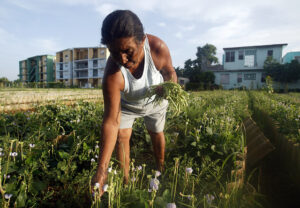
The dirt under your fingernails smells different when it comes from twenty feet above a subway line.
I learned this on a Tuesday morning in late October, standing on a converted industrial roof in Queens while the wind whipped off the East River and stung my cheeks. My boots were caked in a dark, spongy compost that felt nothing like the dry, gray dust of the city streets below. Beside me, rows of kale and heirloom tomatoes stretched toward a skyline of glass towers and construction cranes. A few miles away, another crane was pouring concrete for a luxury apartment block over what used to be a family-run market garden. You might also find this connected story interesting: The Economics and Political Friction of Direct Potable Reuse in Arid Municipalities.
That is the quiet war happening at the edge of every growing metropolis on earth.
We have been sold a false choice for generations. City planners, developers, and nervous homeowners whisper the same ultimatum whenever a town starts to boom: you can have affordable housing, or you can have green space and local food. You cannot have both. Pick one. Build up and pave over the soil, or freeze the skyline and watch rent prices suffocate the working class. As discussed in recent reports by NPR, the implications are notable.
They got it completely backward.
The Myth of the Concrete Trade-Off
Consider a hypothetical city council meeting in any fast-growing suburb—let’s call it Oakridge, though you already know its real name because you probably live near it. On the left side of the room sit young teachers, nurses, and line cooks holding signs demanding lower rents. They are exhausted from two-hour commutes. On the right side sit conservationists and local growers holding maps of the county’s last remaining prime farmland, begging the board not to rezone the valley for three thousand new townhomes.
Both sides are right. Both sides are terrified. And both sides are fighting inside a cage built by outdated zoning laws.
For seventy years, urban growth has operated like a spilled bucket of paint. We call it sprawl. When housing gets expensive in the core, we push outward, swallowing the flattest, richest agricultural land first because flat, cleared soil is the cheapest terrain for a developer to grade and pour foundations upon. According to data from the American Farmland Trust, the United States alone lost roughly eleven million acres of agricultural land to urban and highly developed uses between 2001 and 2016. That is an area roughly the size of Vermont and New Hampshire combined, vanished beneath strip malls, cul-de-sacs, and asphalt parking lots.
Once you pour concrete over Class I topsoil, you do not get it back. Not in your lifetime. Not in your grandchildren’s lifetime.
Yet stopping construction is a fantasy. People need roofs over their heads. Families are growing, migrating, and searching for safety and work. If we refuse to build homes, we trigger a housing crisis that hollows out communities from the inside, turning vibrant neighborhoods into museum pieces only billionaires can afford.
So we panic. We pave the orchards to house the people, and then we truck lettuce three thousand miles across the continent to feed the people who now live where the orchards used to be.
It is madness. Slow, polite, municipal madness.
How Cities Actually Breathe
To understand how we break out of this trap, you have to stop thinking of a city as a machine made of steel and start thinking of it as a living forest.
In an old-growth forest, nothing is wasted, and nothing occupies just one layer. High above, the canopy catches raw sunlight. Beneath that, smaller trees thrive in dappled shade. Shrubs, ferns, fungi, and deep root networks occupy the exact same square footage on the forest floor, each performing a distinct job without evicting its neighbors.
Modern cities, by contrast, are built like single-story warehouses stacked lazily on top of one another. We separate everything into sterile, isolated boxes. Homes go in Zone A. Offices go in Zone B. Parks go in Zone C. Farms are banished fifty miles beyond the county line.
When you stack functions instead of separating them, the math changes overnight.
Take Maya, a fictional composite of the urban architects and community organizers I have spent the last decade interviewing. Suppose Maya is tasked with redesigning a crumbling, six-acre industrial rail yard in the heart of a mid-sized city. Under the old rules, a developer would flatten the site, build four-story stick-frame apartments surrounded by a sea of surface parking, and plant three ornamental pear trees near the leasing office.
Now watch what happens when Maya applies ecological density.
First, she builds up—eight to twelve stories of mass-timber and recycled-steel housing, creating four hundred new homes where zero existed before. Because the building is dense and sits near a transit hub, she eliminates the sprawling asphalt parking lot. That single move frees up three full acres of ground-level earth.
Second, she treats every horizontal surface as living territory. The rooftops aren't tar-and-gravel dead zones radiating heat into the summer sky; they are reinforced, irrigated soil beds producing sixty thousand pounds of leafy greens, peppers, and herbs every year. The south-facing balconies hold modular vertical planters. The ground-level courtyard isn't manicured turfgrass soaked in chemical fertilizers; it is an agroforestry park lined with dwarf fruit trees, berry bushes, and pollinator corridors that double as stormwater sponges during flash floods.
No farmland at the edge of town was touched. Four hundred families got homes. And the grocery store on the ground floor sells tomatoes harvested forty feet above the checkout counter.
The Invisible Stakes of the Soil
I used to think urban farming was a cute hobby for retired professors and weekend idealists. I was wrong.
My mind changed during a brutal August heatwave three summers ago. I was walking through two neighborhoods separated by less than two miles. The first was a traditional low-density commercial strip—wide boulevards, endless parking lots, flat black roofs, and hardly a tree in sight. The air felt like the inside of a clothes dryer. By four in the afternoon, the pavement was radiating heat so fiercely it warped the air above the crosswalks. Surface temperatures in neighborhoods like that regularly spike ten to fifteen degrees Fahrenheit higher than green districts just a few blocks away—a phenomenon scientists call the urban heat island effect.
Then I crossed into an older district retrofitted with green roofs, bioswales, pocket parks, and community orchards.
The temperature drop hit my skin like stepping into a cellar. You could hear birds over the hum of traffic. The air smelled damp and sweet instead of acrid and metallic.
Green cities are not merely prettier; they are survival infrastructure. As extreme weather becomes louder and more erratic, bare concrete turns into a liability. Rainwater hits asphalt, picks up motor oil and heavy metals, and rushes straight into overwhelmed storm sewers, flooding basements and polluting rivers. Soil, by contrast, acts like a giant living sponge. A single square foot of healthy, organic-rich urban soil can absorb several gallons of stormwater during a cloudburst, filtering toxins through plant roots and microbial networks before the water ever reaches the water table.
When we weave farms and dense housing together, we solve three crises with a single stroke:
- We cool the air, slashing summer electricity demand and protecting elderly and vulnerable residents from lethal heatwaves.
- We shorten the supply chain, ensuring that when a highway floods or fuel prices spike, fresh produce still reaches neighborhood tables.
- We heal the isolation of modern life, turning anonymous apartment blocks into places where neighbors actually know each other's names because they share a harvest.
The Hard Truth Nobody Likes to Admit
If this works so well, why isn't every city doing it tomorrow morning?
Because change is messy, expensive upfront, and collides head-on with human fear.
I won't pretend this is effortless. Retrofitting an existing roof to hold wet soil and crops requires serious structural engineering; wet dirt is heavy, and old warehouses collapse if you cut corners. Building taller, denser housing in neighborhoods accustomed to single-family lawns triggers fierce political backlash from residents who worry about shadows, traffic, and changing neighborhood character. And urban soil at ground level is often poisoned by a century of leaded gasoline, industrial paint, and factory ash—meaning growers must either remediate the earth over years or build expensive raised beds filled with imported compost.
There are no magic wands here. Anyone promising an easy, friction-free transition is selling you a brochure, not a blueprint.
Yet look at the alternative. Doing nothing is not neutral. Keeping our cities flat, sprawling, and paved carries a staggering hidden bill that we pay every month in higher rents, longer commutes, asthma inhalers for our children, flooded streets, and vanishing family farms.
Countries and cities that have embraced this shift prove the hurdle is political, not physical. In Singapore—a dense island nation with almost no agricultural hinterland—planners have mandated skyrise greenery and aggressively funded high-tech rooftop and vertical farms, aiming to produce thirty percent of the nation's nutritional needs locally by 2030 while housing millions in towering, lush residential complexes. In Paris, municipal initiatives have turned hectares of schoolyards, flat roofs, and underground parking garages into productive urban farms, proving that even a historic city carved from limestone can learn to grow its own food without sacrificing housing.
How a City Learns to Grow Again
You do not need a trillion-dollar federal grant to start rewiring a city. You start by changing the rules of what is allowed.
First, cities must abolish mandatory parking minimums near transit and allow gentle density—four-to-eight-story mixed-use buildings—in neighborhoods currently locked into single-family zoning. Every acre saved by building up instead of out is an acre of farmland spared from the bulldozer.
Second, municipal building codes should treat green roofs and solar canopies as standard equipment on all new commercial and multi-family developments, just like fire sprinklers and wheelchair ramps. When green infrastructure becomes routine, construction costs drop through scale and familiarity.
Third, cities need to protect urban agricultural land with the same legal ferocity they use to protect historic monuments. Too often, community gardens are treated as temporary placeholders—cute decorations tolerated only until a real estate developer decides the lot is valuable enough for condos. Establishing permanent urban agricultural trusts ensures that soil built up over twenty years of sweat and compost isn't scraped away overnight.
Finally, we have to change what we value when we look out our windows. For decades, status in the Western world meant a manicured half-acre lawn sprayed with chemicals to kill every dandelion, separated by a fence from your neighbors and a forty-minute drive from your job. That dream has bankrupted our towns and exhausted our land.
A richer dream is sitting right in front of us. It looks like sunlight filtering through pole beans strung across a sixth-floor balcony. It sounds like bees humming inside a lavender hedge planted along a busy bike lane. It tastes like a strawberry still warm from the afternoon sun, picked three flights above the street where you live.
The Roof in Queens
Before I climbed down the ladder from that rooftop farm in Queens, the head grower handed me a small, bruised heirloom tomato she had just pulled from the vine. It wasn't uniform. It wouldn't have survived a thousand-mile ride in the back of a refrigerated semi-truck without turning to mush.
I bit into it right there against the parapet wall. Juice ran down my wrist. Behind me, the subway rumbled through the steel trestle, shaking the gravel beneath my boots, while six floors below, delivery trucks honked and parents pushed strollers toward the corner bodega.
The city was loud, crowded, relentless, and alive. And right there in the middle of the concrete, something green was holding its ground.


