You spent three months drafting the perfect corporate AI policy. HR signed off. Legal scrutinized every sentence. The board gave its enthusiastic blessing. You hit "send" to the entire company, breathed a sigh of relief, and checked it off your Q1 to-do list.
Big mistake.
While you were celebrating, a new open-source model dropped. It cut processing costs in half and rendered your data-sharing clauses completely irrelevant. Three of your software engineers secretly used an unapproved browser extension to debug proprietary code. Your marketing team adopted a synthetic video tool that your policy doesn't even have a name for yet.
Treating AI guidelines as a static document is a fast track to irrelevance, or worse, a massive compliance disaster. Static policies fail because artificial intelligence doesn't sit still. It changes weekly. If your guidelines aren't actively changing with it, they're dead on arrival.
The Myth of the Finished AI Policy
Many executives mistake AI implementation for traditional software procurement. When you buy an ERP system or a payroll tool, the rules are clear. You know what data goes in, who has access, and where the boundaries lie. You write a policy, review it annually, and move on.
AI doesn't work that way.
The technology evolves exponentially. When OpenAI released GPT-4o, and subsequent updates followed, capabilities shifted overnight from simple text generation to complex, multi-modal reasoning and real-time audio processing. A policy written for text-based chatbots cannot protect a company using autonomous agents that execute financial transactions or write software independently.
According to data from the Stanford Institute for Human-Centered AI, the pace of commercial AI deployment has outstripped regulatory framework creation by a ratio of nearly three to one. If you're waiting for government regulations or annual industry benchmarks to dictate your internal rules, you're running blind.
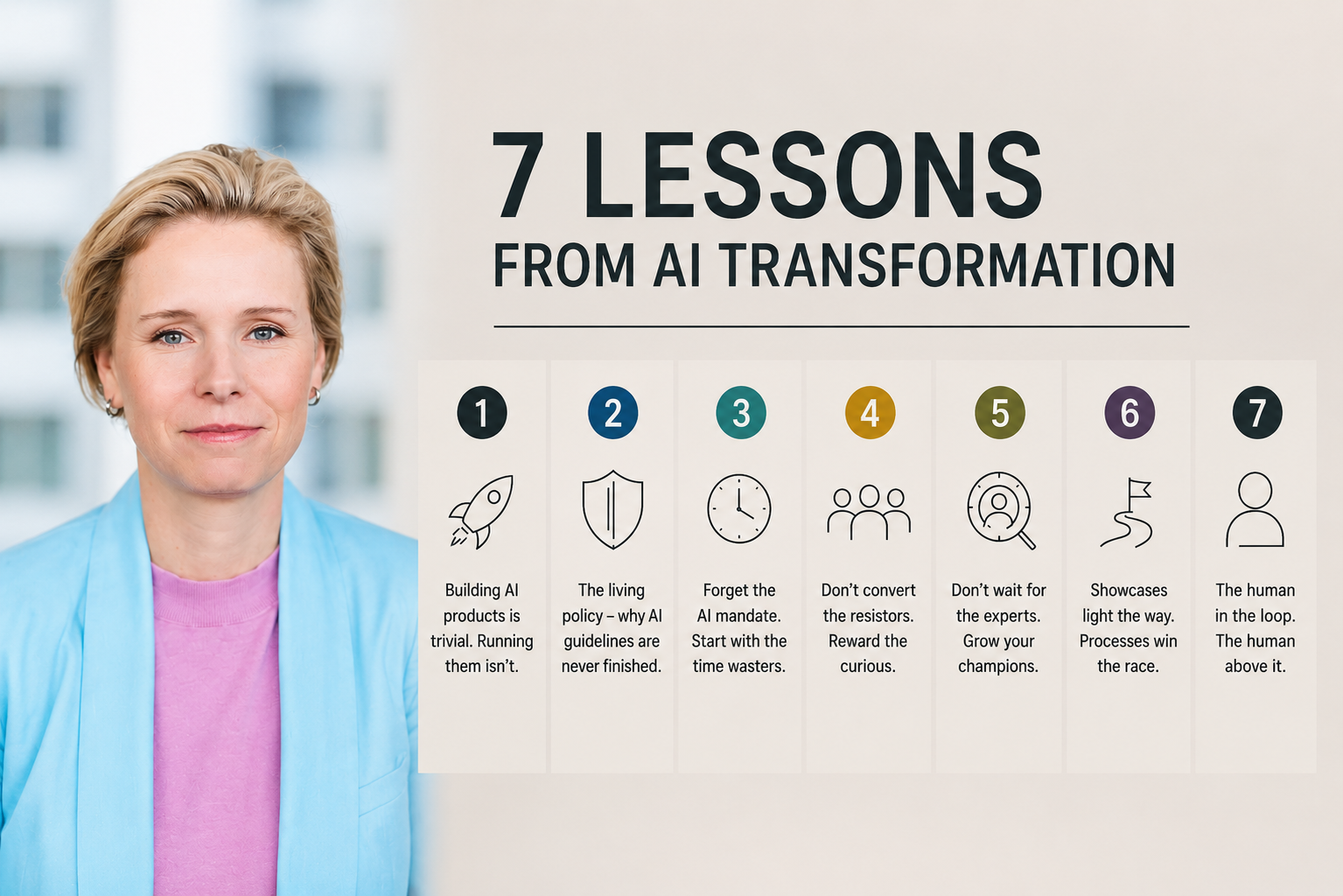
The reality is simple. Your AI guidelines are never finished. They are a living, breathing mechanism. They must function more like software code requiring regular patches than a plaque on a wall.
Where Traditional Guidelines Break Down
Most corporate policies fail because they are built on a foundation of prohibition rather than guidance. Blanket bans don't work. When you tell employees they are strictly forbidden from using public AI models, you don't actually stop them. You just push the behavior underground.
This creates a phenomenon known as Shadow AI. Employees want to do their jobs faster and more efficiently. If official channels block them, they will use personal devices, unverified accounts, and browser workarounds to access the tools they need.
Consider the real-world risk. A financial analyst wants to summarize a messy 80-page market report. The company blocks enterprise AI access due to vague security fears. The analyst copies the text, pastes it into a free, consumer-grade online model on their personal phone, and gets the summary. The company's proprietary data is now training a public model, completely exposed.
The policy caused the exact breach it was written to prevent.
Another failure point is ownership. Who owns the policy? If it sits entirely within the IT department, it lacks commercial nuance. If it belongs solely to Legal, it becomes so restrictive that it strangulates innovation. If HR runs it, the focus stays narrow, looking only at workforce displacement and hiring bias.
Building an Adaptive AI Framework
To survive this rapid evolution, you need to ditch the traditional PDF document. Shift toward an operational framework that adapts automatically to technological shifts.
Create a Tiered Risk System
Not all AI use cases carry the same weight. Writing a catchy email subject line using an LLM requires a different level of scrutiny than deploying an automated credit-scoring model.
Establish a clear, three-tiered classification system:
- Low Risk: Public data manipulation, brainstorming, copyediting, and scheduling assistance. These require minimal oversight but need basic data privacy hygiene.
- Medium Risk: Internal data analysis, customer-facing chatbots, and code generation. These require mandatory human-in-the-loop verification, data encryption, and regular accuracy audits.
- High Risk: Autonomous decision-making involving proprietary IP, HR evaluation tools, and financial forecasting. These demand explicit executive approval, rigorous bias testing, and continuous monitoring.
By categorizing tools based on risk rather than specific brand names, your framework remains intact even when a hot new startup displaces an incumbent vendor.
Establish a Cross-Functional AI Council
Get rid of departmental silos. An adaptive framework requires a dedicated team that meets monthly, not annually. This group must include representatives from legal, cybersecurity, product engineering, and frontline business units.
The council's job isn't to slow things down. Their mandate is to evaluate new capabilities, review grey-area use cases, and update the risk tiering in real time. They serve as the bridge between theoretical risk and commercial reality.
Shift from "No" to "How"
Instead of publishing a list of banned platforms, give your team a clear pathway to approval. If a marketing manager wants to use a new generative design tool, your framework should provide a self-service checklist.
Does the tool store data locally or on public servers? Does it claim ownership of inputted assets? Does it offer an enterprise tier with data privacy guarantees?
When you give employees a clear road map for onboarding new tech, they stop sneaking around the IT department. Compliance becomes the path of least resistance.
The Human Element is the Real Security Patch
You can write the most sophisticated, adaptive framework on earth, but it won't matter if your team doesn't understand it. True compliance isn't about ticking boxes on an HR portal. It requires continuous education.
Most data leaks don't happen because of malicious intent. They happen because well-meaning employees don't understand how data ingestion works. They don't realize that pasting text into a prompt box can sometimes mean giving away the company's secret sauce.
Run short, monthly workshops. Share actual examples of how the company is using AI successfully. Highlight the mistakes people made and how to avoid them. Make the conversation interactive.
Treat your employees like the first line of defense. When they understand the "why" behind the guidelines, they become active participants in protecting the company, rather than adversaries trying to bypass a bureaucratic bottleneck.
How to Audit Your System Today
Stop thinking of your AI policy as a project with a completion date. It's an ongoing operational process. To transition away from outdated, static models, take these immediate steps:
Find your existing document and look at the last modification date. If it's older than 90 days, it's obsolete. Gather your leadership team next week and review every clause against current market capabilities.
Launch an anonymous internal survey to discover what tools your teams are actually using on a daily basis. Don't punish people for their answers. Use the data to map your true AI footprint and identify where your current guidelines are falling short.
Transition your guidelines out of a static PDF and into an internal wiki or live document. Make it easily searchable, clearly categorized by risk tier, and update it instantly whenever the AI council approves a new tool or identifies a new vulnerability.
The companies that win don't have the strictest rules. They have the most adaptable systems.