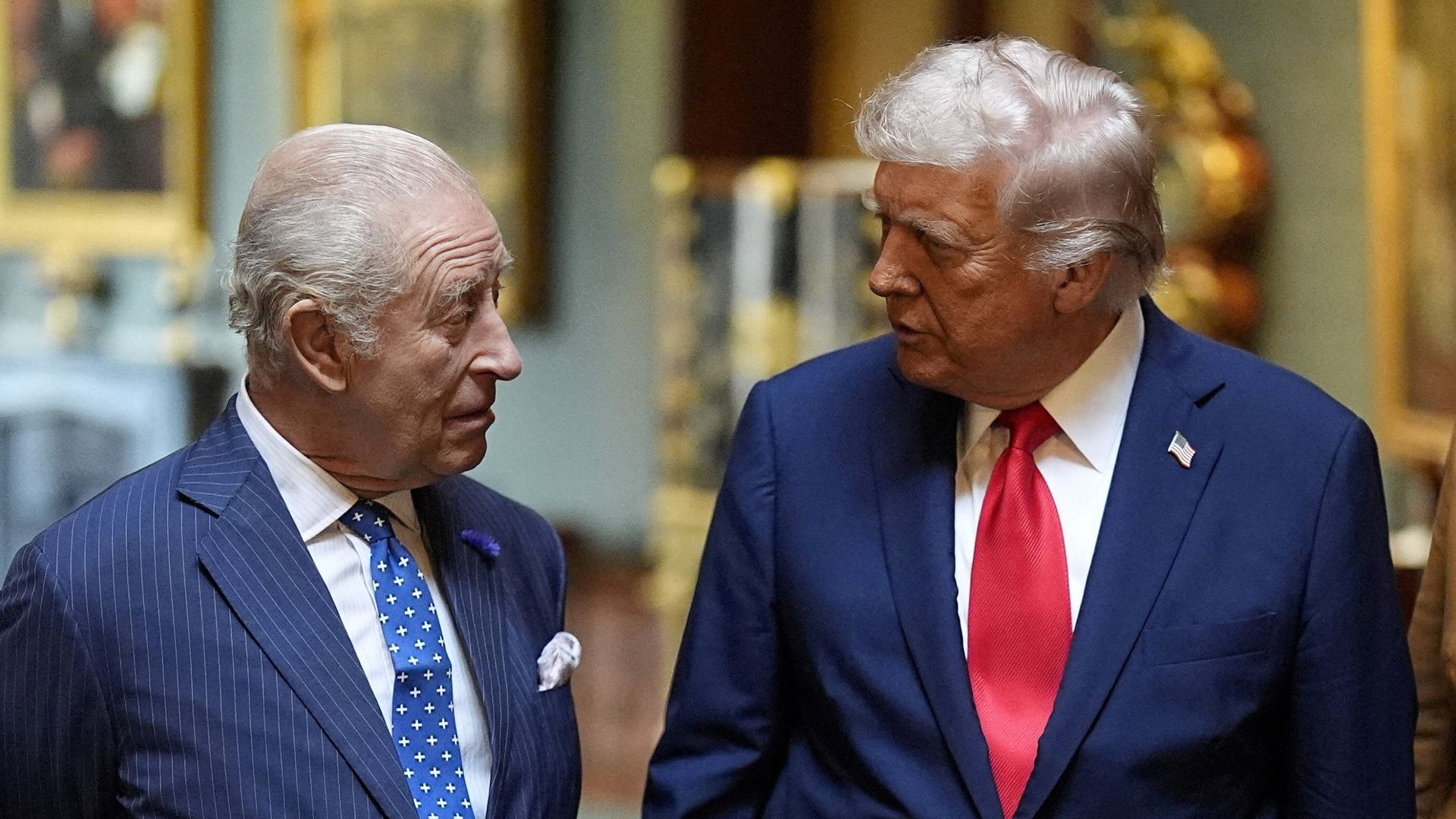
The polished silverware of a state dinner usually whispers of stability. It speaks of centuries-old alliances, of starched linens, and the quiet, rhythmic breathing of a world in order. But when King Charles III prepares to cross the Atlantic for a high-stakes visit to the United States, those silver forks will feel a little heavier. They will rest on a table set in the long, dark shadow of a rifle’s report.
History rarely waits for the guest list to be finalized. The news of the shooting at a Donald Trump rally didn't just ripple through the 24-hour news cycle; it shattered the glass casing of the diplomatic schedule. For the British monarchy, an institution built on the illusion of permanence, a trip into a nation vibrating with political volatility is no longer just a photo opportunity. It is a walk into a furnace.
The Weight of the Gilded Cage
Imagine, for a moment, the view from the window of a private study in Buckingham Palace. You aren't looking at the tourists with their plastic ponchos and selfie sticks. You are looking at a calendar where the dates are marked with the blood of a neighbor.
The King does not have the luxury of choosing a side. He is the personification of the state, a living flag that must remain unfurled even when the wind turns into a hurricane. When the news broke that a former president—and a current candidate—had been targeted by an assassin, the machinery of the Foreign Office didn't just shift gears. It ground to a halt to recalibrate the very nature of "safety."
Security is usually a matter of logistics. It’s about armored motorcades, vetted staff, and rooftop spotters. But the shooting changed the math. It introduced a psychological variable that no bulletproof glass can fully deflect: the unpredictable energy of a fractured electorate. The King isn't just visiting a head of state; he is visiting a country where the democratic process has become physically dangerous.
Diplomacy in the Danger Zone
We often treat state visits like episodes of a high-end period drama. We focus on the hats, the handshakes, and the subtle nods of protocol. But the core of this visit is far grittier. It is about the "Special Relationship" trying to find its footing on shifting sand.
British monarchs have navigated American turbulence before. Queen Elizabeth II saw the country through the civil rights movement, the Vietnam War, and the Cold War. But those eras, for all their strife, still functioned within a certain set of understood boundaries. The current American climate feels different. It is visceral. It is loud.
When the King lands, he will be walking a tightrope stretched over a canyon. If he spends too much time with the current administration, he risks appearing partisan in an environment where "partisan" can lead to violence. If he acknowledges the shooting too directly, he steps into the messy arena of American domestic policy.
The stakes are invisible but absolute. A single misstep, a poorly timed comment, or even a facial expression captured by a long-lens camera can be weaponized in seconds. In the age of the viral clip, the King’s silence must be as carefully choreographed as his speech.
The Ghost at the Table
Hypothetically, let’s consider a young diplomat tasked with the seating chart for the upcoming events. Every name is a potential landmine. In the wake of the Trump shooting, the atmosphere in Washington D.C. has thickened. It’s the kind of tension you can feel in your teeth.
This diplomat isn't just worried about who sits next to whom. They are worried about the conversation. How do you discuss trade, climate change, or defense when the primary topic in every guest's mind is the vulnerability of the men and women who lead?
The shooting served as a brutal reminder that the armor of high office is surprisingly thin. It reminded the world that the "Gilded Cage" is still a cage, and sometimes, the bars are the only thing keeping the chaos out. The King’s visit, once a symbol of the enduring bond between two giants, has become a test of whether that bond can survive a period of American internal combustion.
The Language of Silence
The British Monarchy is an expert in the art of saying everything by saying nothing. It is a survival mechanism honed over a thousand years of civil wars, beheadings, and social upheavals.
In the United States, we are used to the roar. We expect our leaders to shout, to condemn, to tweet, and to dominate the airwaves. The King offers the opposite. He offers the heavy, deliberate silence of institutional memory.
There is a specific kind of bravery required to be the quietest person in a room full of screaming. As Charles prepares for this visit, he isn't just bringing a message of goodwill. He is bringing a reminder that institutions can outlast individuals. He is a walking, breathing data point that suggests the world keeps spinning even when the bullets fly.
But will that message land? Or will it be drowned out by the sirens?
A Mirror Held to the Republic
There is an irony in a King visiting a Republic to provide a sense of calm. The United States was born from the rejection of the Crown, yet in moments of extreme national trauma, there is a strange, lingering fascination with the stoicism the Crown represents.
The shooting at the rally was a uniquely American tragedy—a collision of gun culture, political polarization, and the cult of personality. The King’s visit acts as a foil to that chaos. His presence is a reminder of a different way of doing things, one where the leader is a symbol rather than a lightning rod.
However, symbols are fragile. The Foreign Office knows that the "Trump Factor" is the gravity around which everything else orbits. To ignore the shooting would be seen as a slight by a massive portion of the American public. To address it too warmly would be seen as an endorsement of a man whose rhetoric often clashes with the very stability the King is meant to uphold.
The Logistics of a Haunted Journey
Behind the scenes, the security protocols have likely doubled. Every route is being re-scouted. Every public appearance is being weighed against the potential for protest or further violence.
It isn't just about the King’s physical safety. It’s about the optics of his protection. If the King is seen surrounded by a small army of tactical gear and automatic weapons, the message of "stability" is lost. It becomes a message of "siege."
The goal is to make the King look accessible in a country that currently feels inaccessible to its own people. It is a feat of engineering that requires more than just bulletproof vests; it requires a level of social engineering that few organizations can pull off.
Beyond the Headlines
If we look past the immediate shock of the shooting, we see a deeper narrative at play. This isn't just a story about a King and a candidate. It is a story about the fragility of the structures we take for granted.
We assume the world will keep working. We assume that state visits will happen, that dinners will be served, and that the "Special Relationship" will endure. But that endurance is a choice. It is a result of thousands of small, deliberate actions taken by people who refuse to let the chaos win.
The King’s decision to proceed with the visit—even as the political climate in the U.S. reaches a boiling point—is an act of defiance. It is a statement that the work of nations is more important than the violence of individuals.
The Long Walk to the Podium
When the King finally stands to speak during his visit, he will be looking out at a room full of people who are still processing the sight of a bloodied former president with his fist in the air.
He will feel the electricity in the air. He will know that his words are being weighed not just by the dignitaries in front of him, but by millions of people who feel like their country is slipping away.
He won't use the language of the campaign trail. He won't use the "game-changing" rhetoric of the cable news pundits. He will use the language of the ages. He will talk about duty. He will talk about history. He will talk about the things that remain when the shouting stops.
It is a gamble. In a world that craves fire, he is bringing a cool breeze.
The real story isn't the shooting itself, or the visit itself. It is the friction between the two. It is the moment where the oldest monarchy in the world meets the most modern, fractured democracy in its hour of crisis.
As the King’s plane touches down, he isn't just arriving in a country. He is arriving in a moment. And the world will be watching to see if the Crown can hold its steady, silent ground while the ground beneath it continues to shake.
The silver will be polished. The speeches will be vetted. The motorcade will roll. But beneath the surface, everyone knows the truth. The world changed in a field in Pennsylvania, and now, even a King must find a way to navigate the wreckage.