The spring air in Pyongyang usually carries the scent of apricot blossoms and coal dust. But on a recent morning, the atmosphere at a nondescript launch site was scrubbed clean by the smell of kerosene and burnt ozone.
Kim Ju Ae stood beside her father. She wore a dark, formal coat, her hair styled with a precision that mirrored the ballistic trajectories plotted on the monitors behind them. She is a child of perhaps eleven or twelve, an age when most are preoccupied with schoolyard social hierarchies or the private mysteries of growing up. Instead, she was watching the sky break.
Her father, Kim Jong Un, didn't just bring her to a military exercise. He brought her to a rehearsal for the end of the world.
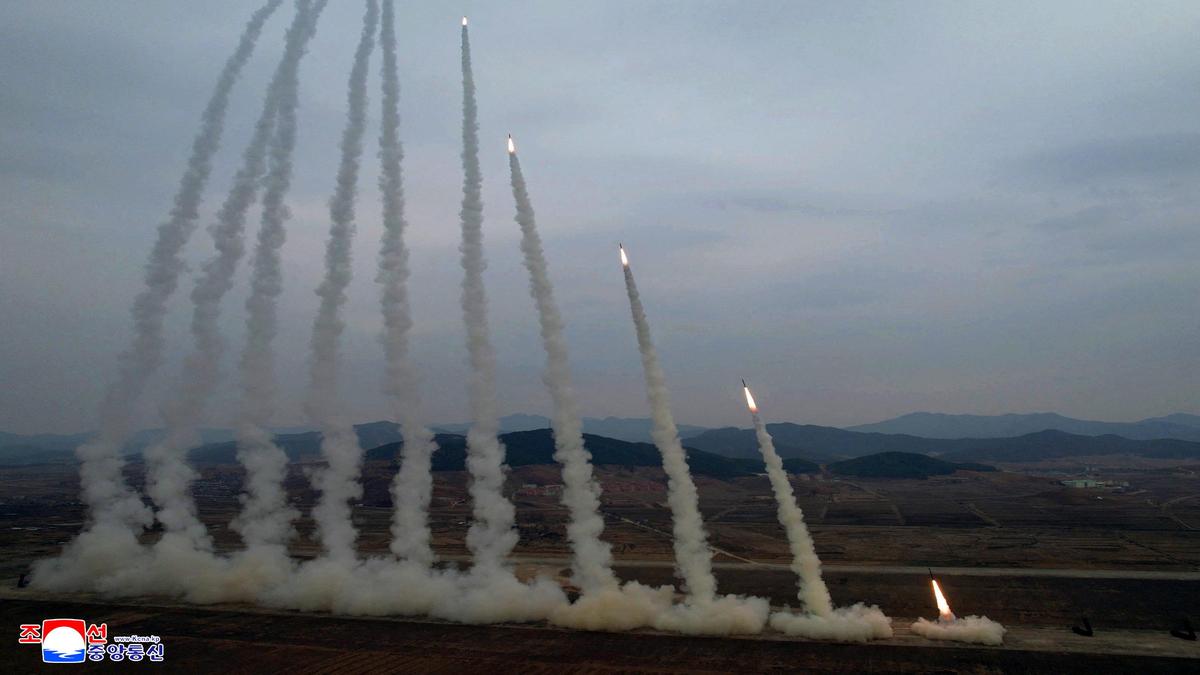
The weapons in question were 600mm super-large multiple rocket launchers. In the clinical language of a defense manual, these are "short-range ballistic missile systems." In reality, they are mobile, rapid-fire delivery mechanisms for tactical nuclear warheads. They are designed to saturate an area, leaving no room for interception, no time for prayer, and no space for escape.
The Architecture of the Shadow
To understand why this specific test matters, we have to look past the smoke. Traditional nuclear deterrence is built on the idea of the "big one"—the city-leveler that stays in its silo because using it means the total erasure of the person who pushed the button. It is a stalemate of ghosts.
Tactical nukes change the math. They are smaller. They are "usable." By miniaturizing the horror, the regime is attempting to make the unthinkable a viable Tuesday afternoon strategy.
Imagine a chessboard where one player suddenly introduces a piece that can wipe out five squares at once, and they have twenty of them hidden under the table. That is the 600mm system. It isn't meant for Washington. It is meant for the ports, the airfields, and the crowded command centers of the South.
Kim Jong Un looked at these steel tubes with a proprietary warmth. He spoke of "shaking the enemy's will" and "perfecting readiness." But the most chilling part of the tableau wasn't the technical specs of the rockets. It was the presence of the girl.
A Dynasty Written in Fire
Why bring a child to a missile range?
It is a message of terrifying permanence. By placing Ju Ae in the frame, the regime is telling the world that this isn't a temporary standoff. This isn't a "Kim Jong Un problem" that will vanish with his passing. It is a multi-generational commitment to the atom.
She represents the fourth generation of the Kim dynasty. Her presence suggests that the nuclear program is not a bargaining chip to be traded away for food or lifting sanctions. It is the family heirloom. It is the throne itself.
Think about the sensory experience for that young girl. The ground-shaking roar that hits you in the chest before you hear it. The heat of the ignition. The sight of six massive projectiles screaming toward a target island in the East Sea. For Ju Ae, this isn't "geopolitics." This is the family business. It is as normal to her as a CEO taking their child to a factory floor.
Except this factory produces nothing but the promise of fire.
The Mechanics of the Salvo
The test wasn't just about one rocket. It was about the "salvo."
In military terms, a salvo is a simultaneous discharge of artillery. The goal is to overwhelm. Modern missile defense systems, like the Patriot or the specialized THAAD batteries, are incredibly sophisticated. They are the equivalent of trying to hit a bullet with another bullet in a dark room.
But even the best marksman fails when someone throws a bucket of sand in their face.
By firing multiple, nuclear-capable rockets at once, North Korea is signaling that they can bypass the shield. They aren't looking for a surgical strike. They are looking for a flood.
The projectiles flew approximately 350 kilometers. That distance isn't a random number. It is the exact distance needed to reach any major military installation or population center in South Korea. The message was sent in a straight line, written in white smoke against a blue sky.
The Human Cost of the Invisible Stake
We often talk about these events in terms of "escalation" or "provocation." These are heavy, academic words that act as a buffer. They keep us from feeling the actual vibration of the event.
The real stake is the quiet morning in Seoul or Tokyo that never happens. It is the million individual lives—baristas, teachers, software engineers, grandmothers—who are currently living in the crosshairs of a 600mm tube.
There is a psychological weight to living under a "tactical" threat. Unlike the Cold War's "Mutual Assured Destruction," which felt like a distant, abstract nightmare, the tactical nuke feels intimate. It is the bullet in the chamber of a gun held to the side of a peninsula's head.
Kim Jong Un's laughter, captured in the state media photos, felt jarringly out of sync with the destruction being simulated. He looked like a man who had just won a round of golf. Beside him, Ju Ae watched with a composed, almost clinical interest.
This is the new normal.
The Logic of the Cornered
It is easy to dismiss this as madness. It is far more frightening to realize it is perfectly logical.
The North Korean regime knows that in a conventional war, they lose. Their planes are old. Their tanks are outmatched. Their soldiers are hungry. The only way to ensure survival—to ensure that Ju Ae one day takes the seat her father now occupies—is to be too dangerous to touch.
The rockets are their armor.
During the test, Kim called for the "modernization" of the entire force. He isn't satisfied with what he has. He wants more. More launchers. More warheads. More ways to ensure that no one ever dares to suggest a change in management in Pyongyang.
The tragedy lies in the diverted resources. Every kilogram of high-grade propellant represents a mountain of grain that never reached a village. Every precision-milled firing pin is a schoolbook that was never printed. The regime has mastered the art of building the most expensive things in the world while their people survive on the barest essentials.
It is a kingdom of ghosts fueled by the most advanced physics known to man.
The Silent Sky
As the dust settled at the launch site, the state media reports began their usual thundering praise. They spoke of "iron-willed" leadership and "shattering" the enemies of the state.
But the most haunting image isn't the explosion on the target island.
It is the image of a father and daughter walking back to their armored limousine. They are holding hands. It is a moment of domestic tenderness framed by the machinery of mass death.
In that handhold, the future is written. It is a future where the nuclear flame is passed from parent to child, a torch that illuminates nothing but the path to a deeper darkness. The rockets are back in their sheds now, cooling down, waiting for the next time they are needed to remind the world that the shadow is still there.
The apricot blossoms will fall in Pyongyang, and the coal dust will settle, but the sky will never truly feel empty again.