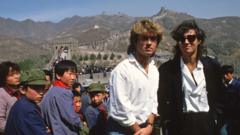
The air in Beijing in the spring of 1985 tasted of coal dust, cabbage, and caution. If you walked down Changan Avenue, the visual palette was strictly enforced by history: rows of heavy wool coats in dark blue, dull olive, and charcoal gray. People rode flying Pigeon bicycles in vast, silent rivers. To a Westerner stepping off a plane, the city felt like a photograph waiting to be developed. It was quiet. It was uniform.
Then came the cassette tapes. In related news, we also covered: The Boosie Pardon Grift: Why Rappers Keep Buying Into the Illusion of Political Leverage.
They arrived inside the Workers’ Stadium not with a trickle, but with a sudden, deafening crack. Two young British men stepped onto a stage under the harsh fluorescent lights, sporting massive hair, oversized white shoulder pads, and smiles that seemed to defy the gravity of the Cold War. George Michael and Andrew Ridgeley—collectively known as Wham!—had arrived.
For the fifteen thousand Chinese citizens sitting in the stands, the experience was less of a musical concert and more of a cultural alien abduction. IGN has provided coverage on this important subject in extensive detail.
To understand what happened inside that stadium, you have to look past the global headlines that flashed across televisions in London and New York. The West saw a marketing triumph, a diplomatic coup engineered by a clever manager who convinced a freshly opening communist nation to host a pop band. But the real story belonged to the kids in the audience who had never heard a bassline slap like a heartbeat. It belonged to a generation that had grown up under the strict artistic dictates of the Cultural Revolution, where music was a tool for collective labor, not personal euphoria.
Consider a hypothetical young man in the crowd—let us call him Xiao Liu. He is twenty years old, wearing his best pressed tunic, sitting next to a row of stern, uniformed police officers. He has a ticket that cost a week’s wages, given to him by a relative with connections. He has no idea what "Careless Whisper" means. He doesn't know who these two men are, only that they are from a magical, distant place where people wear gold earrings and dance without asking permission.
When the first notes of "Wake Me Up Before You Go-Go" thudded through the massive sound system, Xiao Liu did not move. Nobody did.
The silence was paralyzing. In 1985, Chinese audiences were accustomed to polite, rhythmic clapping at the very end of a performance. You sat still. You absorbed the message. You did not stand up. You certainly did not scream. Andrew Ridgeley would later recall looking out at a sea of blank faces, wondering if the entire show was crashing into a wall of cultural misunderstanding. The police stood at the front of the stage, facing the crowd, their expressions frozen, watching for the slightest sign of disorder.
But human curiosity is a volatile thing.
George Michael began to move. He paced the stage with a loose, kinetic freedom that looked completely improvised, even though it was highly choreographed. He shook his hips. He smiled directly at the front rows. Next to him, backing singers in bright, tropical colors swayed with an infectious rhythm.
Xiao Liu felt something strange in his chest. It was the physical impact of sub-bass frequencies, a sensation completely foreign to traditional Chinese instruments or state-sanctioned orchestras. The rhythm demanded a physical response. It was an invitation to feel something entirely separate from the group, entirely unique to oneself.
Slowly, the tension cracked.
A few brave students near the front tried to stand up and clap along. Instantly, officers moved in, ordering them back into their seats. The state was terrified of what this music represented—not just Western capitalism, but the untamed energy of youth. Yet, you cannot put a fence around sound. The music filled the concrete bowl of the stadium, bouncing off the gray walls and settling deep into the minds of everyone present.
By the time the band launched into the slow, aching melody of "Careless Whisper," the atmosphere had shifted. The initial shock had worn off, replaced by an intense, obsessive focus. The crowd was learning a new language in real time. They were realizing that music could be a vehicle for private desire, for heartbreak, for individual identity.
That single afternoon transformed the cultural trajectory of a nation.
It is easy to look back from the vantage point of the present day, where Beijing is a glittering metropolis of glass skyscrapers and underground rock clubs, and forget how fragile that moment was. The concert acted as a giant crowbar, wedging open a door that had been locked for decades.
In the weeks and months that followed, the black market for cassette tapes exploded. Young Chinese musicians who had been classically trained or who played acoustic folk songs suddenly traded their instruments for electric guitars and cheap synthesizers. The performance provided the exact spark that ignited the Chinese rock movement of the late 1980s. Pioneers of the scene would later point to that specific Wham! concert as the moment they realized music could be dangerous, beautiful, and completely free.
Andrew Ridgeley reflected on this years later, noting that they weren't just playing songs; they were introducing a concept of the modern world to a society that had been kept in the dark. The band didn't change the politics of the country overnight, but they changed the imagination of the people who would eventually build its future.
The concert ended not with a riot, but with a lingering sense of awe. As the lights came up and the crowd filed out into the chilly Beijing night, the silence returned, but it was a different kind of silence. It was the quiet of people processing an internal earthquake.
Xiao Liu walked back to his bicycle, the ringing in his ears matching the sudden, erratic pulse of his own ambitions. The sky above the city was still dark, still heavy with the smell of coal, but the gray had begun to fade. The world was suddenly much bigger than it had been two hours before, and it was impossible to ever make it small again.