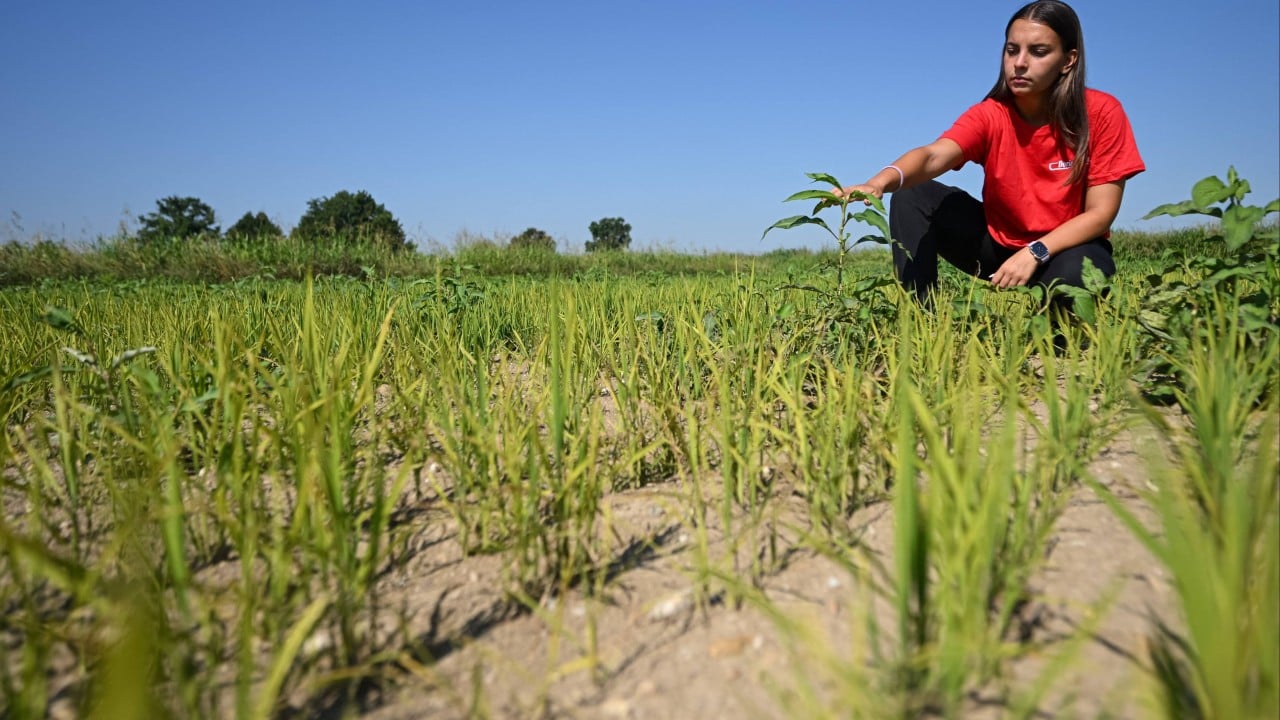
The mud beneath Fabrizio’s boots did not squelch. It shattered.
For three generations, the Balocco family has farmed the low-lying fields of the Po River Valley in northern Italy, a region often called the culinary heartbeat of the nation. This is where risotto was born. It is a landscape historically defined by water—an intricate, labyrinthine network of canals, flooded paddies, and rushing alpine streams that turned the plains into a shimmering emerald mirror. Read more on a related topic: this related article.
Now, that mirror is cracked.
When you walk through a traditional Italian rice paddy in July, your ears should be filled with a distinct, chaotic symphony. Frogs croak. Dragonflies buzz. The water itself makes a soft, rhythmic lapping sound against the earthen banks as it keeps the delicate roots of the Arborio and Carnaroli rice submerged. But during the recent European heatwave—a brutal, record-smashing meteorological event that climatologists confirmed as the worst the continent has ever seen—Fabrizio walked out into his fields and heard nothing. Further journalism by USA Today explores similar views on the subject.
Silence. The eerie, suffocating silence of a desert where an ocean used to be.
To understand the scale of what is happening in northern Italy, one must look past the dry statistics and look at a single grain of rice. Rice is not just a crop here; it is a cultural anchor. The Po River, stretching over 400 miles from the Cottian Alps to the Adriatic Sea, supplies the lifeblood for roughly a third of Italy’s entire agricultural production. In a normal spring, the melting snowcaps from the Alps fill the river to its brim, sending a predictable, icy rush of water down into the valley just as farmers begin to sow their seeds.
That snow never arrived. A winter of unprecedented drought left the mountains bare. Then came the summer heat, a relentless, oppressive blanket of hot air pushed up from Africa that parked itself over southern Europe for weeks on end. Temperatures routinely marched past 40 degrees Celsius. The Po River did not just drop; it gasped. It receded to levels not seen in seventy years, exposing vast, skeletal sandbars that looked like the bleached bones of a forgotten giant.
Consider the mechanical cruelty of a modern drought. When a major river system loses its pressure and volume, it does not just dry up from the source. The ocean fights back. With the Po flowing at a mere fraction of its normal strength, the saltwater of the Adriatic Sea began to push backward, crawling more than twenty miles inland up the riverbed.
This is the invisible poison. Rice is a thirsty plant, but it cannot drink salt. Farmers who desperately pumped what little water was left in the river branches inadvertently poisoned their own soil. The salt burns the roots, turning the vibrant green stalks a sickly, rust-colored brown.
Let us use a hypothetical scenario to understand the math confronting these farmers. Imagine a business where your fixed overhead costs—tractor fuel, specialized seeds, labor, fertilizer—remain entirely unchanged, but your access to the single raw material required to create your product is suddenly cut by 70%. You cannot ration the water evenly across the entire farm; if you give every acre only a third of what it needs, the entire crop dies. Instead, you are forced into a grim, agrarian triage. You must choose which fields to water and watch the rest burn under the sun. Fabrizio had to abandon nearly half of his acreage, sacrificing millions of potential meals to save a fraction of his livelihood.
The economic ripples of this dry spell extend far beyond the borders of the Piedmont and Lombardy regions. Italy produces roughly half of all the rice grown in the European Union. This is not the long-grain variety destined for a quick stir-fry; this is superfine, starch-rich rice designed specifically to absorb liquids and flavors to create the creamy texture of a perfect restaurant-grade risotto.
When the supply of Carnaroli drops by double digits, the impact hits the global supply chain like a hammer. Grocers across Europe and North America have already begun warning of stark price increases and empty shelves. The local trattoria in Rome or Florence is feeling the squeeze, forced to pay premium prices for a staple that used to be as cheap and ubiquitous as table salt.
But the true cost cannot be measured solely in euros or dollars per kilo. The real tragedy lies in the unraveling of a way of life.
The people of the Po Valley have a unique relationship with their land. The mondine—the historic female rice paddy workers who spent their days knee-deep in the water, weeding the fields and singing songs of resistance and solidarity—are a legendary part of Italian cultural history. Their songs still echo in the folklore of the region. To see these historic wetlands transformed into dusty, cracked plains feels less like a bad harvest and more like a cultural eviction.
There is a temptation to look at these events and view them as an isolated, freak occurrence. A bad year. A streak of terrible luck. But the data tells a far more stubborn story. The Mediterranean basin is warming significantly faster than the global average. The historic heatwave that crippled the continent was not a statistical anomaly; it was a preview.
Farming has always been a gamble with the elements, but the rules of the game have been rewritten overnight. In the past, a farmer could look at the sky, read the clouds, and rely on generational wisdom passed down from grandfather to grandson. Today, that wisdom is obsolete. The weather patterns that sustained the valley for centuries have become volatile and unrecognizable.
The response to this crisis requires a radical reimagining of how we interact with our natural resources. Some farmers are experimenting with dry-seeding methods, a technique that requires significantly less water during the early stages of growth. Others are looking into tech-driven irrigation systems that use satellite data to drop water with pinpoint precision, down to the exact milliliter required by an individual plant.
Yet, technology can only do so much when the primary source of water simply ceases to exist. If the alpine glaciers continue to shrink and the winter snows fail to return, no amount of smart irrigation can save the valley. It is an uncomfortable, terrifying reality that many families are only now beginning to voice out loud.
The sun begins its slow descent over the Balocco farm, casting long, amber shadows across the parched earth. In the distance, a dry wind kicks up a swirl of fine dust from a field that should be vibrant green and teeming with life. Fabrizio reaches down, picks up a handful of the powdery soil, and lets it slip through his fingers. It drifts away in the breeze, light as ash.
The world will likely continue to debate emission targets, infrastructure budgets, and climate policy in air-conditioned rooms hundreds of miles away. But here on the ground, in the quiet corners of northern Italy, the debate is already over. The water is gone, the earth is dry, and a centuries-old heritage is quietly blowing away into the summer wind.