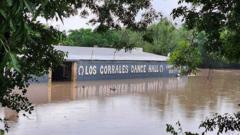
Stop calling it a tragedy when gravity does its job.
Every time a river basin in the Texas Hill Country swells, sweeps away campsites, and claims lives, the media deploys the same tired script. They talk about "unprecedented rainfall." They profile the victims with somber music. They treat a predictable hydrological certainty as an act of an angry, unpredictable God. In other developments, we also covered: The Materials Science and Cost Realities of the Lincoln Memorial Reflecting Pool Failure.
It is a lie.
The recent flooding in the exact same corridors where campers have previously died is not a freak statistical anomaly. It is the natural, inevitable outcome of human arrogance meeting basic topography. We have spent decades convincing ourselves that we can civilize flash flood alleys with warning signs, concrete retaining walls, and colorful recreation maps. The Guardian has provided coverage on this important topic in extensive detail.
We cannot. The hard truth is that camping in these zones is not "outdoor adventure." It is hydrological roulette. And the house always wins.
The Topography of a Funnel
To understand why people keep dying in the same spots, you have to throw out the comforting myths sold by local tourism boards.
The Texas Hill Country is essentially a massive limestone slab covered in a thin layer of topsoil. It has virtually no absorption capacity. When a storm system stalls over this region—which happens with mathematical regularity—the ground does not act like a sponge. It acts like a concrete parking lot.
Every drop of rain immediately becomes runoff. Because of the steep, rocky terrain, that runoff does not spread out evenly. It finds the nearest dry creek bed, ravine, or canyon and rages downward.
- The Velocity Factor: Water flowing down these limestone chutes behaves less like a rising lake and more like a collapsing building. It carries boulders, uprooted cypress trees, and asphalt.
- The Compression Factor: As millions of gallons of water are forced into narrow river canyons, the depth of the water increases exponentially in minutes. A serene stream can become a thirty-foot wall of liquid concrete before a camper can even unzip their tent.
I have spent fifteen years analyzing watershed data and advising municipal planning boards on flood plain management. I have watched cities spend millions of dollars on sophisticated early-warning sirens and automated road barriers. Yet, year after year, people still drown in their sleeping bags or get swept off low-water crossings.
Why? Because our entire approach to outdoor recreation safety is built on a fundamental misunderstanding of risk.
The Myth of the Hundred-Year Flood
If you want to find the root of this systemic failure, look no further than the terminology used by engineers and repeated by journalists. The term "100-year flood" is one of the most damaging pieces of jargon ever unleashed on the public.
Ask the average camper what a "100-year flood" means, and they will tell you it is a severe flood that only happens once every century. They assume that if a major flood happened five years ago, they are safe for another ninety-five.
This is dangerously wrong.
A 100-year flood is a statistical concept representing a 1% probability of occurring in any given year.
The Real Probability Matrix
Let us break down the actual math of risk over time. If you own a cabin or frequently camp in a designated 100-year floodplain, your risk is not a negligible fraction.
| Time Horizon | Probability of Experiencing a 1% (100-Year) Flood |
|---|---|
| 1 Year | 1% |
| 10 Years | 9.5% |
| 30 Years (Standard Mortgage) | 26% |
| 50 Years | 39.5% |
A one-in-four chance of your property being completely inundated during a standard mortgage is not a rare, catastrophic outlier. It is a highly probable event.
When you camp in these areas during the spring or autumn storm seasons, you are betting your life on a statistical distribution that you do not understand. Worse, municipal authorities continue to hand out camping permits in these high-velocity zones, hiding behind the excuse that "nature is unpredictable."
It is entirely predictable. We just choose to ignore the math because closed parks do not generate tourism revenue.
Dismantling the Illusions of Safety
Let us address the questions that inevitably dominate the search engines whenever these disasters strike. The answers usually provided by "survival experts" are not just useless—they are actively lethal.
PAA: "How do I survive a flash flood while camping?"
The standard advice tells you to watch the weather report, monitor local river gauges on your phone, and seek high ground if you hear rushing water.
This advice assumes you have time, signal, and visibility.
In a real Hill Country flash flood, you have none of these.
- The Signal Fallacy: The deepest canyons—the exact places where people love to pitch tents because of the shade and scenery—are notorious cellular dead zones. Your weather app will show a clear radar screen from three hours ago because it cannot refresh.
- The Acoustic Fallacy: You will not hear the water coming. The sound of heavy rain hitting your tent canopy easily drowns out the rumble of an approaching flood wall until it is literally tearing through your campsite.
- The Night Fallacy: Most convective storm complexes in Texas peak between midnight and 4:00 AM. Trying to navigate a steep, muddy, limestone cliffside in pitch darkness while carrying children or gear is a highly effective way to fall to your death before the water even reaches you.
The only real way to survive a flash flood while camping is to never camp in a river bend, canyon floor, or low-lying floodway during storm season. Period. If your campsite is within fifty vertical feet of a riverbed in the Hill Country, and the forecast calls for even a 20% chance of rain, you are sleeping in a trap.
PAA: "Why can't we build better flood walls and dams to protect these areas?"
This question exposes our deep-seated obsession with engineering our way out of natural limits.
You cannot build a retaining wall big enough to contain a flash flood in a limestone canyon without turning the entire natural park into a concrete drainage ditch. Even if you did, you would simply accelerate the water, pushing the catastrophic destruction further downstream to the next town.
Furthermore, infrastructure creates a psychological trap known as the Risk Compensation Effect. When you build a levee or a retention basin, people feel safer. Because they feel safer, they build more permanent structures, camp closer to the water, and ignore warning signs. The infrastructure does not eliminate the risk; it merely pools it up until a storm eventually exceeds the design capacity, resulting in an even larger catastrophe.
The Structural Cowardice of Local Government
We need to stop treating these events as tragedies of nature and start treating them as failures of policy.
Every time a camper dies in a known flash-flood zone, local officials issue press releases expressing condolences and reminding people to "Turn Around, Don't Drown." This is a classic deflection tactic. It shifts the entire burden of safety onto the individual while the system continues to profit from placing people in harm's way.
If a theme park operated a roller coaster that derailed and killed passengers every few years under specific, predictable weather conditions, we would shut it down and prosecute the operators. Yet, state and local parks continue to lease out low-lying campsites directly in the path of known floodways, relying on liability waivers and flimsy warning signs to cover their legal flanks.
- The Permitting Loophole: Parks routinely book campsites months in advance and refuse to offer refunds for bad weather unless an official evacuation order is issued. This incentivizes families who saved money for a vacation to stick out a storm rather than lose their investment.
- The Valuation Lie: We value the short-term economic boost of outdoor tourism over the long-term cost of search-and-rescue operations. When a flash flood hits, we risk the lives of swift-water rescue teams, helicopters, and local first responders to drag negligent or uninformed campers out of trees.
The Cold Reality
If you want to enjoy the wild spaces of Texas, you must accept them on their terms, not yours.
The rivers of the Hill Country were not designed for your weekend relaxation. They are high-energy drainage channels shaped by millennia of extreme weather. They do not care about your camping reservation, your expensive gear, or your family vacation.
If you choose to sleep in a dry creek bed because it looks picturesque, you are participating in a system of denial. When the water rises, there will be no heroic rescue, no miraculous escape, and no mysterious act of God to blame. There will only be gravity, water, and the consequence of your own bad math.


