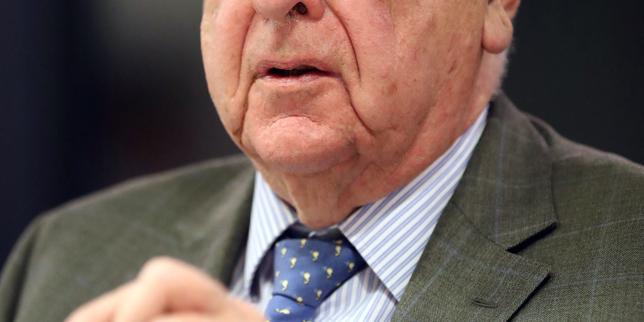
The death of Étienne Davignon at age 93 brings a sudden, permanent halt to Belgium's most anticipated war crimes trial. As the last surviving suspect in the 1961 assassination of Congolese independence leader Patrice Lumumba, the prominent count and former European Commissioner died in Brussels just weeks after a court ordered him to stand trial. His passing officially closes the criminal case, frustrating a fifteen-year legal battle by the Lumumba family and cementing a pattern of institutional delay that has shielded colonial-era officials from accountability for more than six decades.
For the Belgian establishment, Davignon was an architect of modern Europe and a titan of domestic industry. For historians and human rights lawyers, he represented the final link to an era of state-sponsored violence that shaped modern Africa. The termination of his trial means the public will never see a full judicial examination of the state machinery that engineered the removal and execution of the Democratic Republic of the Congo's first democratically elected prime minister. If you found value in this piece, you should read: this related article.
The Wire Service Record versus the Court Docket
Most obituaries frame Davignon as a grandfather of European integration who was incidentally shadowed by a late-life legal dispute. This perspective ignores the specific nature of the criminal charges leveled against him by the Brussels federal prosecutor's office.
Davignon was not accused of pulling the trigger in the Katangan savannah. He was charged with war crimes, specifically concerning the unlawful detention, transfer, and degrading treatment of Lumumba, as well as two of his political allies, Maurice Mpolo and Joseph Okito. For another perspective on this event, check out the recent update from USA Today.
In late 1960 and early 1961, Davignon was a young, ambitious diplomat operating inside the Belgian Ministry of Foreign Affairs. Investigators alleged that he helped facilitate the logistics and bureaucratic cover necessary to hand Lumumba over to his sworn enemies in the breakaway region of Katanga, fully aware of the likely outcome.
[Belgian Foreign Ministry / Young Diplomats]
               │
               ▼
   [Logistical Facilitation] ──► [Unlawful Transfer to Katanga]
                                              │
                                              ▼
                                   [Execution of Lumumba]
Davignon denied all charges. His defense focused on his junior status at the time, arguing that a low-ranking diplomat could not be held responsible for the geopolitical strategies of a colonial power. Yet, documents uncovered during a 2001 Belgian parliamentary inquiry showed that even junior officials within the ministry wielded significant operational influence during the chaotic transition of power in Léopoldville.
The Strategy of Judicial Attrition
The Lumumba case did not fail because of a lack of evidence. It failed because of time.
The criminal complaint was originally filed by François Lumumba in June 2011. It targeted ten Belgian individuals, including military officers, police inspectors, and intelligence operatives. Over the next fifteen years, the investigation crawled through the Belgian judicial system, delayed by bureaucratic hurdles, appeals, and political resistance. One by one, the defendants died of old age.
By the time the Brussels council chamber issued its historic order on March 17 to send the case to a criminal court, Davignon was the sole survivor. His defense team immediately filed an appeal, a standard legal maneuver that guaranteed months of additional delay. He died before that appeal could be resolved.
This outcome highlights a significant flaw in how western legal systems handle historical state crimes. When investigations into state-sponsored assassinations take decades to reach an indictment, biology guarantees immunity. The state avoids the discomfort of a public trial, and the accused avoids a verdict.
From Colonial Envoy to Corporate Titan
To understand how Davignon evaded accountability for so long, one must look at his position within the Belgian state. He was not an isolated actor; he was the embodiment of the country's ruling class.
Born into an aristocratic diplomatic family—his grandfather was Belgium's Foreign Minister at the start of World War I—Davignon transitioned smoothly from the wreckage of the Congo empire into the leadership of the European project.
- 1959: Enters the Belgian diplomatic service just as the Congo crisis begins.
- 1960s: Becomes chief of staff to Paul-Henri Spaak, one of the founding fathers of the European Economic Community.
- 1977-1985: Serves as European Commissioner for Industrial Affairs, restructuring the continent's collapsing steel industry through aggressive state-intervention quotas.
- 1989-2001: Chairs the Société Générale de Belgique, a massive holding company that historically controlled much of the Congo's mineral wealth.
His career demonstrates that the networks of power running the Belgian colonial apparatus did not disappear after African independence. They simply moved into corporate boardrooms and European Union institutions. Davignon sat on the steering committee of the Bilderberg Group, chaired Brussels Airlines, and was elevated from viscount to count by King Philippe in 2018.
An establishment does not easily prosecute its own architects. The reluctance to push the Lumumba investigation forward was directly tied to Davignon's status as a living symbol of post-war Belgian success.
The Shift to Civil Action and the State Debt
The criminal case is over, but the legal battle is changing form. Representatives for the Lumumba family announced they will now pursue civil litigation directly against the Belgian state.
This shift moves the focus from personal criminal liability to institutional responsibility. A civil suit avoids the problem of the defendant's death, focusing instead on the state's actions as a continuous legal entity. The family’s legal team intends to use the historical and factual foundations established during the fifteen-year criminal investigation to argue that the Belgian state owes a legal and moral debt for its role in destroying the Congo’s early democracy.
The evidence remains formidable. The 2001 parliamentary commission concluded that Belgium bore "moral responsibility" for the assassination, admitting that King Baudouin and senior ministers wanted Lumumba removed from power. The commission stopped short of admitting direct legal complicity, a distinction that civil courts will now have to evaluate.
The stakes extend beyond financial compensation. A civil judgment validating the war crimes charges would legally establish that Belgium’s involvement in the execution went beyond passive approval to active logistical support.
An Unresolved Precedent
The sudden termination of the trial leaves a significant gap in international law and colonial history. A full trial would have set a precedent for how European domestic courts handle crimes committed during the retreat from empire. Instead, the history remains unadjudicated.
Belgium has made symbolic gestures in recent years. In 2020, King Philippe expressed his "deepest regrets" for the violence of colonial rule, and in 2022, the government returned Lumumba's remaining physical relic—a single gold tooth seized by a Belgian police officer who helped dissolve the leader's body in acid.
These symbolic actions contrast sharply with the resistance to actual legal accountability. Returning a tooth while allowing the judicial process to stall until the last suspect dies shows a clear preference for public relations over legal consequences.
The death of Count Davignon ensures that the individuals who managed the transition from colonial exploitation to modern European governance will never face cross-examination. It leaves the truth buried in archives and incomplete court files, forcing the descendants of the victims to pursue an indifferent state while the actors themselves slip quietly into history.