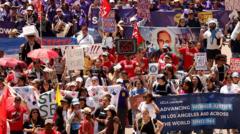
The placards lining the streets of Los Angeles and Chicago this May Day carry the familiar slogans of the 1880s, but the desperation behind them is distinctly modern. While traditional news outlets focus on the spectacle of the marches, they miss the tectonic shift occurring beneath the pavement. This isn't just an anniversary of the Haymarket Affair. It is a mass realization that the standard tools of American labor—contract negotiations, NLRB filings, and incremental raises—are failing to keep pace with an economy that has effectively reclassified "stability" as a luxury.
We are witnessing the birth of the unquantifiable political strike. Unlike the localized walkouts of the past decade, the rallies in 2026 are no longer just about a few extra dollars in the paycheck. They are a direct response to a coordinated rollback of worker protections and the unchecked integration of generative automation into the white-collar and service sectors alike.
The Illusion of the Union Resurgence
On paper, the labor movement looks healthy. The Bureau of Labor Statistics recently reported that union membership hit 16.5 million in 2025, the highest raw number in over a decade. But numbers lie. While nearly half a million workers unionized last year, the private sector membership rate remains stuck at a dismal 6 percent.
The growth is almost entirely concentrated in the public sector, where federal employees are unionizing at record rates to shield themselves from executive orders aimed at stripping their civil service protections. In the private sector, the "Amazon effect" has reached its logical conclusion: high-profile organizing wins at individual warehouses have not triggered the promised national wave. Instead, they have been met with a sophisticated, AI-driven attrition strategy that wears down organizers before they can ever reach a first contract.
The AI Shadow Over the Picket Line
The "May Day Strong" organizers are demanding transparency that the current administration has systematically dismantled. A series of federal reversals has effectively killed the Biden-era requirements for companies to disclose how and where they use AI to monitor or replace staff.
In call centers across the South and Midwest, workers are being "augmented" out of existence. It isn't a sudden mass layoff that makes the evening news. It is the slow, silent reduction of hours and the shifting of complex tasks to algorithmic systems, leaving human workers with the repetitive, low-value scraps that pay half as much. This is the "frontloaded" displacement that economists warned about, and it is happening without a single legislative guardrail in place.
Why a General Strike is No Longer a Radical Pipe Dream
For decades, the "General Strike" was a term reserved for history books or fringe pamphlets. That changed this year. Organizers are openly treating these May Day demonstrations as a "dress rehearsal" for a nationwide work stoppage in 2028.
The strategy has shifted from economic to existential. By linking labor rights with immigration policy and housing costs, the movement is building a coalition that legacy unions ignored for half a century. In Minneapolis and Atlanta, the rallies specifically targeted the "rigged system" of tax dollars being diverted from human needs to enforcement and corporate subsidies.
This isn't about "fostering" a better workplace culture. It is a cold, calculated attempt to use the only leverage left: the refusal to participate in "business as usual." When the cost of living outpaces even the most aggressive union-won raises, the traditional strike loses its teeth. If a 10 percent raise still doesn't cover rent, the worker has nothing left to lose by walking off the job indefinitely.
The Geography of Resistance
The intensity of these rallies is not uniform. The West Coast remains the heart of the movement, with California’s robust strike activity propping up national statistics. However, the most significant developments are happening in "unlikely" cities like Charlotte and Phoenix, where the influx of tech and logistics jobs has brought with it a new, militant class of college-educated workers who find themselves in the same precarious boat as the warehouse staff.
These workers are not waiting for the AFL-CIO to give them a signal. They are utilizing "sick-outs" and wildcat actions to bypass the restrictive labor laws that make legal striking almost impossible in many states.
The Brink of a New Labor Era
The current administration's rollbacks on safety and AI transparency have created a vacuum that is being filled by anger. The Goldman Sachs estimates of 300 million jobs exposed to automation are no longer abstract projections; they are the daily reality for graphic designers, paralegals, and administrative assistants who are seeing their industries hollowed out in real-time.
The 1886 fight was for the eight-hour day. The 2026 fight is for the right to exist in an economy that seems increasingly designed to function without a human workforce. The rallies we see today are the final warning. If the legislative response remains stuck in the 20th century, the "unquantifiable" political strikes of this year will become the standardized chaos of the next.
Pick up a sign or pick up the pace of the status quo. There is no middle ground left.