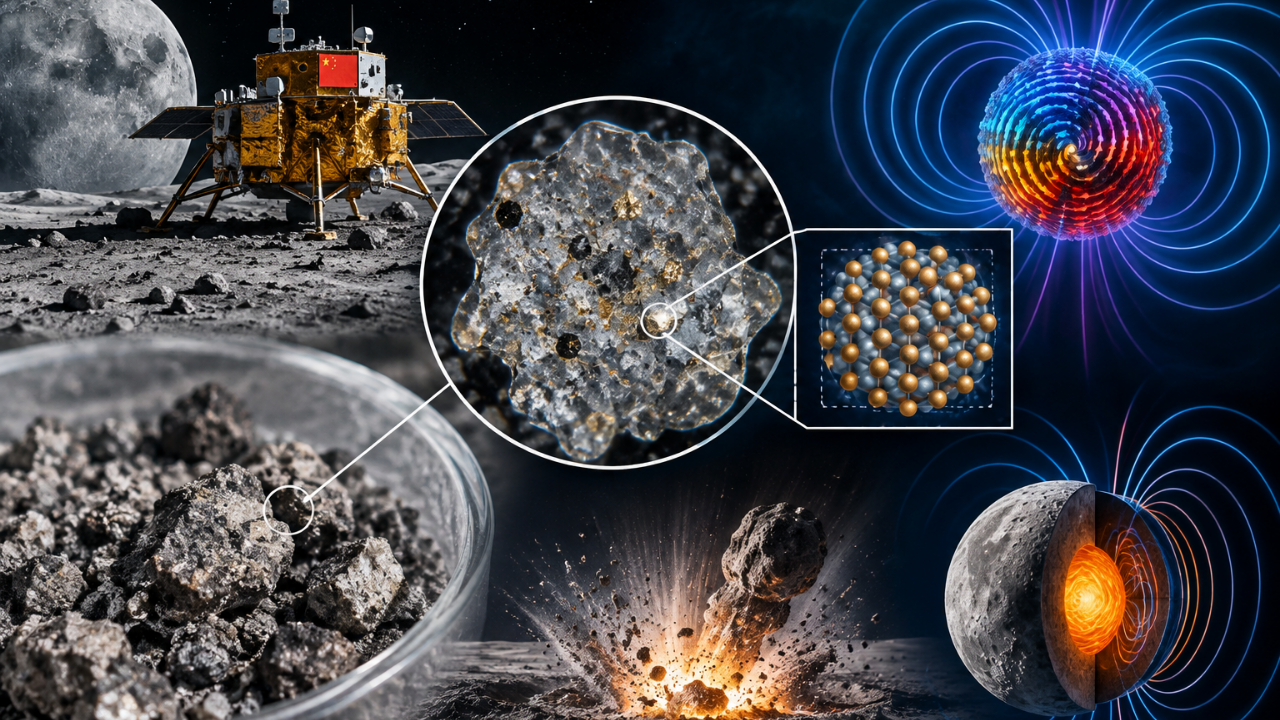
Planetary paleomagnetism relies on structural memory within minerals. When molten planetary material cools below the Curie temperature, ferromagnetic domains align with the prevailing external magnetic field, preserving a permanent record. On Earth, this record is dominated by iron oxides such as magnetite. On the Moon, which lacks a global magnetic field today yet displays localized crustal magnetic anomalies, the recording mechanism remains an active debate in planetary geophysics. The recovery of lunar soil samples from the South Pole-Aitken Basin by the Chang'e-6 mission provides new empirical data that reshapes this understanding, centering on the identification of face-centered cubic gamma-iron ($\gamma$-Fe) preserved within impact glass.
Thermodynamic Instability and Preservation Mechanics
Under standard planetary conditions, pure metallic iron exists in two primary crystal structures depending on temperature and pressure. Below 912 degrees Celsius, body-centered cubic alpha-iron ($\alpha$-Fe) is the thermodynamically stable phase at low pressure. Pure gamma-iron, characterized by a face-centered cubic (FCC) lattice, is stable only within a high-temperature bracket spanning roughly 912 to 1,394 degrees Celsius. As molten iron cools under normal geological timescales, it undergoes an allotropic phase transition, completely converting from the FCC $\gamma$-phase to the BCC $\alpha$-phase.
The detection of abundant $\gamma$-Fe nanoparticles trapped inside impact-glass fragments within Chang'e-6 lunar soil contradicts standard slow-cooling expectations. Analytical transmission electron microscopy and electron holography reveal that gamma-iron constitutes the dominant fraction of metallic iron in the analyzed impact-glass grains. Two distinct mechanisms account for this anomalous survival:
- Thermal Quenching: High-velocity meteorite impacts on the airless lunar surface generate extreme, transient thermal spikes followed by instantaneous radiative and conductive cooling. This rapid quenching freezes the molten droplet's atomic arrangement before atoms can rearrange into the stable alpha lattice.
- Matrix Mechanical Confinement: The surrounding silica-rich glass exerts compressive mechanical constraints and thermal expansion mismatches on the embedded nanoparticles. This glassy encapsulation prevents grain growth and suppresses the structural phase transition.
Magnetic Domain States as Paleomagnetic Recorders
The utility of these microscopic iron inclusions as paleomagnetic archives depends directly on their domain configuration. Traditional paleomagnetism favors stable single-domain (SD) grains because they resist thermal agitation and magnetic decay over geological timescales. However, multi-domain grains are prone to internal flux closure, which degrades their remanence retention.
Electron holography of the Chang'e-6 $\gamma$-Fe nanoparticles demonstrates the presence of stable single-vortex (SV) magnetic states. A single-vortex configuration forms in nanoparticles whose dimensions sit between the single-domain threshold and multi-domain states.
- Vortex Core Stability: The magnetic induction lines curl into a closed vortex loop around a central core. This configuration minimizes magnetostatic energy while resisting external demagnetization.
- Remanence Retention: Unlike multidomain particles that easily lose or alter their magnetization, single-vortex $\gamma$-Fe nanoparticles retain a stable remanent magnetic field. This structural property enables them to act as microscopic magnetic fossils, preserving ancient field signatures generated either by a long-lost lunar core dynamo or by transient impact-generated plasma fields.
Quantifying the Lunar Magnetic Budget
Bulk magnetic measurements of Chang'e-6 surface soils reveal heightened magnetic susceptibility, higher saturation magnetization ($M_s$), and elevated saturation remanence ($M_{rs}$) compared to mare basalts returned by earlier nearside missions. Empirical scaling relating the $I_s/\text{FeO}$ ratio estimates the metallic iron content in the analyzed far-side soil at approximately $0.75%$, pointing toward advanced soil maturity driven by extensive micrometeoroid bombardment and space weathering.
This high concentration of ferromagnetic carriers introduces a distinct analytical challenge: separating primary dynamo signals from impact-induced remanent magnetization.
- The Core Dynamo Hypothesis: A historically active lunar core dynamo would have generated a global dipole field, aligning the moments of cooling minerals uniformly across broad geographic zones.
- The Impact Plasma Hypothesis: High-energy hypervelocity impacts generate expanding vapor and plasma clouds carrying strong transient magnetic fields, which can instantaneously imprint local magnetic vectors onto newly formed impact glass.
The presence of single-vortex $\gamma$-Fe within impact glass strongly favors the latter or a hybrid recording pathway, where impact-generated microstructures record localized field conditions rather than purely global dipole metrics. Consequently, researchers must evaluate the exact spatial distribution and host matrix context of each nanoparticle before assigning its magnetic vector to a global core dynamo timeline.
Strategic Analytical Forecast
Future lunar sample analysis must move beyond bulk magnetic susceptibility toward site-specific, nanometer-scale correlative microscopy. To resolve whether the Moon sustained a stable core dynamo for billions of years or experienced episodic, impact-driven magnetic pulses, investigators must isolate the absolute chronology of individual impact-glass spherules using high-precision argon-argon dating coupled with nanoscale magnetic mapping.
The presence of preserved gamma-iron establishes that lunar impact glass functions not merely as degraded debris, but as a high-fidelity preservation medium. Quantitative modeling of cooling rates and mechanical stress within synthetic impact analogues will determine the exact threshold values required to trap single-vortex $\gamma$-Fe. If these thresholds can be reliably modeled, planetary scientists can reconstruct localized paleointensity vectors with unprecedented fidelity, converting anomalous mineral phases into a rigorous chronological index of lunar interior evolution.