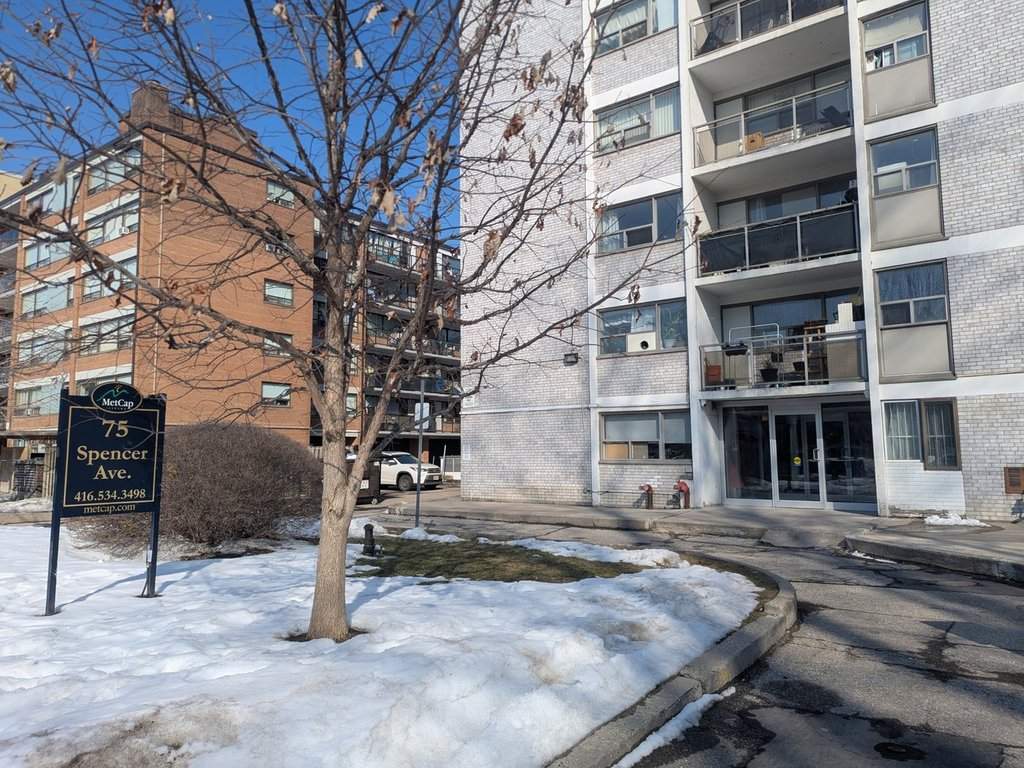
Residential real estate economics operates on a predictable cash-flow model where rental income services debt, funds capital expenditures, and yields investor returns. When tenants disrupt this revenue stream through collective withholding, the financial equilibrium of a property manager shifts instantly. The recent resolution of the six-month rent strike at 75 Spencer Avenue in Toronto, where property manager MetCap Living withdrew an above guideline rent increase application after persistent tenant action, exposes the mechanical realities of landlord-tenant financial leverage. Analyzing this event requires stripping away emotional rhetoric to examine the cost functions, legal frameworks, and strategic game theory that dictate outcomes in rent-controlled housing markets.
The Ontario residential rental market functions under statutory price ceilings established by the provincial government, which set the annual maximum allowable rent increase for eligible units. However, the regulatory framework includes a statutory escape valve known as the Above Guideline Increase application. This mechanism permits property owners to apply for rent hikes exceeding the standard provincial cap to offset extraordinary capital expenditures, municipal tax spikes, or security costs. Property owners view these applications as essential tools to maintain net operating income against inflationary pressures, while occupants frequently experience them as structural shocks that threaten housing stability.
At 75 Spencer Avenue, the property management applied for a rent increase exceeding the baseline by more than five percent, specifically citing capital investments such as lobby upgrades and converting an office space into an additional rental unit. From a financial perspective, management sought to accelerate the payback period on capital improvements by shifting the financing burden onto existing tenants. From the occupant perspective, these capital outlays failed to generate marginal utility or improve the habitability of individual units, creating a profound misalignment between capital cost allocation and consumer value.
When formal regulatory dispute mechanisms fail to resolve this misalignment, participants resort to direct economic disruption. A rent strike functions as an operational boycott. By withholding capital en masse, organized tenants weaponize liquidity against the property owner. Fixed costs such as mortgages, property taxes, insurance, and utilities continue to accumulate regardless of cash collection. While the legal obligation to remit rent remains intact, the immediate cash-flow deficit creates acute operational friction for the property manager or institutional investor.
Evaluating the efficacy of this friction requires analyzing the landlord's cost function during a prolonged revenue stoppage. Institutional portfolios operate on strict debt-service coverage ratios and liquidity thresholds. When a significant percentage of units enter delinquent status, the property manager faces three distinct financial vectors. First, the immediate loss of monthly revenue compromises debt servicing capability. Second, the administrative and legal expenditure required to pursue individual evictions through the Landlord and Tenant Board accumulates rapidly, burdened by systemic institutional backlogs. Third, the asset's valuation drops if prospective buyers or lenders perceive persistent operational instability or tenant unrest.
The duration of the strike at 75 Spencer Avenue stretched across six months, representing a critical threshold where the cost of legal enforcement and revenue forfeiture began to exceed the long-term net present value of the contested rent increase. Institutional property managers calculate risk-adjusted returns continuously. If the projected legal expenses, protracted administrative delays at the tribunal, and reputational risk outweigh the marginal revenue gains of an approved above guideline increase, rational economic actors will seek an exit strategy. Withdrawing the application represents a pragmatic capitulation designed to restore cash flow normalization and mitigate further asset devaluation.
Collective action theory explains why this strategy succeeded where individual complaints typically fail. Individual tenants lack bargaining power due to severe structural asymmetry in housing markets, characterized by low vacancy rates and high relocation costs. When occupants form an independent working-class organization, they alter the transaction costs for the landlord. Negotiating with a unified tenant body shifts the landlord's administrative burden from managing dozens of isolated disputes to engaging with a consolidated negotiating block capable of sustaining long-term disruption.
Critics of rent strikes frequently emphasize the legal vulnerability of withholding rent, noting that statutory frameworks designate non-payment as a breach of contract that exposes participants to eviction proceedings. This legal risk is a foundational element of the risk matrix. Strikers accept the probabilistic threat of tribunal filings in exchange for collective deterrence. The sheer volume of non-compliant units overwhelms standard administrative enforcement pipelines, rendering mass eviction logistically impractical and economically catastrophic for the property owner. Tribunals and landlords alike recognize that evicting a substantial portion of a building's population simultaneously destabilizes the asset far more severely than negotiating a settlement.
The outcome in Parkdale highlights a broader structural pattern across urban rental markets facing chronic affordability crises. Property acquisition models that rely heavily on aggressive yield optimization through capital cost pass-throughs are increasingly vulnerable to coordinated resistance. When institutional capital purchases older, rent-controlled apartment blocks, the business plan frequently relies on maximizing turnover and aggressively utilizing above guideline applications to boost net operating income. This strategy assumes that regulatory mechanisms will function smoothly without organized pushback. The Spencer Avenue case demonstrates that collective tenant mobilization introduces an unmodeled variable that disrupts these underwriting assumptions.
Furthermore, the diffusion of this tactic across other properties signals a shift in the tactical repertoire of urban renters. Success in one building lowers the perceived organizational barrier to entry for neighboring complexes. When tenants observe a peer group successfully forcing a corporate landlord to rescind a rate hike, the demonstration effect reduces uncertainty and accelerates mobilization timelines in subsequent conflicts. This contagion effect transforms isolated disputes into systemic operational risks for property management firms operating large residential portfolios.
For real estate analysts and institutional investors, these dynamics necessitate a recalibration of risk assessment models. Traditional underwriting models account for vacancy rates, maintenance expenditures, and historical rent control caps, but they rarely quantify tenant mobilization risk or the elasticity of occupant compliance under aggressive pricing strategies. Asset valuation must now incorporate the probability of organized resistance when evaluating portfolios dependent on aggressive capital expenditure pass-throughs.
Property managers responding to these market realities must adopt more sophisticated stakeholder management and transparent communication protocols. Attempting to pass the costs of capital improvements that offer no tangible benefit to current residents generates predictable friction. Mitigating this risk requires aligning capital expenditure projects with genuine improvements in living standards or engaging in early consultative dialogues before filing formal administrative increases. Ignoring the cumulative impact of cost-of-living pressures on tenants creates the precise conditions that give rent strikes their economic potency.
Future regulatory scrutiny will likely focus on the friction points within the tribunal system and the criteria governing capital expenditure pass-throughs. If administrative backlogs continue to incentivize protracted disputes, direct action tactics will remain a rational alternative for organized tenants seeking to protect disposable income. The resolution at 75 Spencer Avenue is not an isolated anomaly, but a clear empirical demonstration of how collective liquidity withholding alters the balance of power in constrained housing markets.
Strategic planning for property owners moving forward must prioritize risk mitigation through transparent capital planning and realistic yield expectations. Disregarding tenant organizational capacity invites severe cash-flow interruptions and asset impairment. The economic mechanics are unforgiving: when the cost of suppression surpasses the value of extraction, institutional capital must retreat, recalibrate, and negotiate within the structural limits dictated by collective market power.