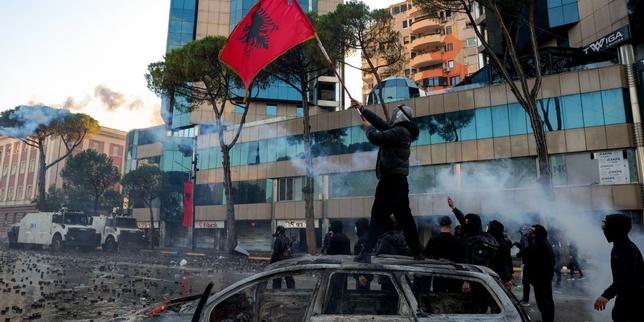
Five days of street protests in Tirana demanding the prime minister resign sounds dramatic. It reads like a textbook story of people power hitting a tipping point.
It is also lazy analysis.
When a French headline frames a five-day protest in Albania around a single demand—the prime minister stepping down—it feeds a comforting illusion. Remove the figurehead. Reset the board. Watch the system heal.
I have watched political crises across post-communist and emerging markets long enough to recognize that script. Investors, journalists, and citizens alike love a villain they can show the door. Blowing millions on hasty political bets or treating a resignation as a structural cure is how smart people get burned. Resignations rarely fix rot. Often, they just rearrange the furniture in a room with a caved-in roof.
The Lazy Consensus Around Street Protests
Standard coverage of Albanian street protests treats crowd size and daily persistence as direct proof that a government is about to collapse. Day one, day two, day three, day four, day five—each day gets counted like a notch on a belt.
That framing assumes two things that rarely hold up in reality. First, it assumes a prime minister's resignation automatically alters the incentives of the institutions underneath them. Second, it assumes street momentum automatically translates into durable institutional reform.
Neither assumption survives close scrutiny.
In many parliamentary and hybrid systems, executive power sits atop entrenched administrative networks, judicial bottlenecks, clientelist patronage, and brittle party machines. A leader can exit stage left while the procurement rules, court backlogs, and media capture stay right where they were. Worse, a sudden exit can trigger a scramble among insiders who know how to work the existing system better than outsiders know how to rebuild it.
Think about the distinction between political turnover and institutional reform. Political turnover changes who holds the title or sits in the chair. Institutional reform changes how rules are enforced when nobody is watching and when cameras turn off. Confusing the two is the fastest way to misread a five-day protest.
Imagine a scenario where a prime minister resigns on day six to calm the streets. A caretaker or successor steps in promising a clean slate. Six months later, the same ministries still struggle with slow permitting, selective enforcement, and public skepticism over who gets ahead. Nothing structural moved because the pressure aimed at the nameplate rather than the machinery.
Why People Ask the Wrong Questions After Five Days of Unrest
Whenever protests hit day five, search behavior and newsroom chatter predictably converge on the same narrow questions. Most of them start from a flawed premise.
"Will the prime minister be forced to resign?"
That question treats power like a glass window that shatters if you throw enough rocks at it. In practice, political survival depends on coalition math, party discipline, security and institutional alignment, and how much cost the ruling camp expects to pay by holding firm versus conceding.
Street pressure raises political costs. It creates bad optics, disrupts daily life, and signals anger that pollsters and rivals cannot ignore. Yet raw persistence on a boulevard does not automatically force a resignation on its own. Governments fall when pressure fractures internal support or alters calculation inside the system, not simply because a calendar flips from day four to day five.
"What do the protesters actually want?"
People ask this expecting a single tidy manifesto. Real protests rarely work like that.
A five-day protest usually pulls together distinct grievances under one visible banner. One group shows up over economic strain or cost of living. Another shows up over perceived corruption, justice delays, or abuse of office. Another shows up out of sheer exhaustion with political dynasties and broken promises. Demanding a resignation acts as a common rallying cry—a simple target everyone can shout—even when participants diagnose the underlying disease differently.
Treating a resignation demand as a complete policy program misses the deeper friction. Removing a leader does not automatically settle debates over wages, rule of law, or representation. It just opens a fight over who gets to manage those tensions next.
"Is Albania headed for instability?"
Headline readers love the word instability because it sounds urgent and total. Reality is messier.
Protests and political turbulence are not identical to state collapse. A capital city can see heated demonstrations for several days while border crossings, basic services, and everyday commerce keep running. Conversely, a country can look calm on television while suffering quiet institutional decay behind closed doors. Labeling every multi-day protest "instability" blurs the line between noisy democratic friction and genuine systemic breakdown.
What Serious Observers Track Instead of Resignation Watch
If you want to understand what is actually happening in Tirana—or anywhere else a multi-day protest unfolds—stop treating a resignation as the finish line. Watch the mechanics that determine whether a protest changes anything lasting.
- Institutional accountability: Does pressure lead to real checks, transparent investigations, and credible rule of law, or does it stop at political theater? Courts, prosecutors, anti-corruption bodies, and parliamentary oversight matter far more over three years than speeches over five days.
- Coalition and party fractures: Watch whether lawmakers, local officials, or allies inside the ruling camp start distancing themselves. A leader isolated from the street can sometimes survive; a leader losing cohesion inside their own camp faces a much harder climb.
- Grievance durability: Check whether the core complaints driving people into the streets are acute shocks or chronic frustrations. Chronic frustrations tend to return in waves even after temporary concessions calm a given week.
- Media and information pressure: Notice how narratives are shaped on the ground and online. When independent reporting, civic scrutiny, and public debate stay active after the crowd thins out, accountability has a better shot than when attention evaporates on day six.
Political scientists and institutional economists who study post-communist transitions—scholars like Janos Kornai, Daron Acemoglu, and James A. Robinson—have spent decades showing why durable progress depends on inclusive institutions and enforceable rules rather than savior figures or simple leader swaps. When institutions are weak or captured, swapping one top executive for another often produces motion without movement.
The Blind Spot in My Own Contrarian Take
Being contrarian has its own traps, and I will own them plainly.
Sometimes a leader really is the central bottleneck. Sometimes removing the person at the top breaks a logjam that no committee could budge, opening space for real reform or forcing a reckoning that was otherwise impossible. Dismissing resignation demands out of cynicism can make an observer sound clever while missing a genuine turning point.
There is also a risk of sounding detached from real human frustration. People in the streets are not participating in an academic seminar on institutional economics. They are reacting to lived pressure, anger, and a desire for dignity and fairness. Treating their anger purely as a mechanics puzzle can sound cold if you forget the human weight behind it.
Actionable Ways to Read This Moment Without Getting Fooled
If you are following Albanian politics—or analyzing similar multi-day protests elsewhere—take a sharper approach than counting days until a resignation headline drops.
- Separate the demand from the diagnosis. Treat "resign" as the rallying cry, then look closely at the specific grievances fueling attendance across different days and groups.
- Track institutions, not just podiums. Follow court actions, audit findings, procurement rules, and institutional pushback rather than relying solely on daily crowd estimates.
- Watch what happens after the peak. The real test of a five-day protest often comes in weeks two and three—when headlines move on, fatigue sets in, and you see whether any rules or power balances actually shifted.
- Price in second-order effects. Ask who benefits from a sudden resignation and who gets sidelined. A change at the top can improve governance, or it can hand leverage to actors with worse habits.
Five days of protest in Albania proves people are willing to stand up and be counted. Whether that energy produces real change or just another reshuffle depends on what happens to the system—not just who holds the title.