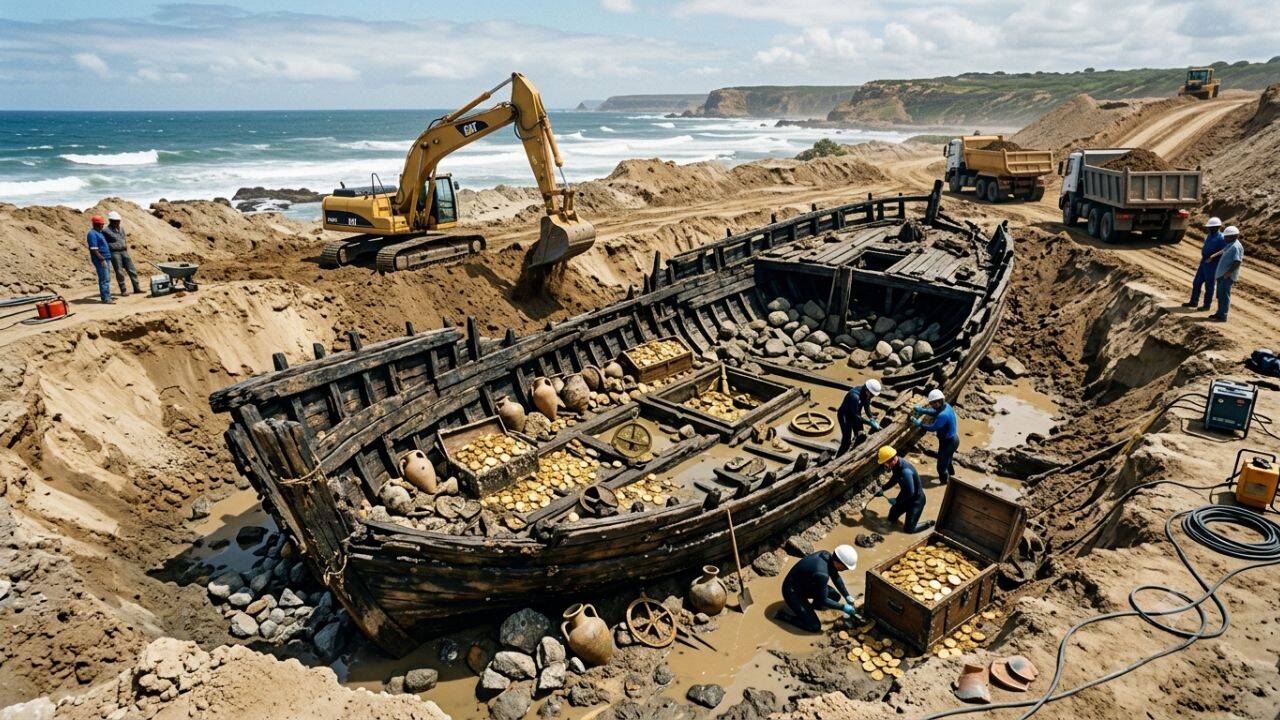
You don't expect to find a 16th-century warship while looking for diamonds. Yet, along the hyper-arid and fiercely hostile Atlantic coastline of Namibia, heavy machinery operating inside a high-security mining concession did exactly that.
When diamond miners near Oranjemund began pushing back the ocean to access mineral-rich bedrock, they exposed more than just gravel. They found timbers, cannons, and an absolute fortune in gold coins. This was the Bom Jesus, a Portuguese trading vessel—known as a carrack or nau—that vanished without a trace back in March of 1533.
The Mystery of the Missing Portuguese Carrack
Let's clear up a common misconception right away. People assume shipwrecks belong at the bottom of the ocean. But the Bom Jesus didn't sink into a deep-sea trench; it ended up stranded on what is now dry land.
When the ship left Lisbon on Friday, March 7, 1533, it carried a massive crew and a staggering commercial cargo destined for India. It never made it. For nearly five centuries, historians had zero clues about its final moments. It simply dropped off the edge of the known world during a violent Atlantic storm.
The geography of the region explains how a ship ends up miles deep in a diamond concession. Centuries ago, a fierce storm drove the vessel too close to the shore. It hit a rocky outcrop, rolled over, and broke apart as coastal waters receded. Over hundreds of years, shifting coastal sands and sediment reclaimed the seabed, eventually turning the marine wreck into an inland desert feature.
Inside the Cargo Hold
The sheer value of the payload stashed inside the Bom Jesus makes it the most lucrative shipwreck ever found off the western coast of sub-Saharan Africa. Because the De Beers diamond mining operation tightly controlled access to the area, looters never touched the site. Archaeologists stepped into a pristine, five-hundred-year-old time capsule.
Workers recovered over 2,000 pure gold and silver coins minted across various European powers. But the coins were just the beginning. The hold also contained:
- 1,845 massive copper ingots weighing nearly 17 tons total, stamped with the distinct trident trademark of the Fugger trading family out of Augsburg, Germany.
- 105 elephant tusks weighing close to two tons, tracing an extensive, brutal trade network reaching deep into West Africa.
- A vast arsenal of swords, early firearms, navigational tools, and bronze bowls.
The copper ingots tell a fascinating story of global economics during the Renaissance. Metallurgical tests proved the metal originated in the Slovak Ore Mountains before traveling through German merchant houses and finally onto a Portuguese crown ship bound for Asia. It proves that early globalization was far more interconnected than textbooks usually suggest.
Where Did the Crew Go?
One unsettling detail haunts this entire discovery. A vessel like the Bom Jesus typically carried around 200 sailors, soldiers, and officers. Yet, intensive excavations yielded almost zero human remains—just a few scattered bone fragments.
Did they drown at sea? Did they make it to the shore?
If the sailors survived the initial crash and dragged themselves onto the Namib Desert, they faced an agonizing fate. This coast—often called the Skeleton Coast—offers virtually no fresh water and punishing temperatures. Walking out of that desert in the 16th century was nearly impossible. Most likely, the fierce surf swept the crew away as the hull broke apart, or those who made it ashore succumbed quickly to the elements.
Protecting History from Industrial Progress
Mining companies and heritage authorities rarely mix well. Industrial extraction usually destroys historical artifacts before anyone notices. In this rare instance, corporate mining security actually saved the archaeological record. Because the Oranjemund diamond area is heavily guarded against theft, the wreck remained completely undisturbed until professional archaeologists could take over the dig.
The government of Portugal ultimately waived its ownership rights over the state vessel, allowing Namibia to retain the cultural treasure. Today, items from the Bom Jesus reside in local museums, giving researchers a physical anchor to the Age of Exploration.
If you ever find yourself looking at industrial extraction projects, remember that beneath the earth, layers of forgotten history wait quietly for someone to dig deep enough.
A 500-Year-Old Shipwreck Found in the Desert!
This video explores the fascinating discovery of the Bom Jesus shipwreck and details how the vessel ended up stranded in the Namibian desert.
http://googleusercontent.com/youtube_content/1