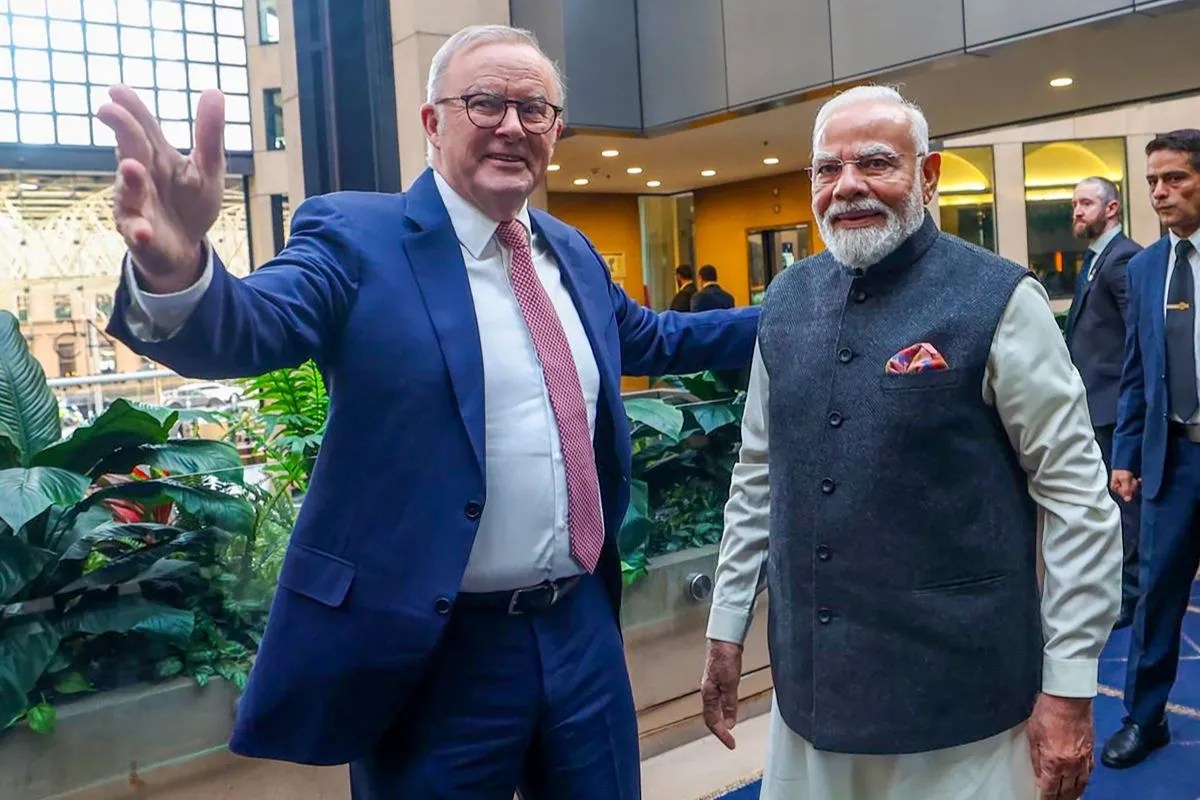
Geopolitics often hides behind folksy wisdom. When Australian Prime Minister Anthony Albanese stood next to Indian Prime Minister Narendra Modi and declared that anyone wishing to truly understand India must climb aboard its crowded public buses and local trains, the comment was widely reported as a charming slice of diplomatic flattery. It painted a picture of a Western leader enchanted by the vibrant, chaotic reality of everyday Indian life. But reducing this statement to mere optical pleasantry misses the deeper, more calculating economic reality driving Australia’s current foreign policy strategy.
Albanese was not just offering travel advice. He was signaling a structural shift in how Western powers attempt to interface with the world’s most populous nation, moving away from elite-level boardroom agreements toward a ground-up comprehension of India’s massive consumer base and labor force. For decades, foreign dignitaries approached New Delhi through the sterile corridors of bureaucratic summits. Today, the realization has set in that India’s economic engine is driven entirely by the demographic moving on those very trains and buses.
Moving Beyond the Lutyens Delhi Bubble
For a long time, Western engagement with India suffered from a distinct isolation. Diplomats and corporate executives arrived in New Delhi, stayed in five-star enclaves, held meetings in the manicured surroundings of Lutyens Delhi, and flew home believing they understood the market. This approach led to decades of miscalculations, particularly for nations like Australia that historically viewed India primarily through the narrow lenses of cricket, commonwealth history, and education exports.
The reality of modern India cannot be decoded from an air-conditioned Mercedes in the capital. The true velocity of the country’s growth is visible in the daily commute of its working class. The massive infrastructure expansion, the digital payment revolution occurring at roadside tea stalls, and the sheer mobility of hundreds of millions of people shifting from rural agrarian economies to urban service sectors define the nation's trajectory.
When a foreign leader publicly acknowledges the grit and scale of India’s public transit systems, it serves a dual purpose. It flatters the host nation’s pride in its massive public works, but more importantly, it demonstrates an awareness that India’s economic power lies in its sheer volume rather than its elite institutions.
The Raw Numbers Driving the Transition
To understand why a Western prime minister is suddenly romanticizing local buses, one has to look at the cold economic data that keeps trade ministers awake at night. Australia is staring down a critical diversification problem. For years, its economy rode on the back of resource exports to China. As geopolitical tensions fluctuating with Beijing exposed the vulnerability of over-reliance on a single market, Canberra urgently needed an alternative anchor in the Indo-Pacific.
India represents that anchor, but it is a radically different beast than China. China’s growth was driven by top-down, state-directed industrialization. India’s growth is organic, messy, and consumption-led.
Consider the scale of the infrastructure that Albanese alluded to. Indian Railways moves over twenty million passengers every single day. That is nearly the entire population of Australia taking a train ride every twenty-four hours. The network serves as the economic circulatory system of the country, moving migrant labor from states like Bihar and Uttar Pradesh to the industrial hubs of Tamil Nadu, Gujarat, and Maharashtra.
By tying diplomatic rhetoric to this mass movement, the Australian leadership acknowledges that future trade deals—whether involving critical minerals, green energy cooperation, or agricultural exports—rely on tapping into this vast, mobile workforce. Australia needs to sell its lithium, its coal, and its educational services not just to Indian conglomerates, but to an economy sustained by the aspirations of the middle and lower-middle classes.
The Infrastructure Gamble and Foreign Investment
The focus on public transport also highlights the massive infrastructure boom currently reshaping Indian cities. The central government has poured billions into transforming transit, building metro rail systems in dozens of tier-two cities, and modernizing traditional railway stations.
The Urban Transit Revolution
- Metro Expansion: Over twenty Indian cities now operate or are rapidly building metro networks, fundamentally altering urban real estate and labor accessibility.
- High-Speed Rail: The ongoing bullet train corridor between Mumbai and Ahmedabad represents a massive technological leap forward.
- Digital Integration: Public transport ticketing has increasingly merged with the Unified Payments Interface (UPI), creating a cashless ecosystem that handles billions of transactions monthly.
For global investors, this infrastructure blitz is the real story. Australia’s massive pension funds, which manage trillions of dollars in retirement savings, are desperately searching for long-term, yield-generating assets. Roads, railways, and renewable energy grids in India represent prime targets. Albanese’s rhetoric acts as a political de-risking mechanism, signaling to conservative Australian institutional investors that the government views India’s physical expansion as a safe, legitimate bet for national capital.
Countering the Romanticized Narrative
However, there is a sharp counter-argument to the idealized vision of boarding an Indian bus to understand the country. Romance quickly fades under the heat of a forty-degree summer day in a vehicle packed past capacity.
The public transport system in India is a marvel of daily logistics, but it is also a stark reminder of the country’s deep structural challenges. It exposes the gaping holes in urban planning, the persistent safety concerns for women commuters, and the choking air pollution that plagues major metropolitan hubs. To view these transit systems solely through a lens of cultural appreciation is to ignore the urgent need for modernization and human dignity in public utilities.
Furthermore, Western leaders face domestic skepticism when they pivot too sharply toward New Delhi. Critics in Australia frequently point out that despite the warm rhetoric, doing business in India remains notoriously difficult. Bureaucratic red tape, complex tax structures, and protectionist tendencies in sectors like agriculture continue to frustrate foreign trade negotiators. The Comprehensive Economic Cooperation Agreement (CECA) between the two nations has taken years of grueling negotiations precisely because the ground reality of Indian commerce is incredibly protective of its domestic working class—the very people riding those buses.
The Shift in People to People Ties
Beyond trade balances and geopolitical strategy against common regional rivals, the public transit metaphor speaks directly to the changing face of the Australian diaspora.
Indians now comprise one of the fastest-growing and highly influential immigrant communities in Australia. Unlike previous generations of immigrants who settled quietly into sub-professions, the modern Indian diaspora in Australia is politically active, economically powerful, and deeply connected to their home country. They are tech executives, academics, healthcare professionals, and business owners.
When Anthony Albanese speaks about understanding the ordinary Indian experience, he is also speaking to his own voters at home in Sydney and Melbourne. He is acknowledging the cultural heritage of a diaspora that remembers the packed suburban trains of Mumbai or the state transport buses of Punjab. It is a calculated piece of domestic politics wrapped inside an international state visit.
The era of conducting diplomacy solely through formal dinners and rehearsed press statements is dead. In a multipolar world where economic influence is fragmented, understanding a partner nation requires a willingness to look at its foundational realities. Australia’s diplomatic apparatus has clearly concluded that its future prosperity is inextricably linked to the aspirations of ordinary Indians. To engage with India now means recognizing that the country's true power does not reside in its elite boardrooms, but in the unstoppable momentum of its masses moving forward every single day.



