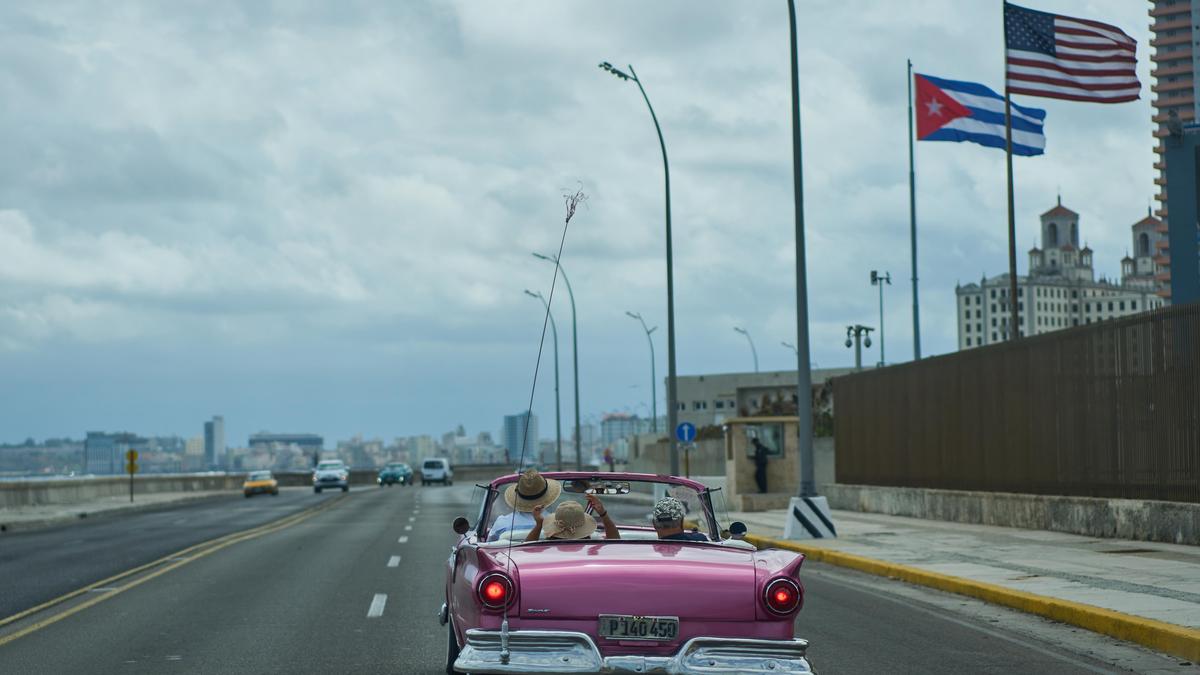
Washington is still playing a game from 1996 while the rest of the world has moved on to 2026.
The recent meetings in Havana between U.S. officials and the Cuban government are being framed by the mainstream press as a "push for reform." It is a tired narrative. It suggests that if American diplomats simply use the right combination of stern adjectives and economic carrots, the Cuban Communist Party will suddenly decide to dismantle its own power structure.
This isn't diplomacy. It's performance art for a South Florida voting bloc.
If you want to understand why U.S.-Cuba policy has been a stagnant pool of failure for sixty years, you have to stop looking at the "human rights" talking points and start looking at the mechanics of state survival. The U.S. is asking the Cuban elite to commit institutional suicide. Predictably, they have declined the invitation.
The Myth of the Reformist Pressure Cooker
The prevailing logic in D.C. is that economic pressure creates a "pressure cooker" effect. The idea is that by restricting trade and demanding specific political concessions, the Cuban populace will eventually boil over, forcing the regime to pivot toward democracy.
It is a beautiful theory that has been proven wrong by every historical data point we have.
Sanctions do not create democrats; they create cartels. When you squeeze a state's formal economy, you don't empower the "private sector" in the way American textbooks describe it. You empower the people who control the black market and the borders. In Cuba, that is the military-run conglomerate GAESA.
By maintaining a policy of aggressive isolation punctuated by high-level meetings that go nowhere, the U.S. provides the Cuban government with its most valuable asset: a permanent excuse for internal failure. Every broken power grid, every shortage of medicine, and every failed harvest is blamed on the bloqueo.
I have spent years analyzing how autocratic regimes respond to external pressure. The result is almost always "rally 'round the flag" syndrome. When you threaten a regime's existence, you don't foster a moderate wing. You purge it. The hardliners win because they are the only ones willing to be "tough enough" to survive the siege.
Stop Asking for Democracy and Start Asking for Data
The U.S. delegation's obsession with political reform ignores the most immediate lever for change: digital and financial infrastructure.
If we actually wanted to help the Cuban people, we would stop holding meetings about "political prisoners"—which the regime treats as currency to be traded for concessions—and start talking about the $500 billion global digital economy.
Cuba is currently an island of brilliant engineers and developers trapped in a 2G reality. While U.S. officials talk about "elections," the real bottleneck for the average Cuban is the inability to access international payment gateways.
- The Problem: U.S. policy makes it nearly impossible for a Cuban freelancer to get paid in USD or EUR without jumping through hoops that involve third-party "mules" or high-risk crypto transfers.
- The Reality: The Cuban government actually fears a self-sufficient middle class more than they fear a U.S. State Department press release.
- The Strategy: Instead of demanding a change in the constitution, demand the removal of barriers for direct peer-to-peer banking.
By focusing on the "Grand Bargain" of democracy, the U.S. misses the tactical wins that actually erode state control. A Cuban citizen who doesn't rely on the state for a paycheck is a much bigger threat to the regime than a protestor who can be easily disappeared.
The Migration Hypocrisy
The most glaring contradiction in these Havana meetings is the U.S. stance on migration.
U.S. officials claim they want a "stable, democratic Cuba," yet our policies are the primary driver of the largest migration crisis in the island’s history. You cannot claim to be working toward a better future for Cubans while simultaneously maintaining an embargo that destroys the very services—healthcare, education, food security—that keep people from fleeing.
Washington is essentially trying to have it both ways:
- They want to crush the Cuban economy to trigger a regime change.
- They want to stop the resulting "broken-economy" refugees from showing up in the Florida Keys.
It is a logical feedback loop of stupidity.
The Cuban government knows this. They use migration as a safety valve. When internal pressure gets too high, they let people leave. This drains the country of its youngest, most ambitious, and most likely-to-rebel citizens. By the time U.S. officials sit down at the table in Havana, the very people they should be empowering are already boarding planes to Managua or rafts to Key West.
The Private Sector Ghost
In recent years, the Cuban government allowed the creation of small and medium-sized private businesses (MSMEs or Mipymes). The U.S. has latched onto this as a sign of progress.
Don't be fooled.
The "private sector" in Cuba is a managed experiment. It is not the wild west of capitalism. Many of the most successful Mipymes are owned or managed by people with deep ties to the bureaucracy. They aren't the vanguard of a revolution; they are a pressure valve designed to provide basic goods that the state-run stores can no longer supply.
U.S. officials are treating these businesses as if they are the seeds of a new parliament. They aren't. They are a survival mechanism for the current elite. Treating them as anything else is a fundamental misunderstanding of how a command economy evolves. It doesn't become a democracy; it becomes a state-directed capitalist hybrid, much like Vietnam or China.
If the goal is "reform," we should be honest about what that looks like. It looks like a more efficient, wealthier version of the current system, not a Caribbean version of Switzerland.
The China and Russia Factor
While the U.S. sends mid-level officials to Havana to deliver lectures on human rights, Russia and China are sending engineers, oil tankers, and surveillance technology.
We are operating under the delusion that we have a monopoly on influence in the Caribbean. We don't. Every time the U.S. walks away from the table because "reforms aren't happening fast enough," we leave a vacuum.
- Russia provides the oil that keeps the lights on.
- China provides the networking hardware that keeps the internet restricted.
- The U.S. provides... speeches.
The Monroe Doctrine is dead, but D.C. hasn't gotten the memo. Our current policy is effectively outsourcing the future of Cuban infrastructure to our greatest geopolitical rivals because we refuse to engage with a regime we don't like.
It is high-ground moralism at the expense of national security.
The Uncomfortable Truth
If we want to change the trajectory of Cuba, we have to stop trying to "fix" it from the outside.
The most "subversive" thing the United States could do is not to tighten the embargo, but to lift it entirely. Tomorrow. Unconditionally.
Imagine the chaos that would ensue for the Cuban Communist Party if they no longer had the "Yankee Imperialist" to blame for the lack of toilet paper. Imagine the threat to the regime if 2 million Cuban-Americans could invest directly in their hometowns, bypass state controls, and saturate the island with American capital, culture, and influence.
The embargo is the Cuban government's life support system. It justifies the repression. It justifies the poverty. It justifies the lack of freedom.
As long as we keep "pressing for reform" through traditional diplomatic channels, we are playing their game. We are confirming their narrative. We are ensuring that the only thing that changes in Havana is the date on the calendar.
The U.S. officials currently in Havana aren't there to solve a problem. They are there to manage a stalemate. They are curators of a museum of failed policy, dusting off the same arguments that have yielded zero results since the fall of the Berlin Wall.
Real reform in Cuba won't come from a meeting in a government building. It will come when the U.S. stops being the regime's most useful antagonist.
Stop talking about the "path to democracy." Start talking about the price of shipping a container of medical supplies. If you can’t win the hearts and minds through diplomacy, win the market through sheer economic gravity. Everything else is just noise.